How to Keep Snowmobile Helmet From Fogging: 9 Fixes Compared
The Short Version: To keep a snowmobile helmet from fogging, use an electric heated shield, a dual-pane shield, and a breath box together. Fog forms when your warm breath hits a cold visor and condenses, so each of these either keeps the inner lens warm or sends your breath somewhere else.
A breath box only works if it seals snugly against your mouth and cheeks; otherwise, your breath leaks straight up onto the shield. Opening your vents helps clear out whatever moist air is left. One catch if you wear glasses: a heated shield won’t stop those from fogging.
You roll up to an intersection on the trail, check both ways, and let out one long breath. By the time you look up again, your shield has turned the color of skim milk.

Disclosure: As an Amazon Associate, we earn from qualifying purchases. Disclosure Statement.
If you’ve ridden in real cold, you know that moment. Learning how to keep snowmobile helmet from fogging isn’t about comfort, it’s about seeing the next tree before you meet it.
The good news is that fog follows some very simple physics, and every fix below works on one side of it. Let’s take a look.
What Causes Snowmobile Helmet Fog in the First Place?
Remember breathing on a cold window as a kid and drawing in the fog with your finger? Your shield is that window, just a couple of inches from your mouth. Warm, moist breath and body heat hit a cold surface, and the water vapor turns back into liquid.
Meteorologists call the tipping point the dew point, meaning the temperature air must be cooled to before it becomes saturated and the moisture starts to condense into water droplets. On a winter ride, the inside of your shield sits well below that mark while you keep pumping warm, wet air at it. So, the shield fogs.
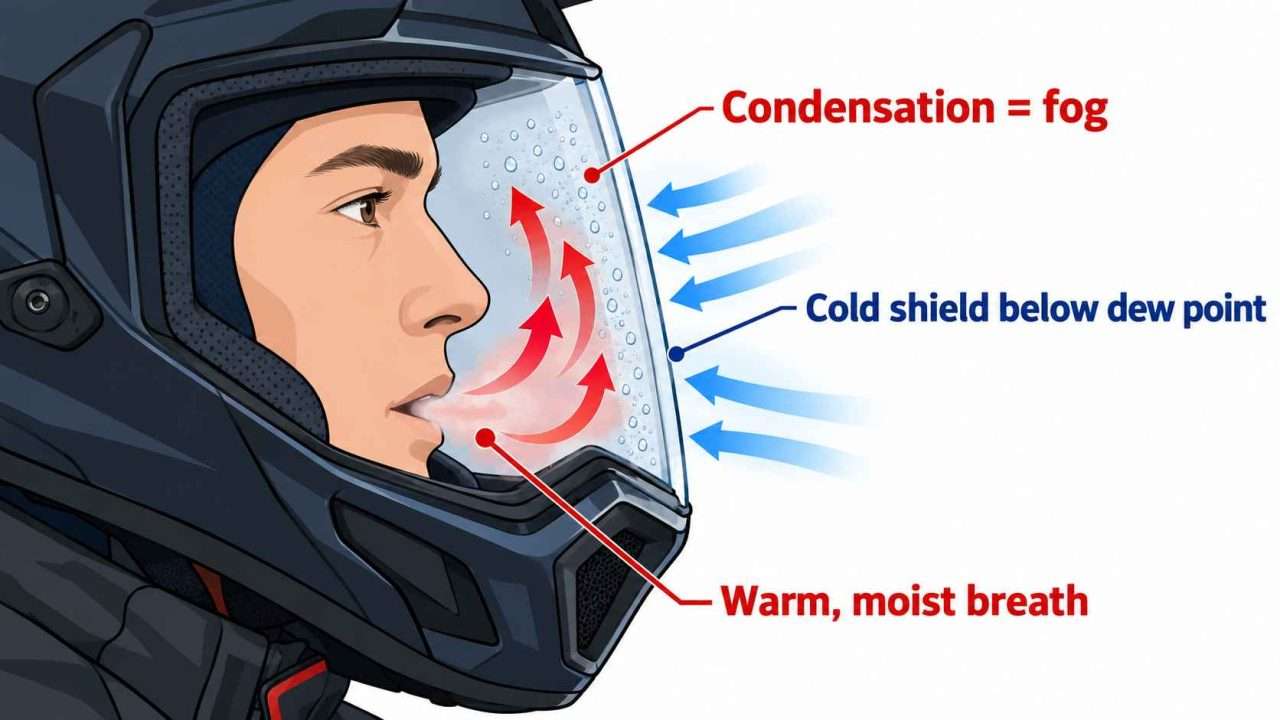
That leaves you three ways to fight back: keep your breath away from the shield, keep the shield warm, or move the moist air out faster than it can settle. Every product in this article does one of those three things (a few manage two).
How Much Does a Fogged Shield Actually Matter?
Snowmobiles aren’t golf carts. A review in Clinical Orthopaedics and Related Research described the modern sled as weighing more than 600 pounds and capable of over 90 mph, with roughly 200 deaths and 14,000 injuries each year in North America and head injury the leading cause of death. That data dates from 2003, but it’s still the broadest North American picture available.
New York’s latest state report is more recent. Of 122 reported snowmobile accidents in the 2024/25 season, 68 were collisions with fixed objects such as trees, embankments, signposts, and culverts. To be fair, the report points the finger at unsafe speed far more than anything else, and it doesn’t single out fogging.
Regardless of that, the common-sense point stands. Trees don’t move, and you can’t steer around what you can’t see. If your shield fogs over while you’re moving, ease off and stop the sled before you do anything else.
Do Helmet Vents Really Help With Snowmobile Helmet Fog?
They do, and they’re free. A full-face snowmobile helmet is built to pull cool, dry air in at the front and push warm, wet air out the back. Ski-Doo, for example, describes an adjustable front intake vent that lets fresh air in while its mask system sends exhaled air out through channels at the sides of the helmet.
The catch is that helmet ventilation needs moving air. Vents do their best work at trail speed and very little when you’re parked at a junction, breathing hard after digging out a stuck sled (we’ve all been there). That’s why fog loves the first minute after you stop.
I learned this one stopped on a frozen lake at dusk, chatting at the trailhead with my shield down. Thirty seconds of conversation and I was looking at the world through wax paper.
The cheapest trick of all is the cracked-open visor. Lifting the shield one notch lets outside air flush the moist air out and closes the temperature gap. It works, but at 20 below your face will tell you how long you can keep it up.
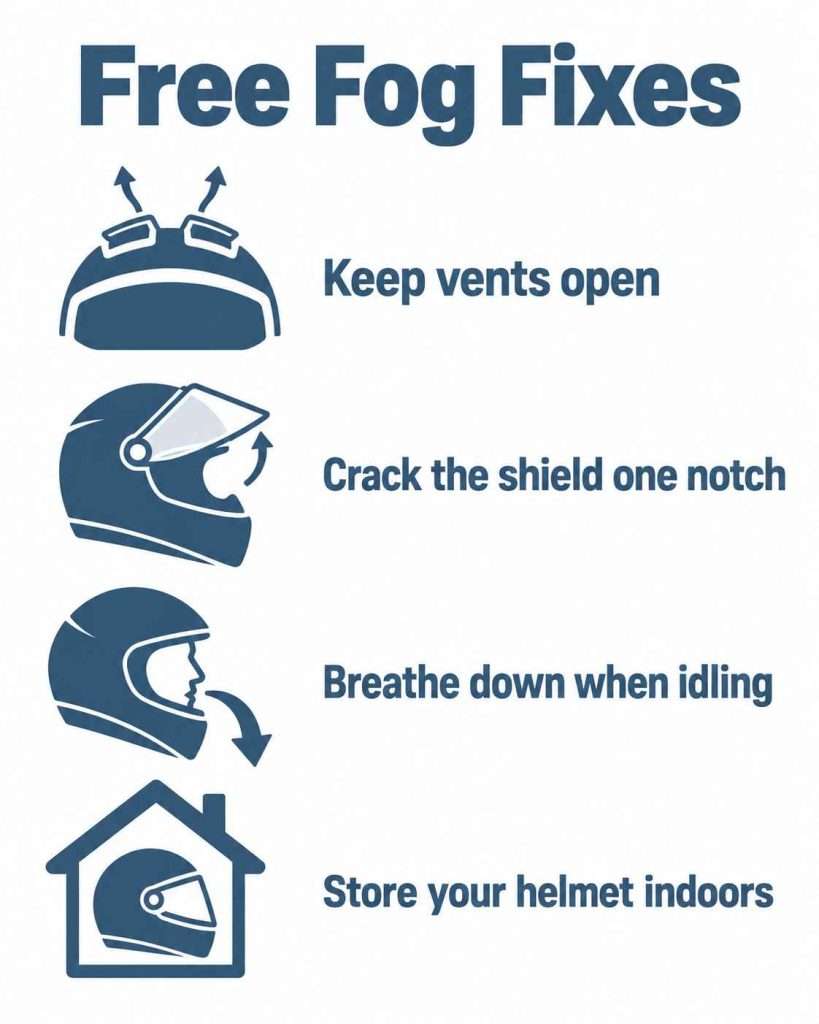
Before you spend a cent, try these:
- Keep the chin and brow vents open unless snow is packing into them.
- Crack the shield one notch when you stop, rather than flipping it all the way up.
- When you’re idling, breathe out slowly and aim it down toward your chest.
- Wear a thin balaclava, which soaks up some of your breath and keeps frostbite off your cheeks.
- Store your helmet somewhere room temperature, not in a frozen truck bed, so you don’t start the ride with an ice-cold shield.
Why Does Helmet Fit Affect Fogging?
This one surprises a lot of riders. A breath box or mask only works if it seals around your nose and cheeks, and that seal depends on the helmet sitting where it should on your head. Common sense says sort out the fit before you spend a dollar on gadgets.
A helmet that’s too big lets the breath box drift away from your face, so breath leaks up toward the shield. Too small, and the box presses on your nose and lips until you loosen it, which defeats the purpose. If it’s been a while, measure your head properly before you blame the helmet.
Face shape matters too. Breath boxes are molded for an average face, and nobody is average (sorry, but a fact’s a fact). If a built-in deflector never quite seals for you, a mask worn on your face instead of clipped into the helmet is usually the answer.


What’s the Best Breath Deflector for a Snowmobile Helmet?
A breath deflector for a snowmobile helmet comes in two forms: a breath box that clips into the helmet, or a mask you wear on your face underneath it. Both aim your breath down and out the bottom of the helmet, away from the shield.
Most snowmobile helmets come with a breath box. The Typhoon TH129 includes one, and Ski-Doo’s Breath Evac mask routes your breath out the sides.
The downside is moisture. By lunch on a long, cold day, the pad in my breath box is usually soggy, and on a really cold ride it starts to stiffen with ice (I carry a spare in my jacket pocket for exactly that reason).
Face-worn anti-fog masks are the other route, usually made from neoprene, the same stretchy rubber as a wetsuit or a laptop sleeve. The No-Fog mask has a sealing nosepiece, and the company says you can unhook a modular helmet’s breath box and wear the mask in its place. R.U. Outside’s Fog eVader works the same way, with a fleece lining, formable nose piece, and a head strap that holds it under a helmet.
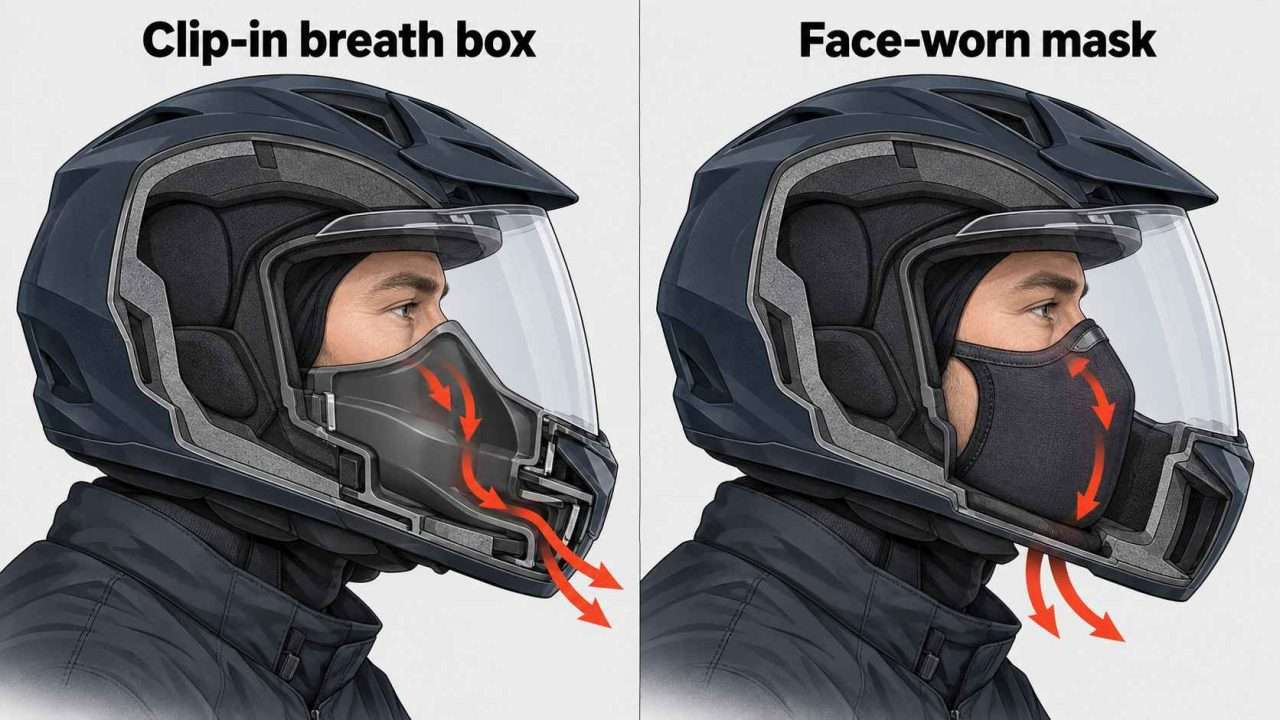
Snow Goer’s test of a similar Castle No-Fog mask liked the full face protection but flagged the wet material against your face, and noted that clip-in breath boxes can snag your forehead on the way off. No free lunch, so pick the annoyance you can live with.
Do you wear eyeglasses? Then a face mask is usually the better bet, because it keeps breath off your glasses as well as the shield. Rest the nose bridge on top of the mask, not tucked underneath (I’ve watched riders do the latter, then spend the day peering over their frames like a librarian).
Is a Heated Shield Worth the Money?
For anyone who rides often in real cold, yes. A heated shield builds a heating element into a dual-pane lens, like the defroster lines on your car’s rear window, so condensation never gets started.
Most heated shields run off the sled’s 12-volt (12V) power through an RCA (Radio Corporation of America) style plug, the same round push-in connector on the back of an old stereo. Typhoon’s heated shield kit connects to an RCA accessory port or straight to the battery, and some aftermarket cords add a magnetic quick disconnect [Ad] so stepping off the sled doesn’t mean yanking your own head back.
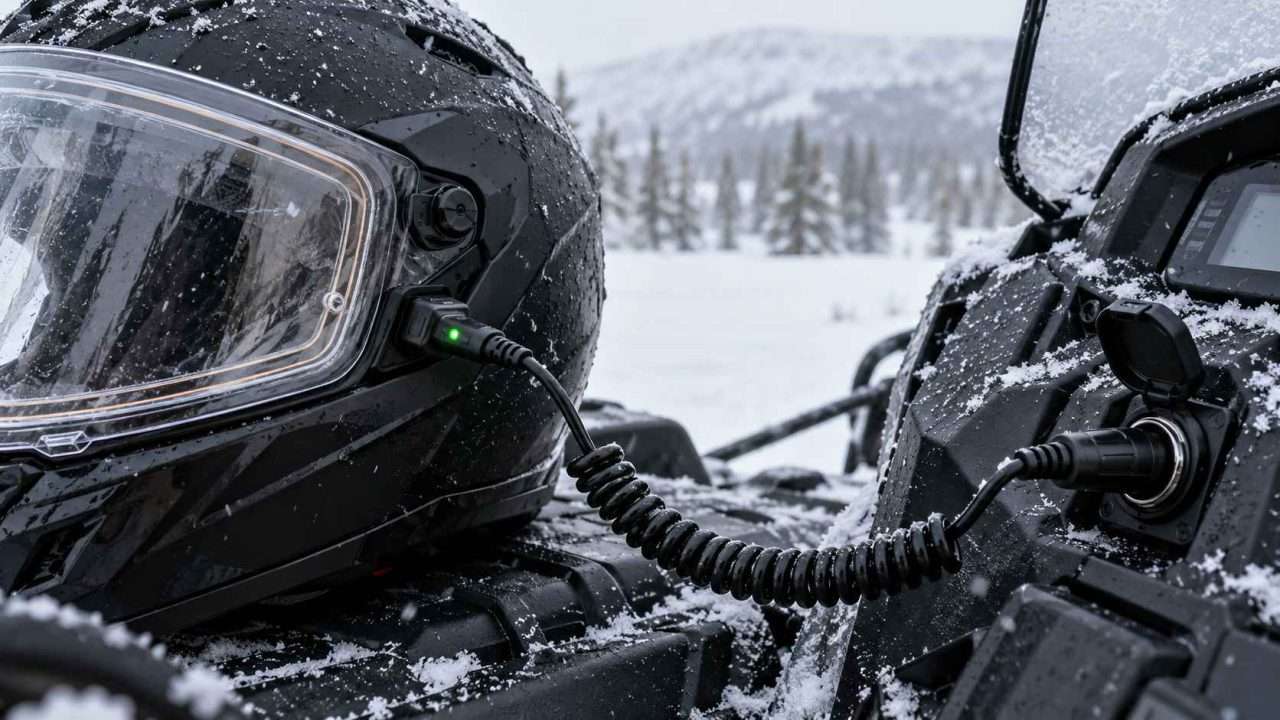
The first time you fumble that little plug into the shield with gloved fingers at 10 below, you’ll wonder why nobody made it bigger. Once it’s in, though, you won’t want to ride a cold night without it.
It’s cheaper than you’d think. Typhoon lists the TH129 with heated shield at a regular price of $149 and sells the heated shield alone for $79. At the premium end, the Ski-Doo Exome Sport Radiant pairs a heated dual-lens visor with its Breath Evac mask.
Our roundup covers heated shields and maintenance requirements if you’re shopping.
Now for the skeptics. Plenty of modular-helmet riders call a heated shield a waste of money, since cracking the shield an inch clears fog in seconds. The common-sense answer is to match the fix to how cold you actually ride, and on a 15-below night run a cord is the difference between seeing the trail and guessing at it.
The honest downsides? You’re tethered to the sled, and Typhoon states that modifying the cord voids the shield and cord warranty. If the cord dies mid-ride, at least the shield is still dual-pane.
Do Dual-Pane Shields and Pinlock Inserts Work in the Cold?
Yes, and for the same reason double-glazed windows stay clear in winter. A dual-pane visor traps a layer of air between two lenses, so the inner lens stays closer to the temperature inside your helmet than outside it.
A Pinlock insert does the same job as an add-on. According to Pinlock, a silicone seal creates an airtight air pocket that acts as a thermal barrier, while the insert’s moisture-absorbing surface stores water in humid conditions and releases it when the air dries out.
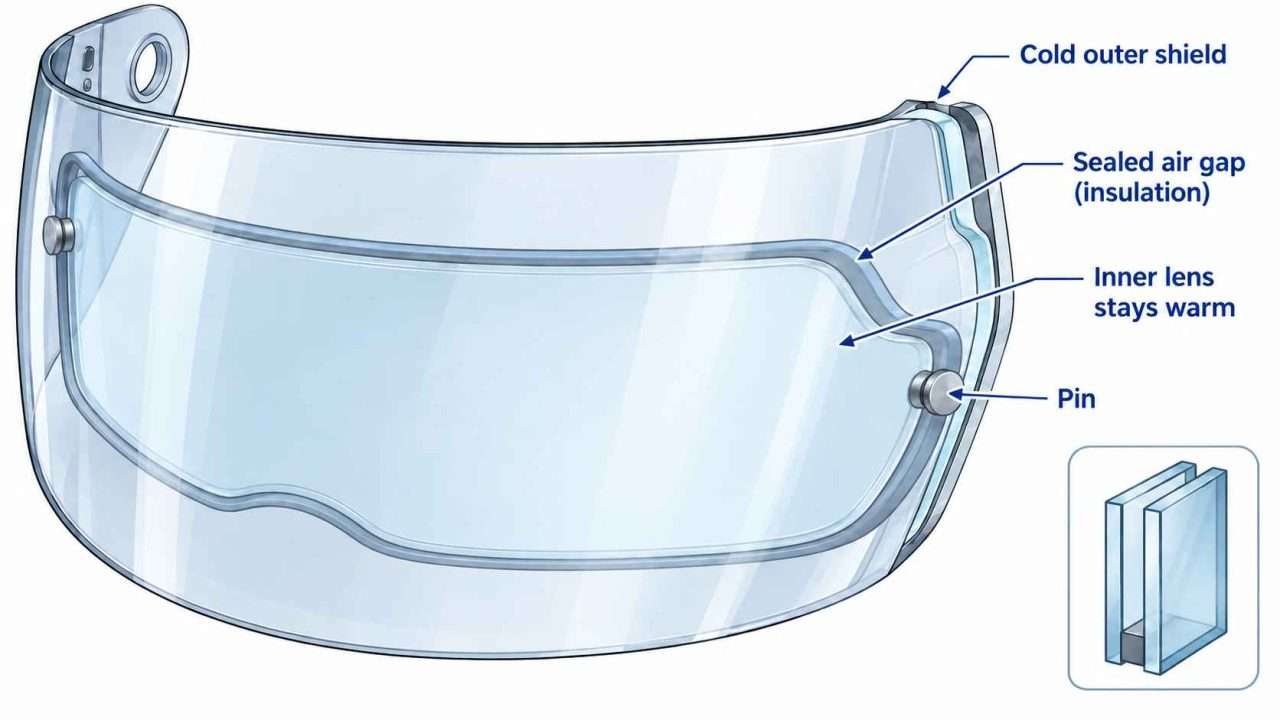
Hold a Pinlock insert up to the light and it looks like a flimsy sheet of plastic. Press it into the visor and you can feel the silicone bead seat all the way around, and that seal is what does the work.
The catch is that your visor must be Pinlock-ready, meaning it has two small pins to hold the insert, and the insert has to match that exact visor. We’ve explained how a helmet Pinlock works if you want the full rundown. So check your shield before you order.
Both systems need a little care. Scratches, a tired seal, or a heavy-handed cleaning job will undo them, which is why maintaining anti-fog shield coatings matters as much as buying them.
Does Anti-Fog Spray for Snowmobile Helmets Actually Work?
Riders will happily spend thousands on a sled and then try to fix fog with spit and a glove. Sprays are a step up from that, but do they actually work?
Sometimes, for a while. An anti-fog spray for snowmobile helmets is mostly a surfactant, a chemical that lowers water’s surface tension so condensation spreads into a thin clear film instead of light-scattering droplets. McGill University’s Office for Science and Society explains that alcohol and a range of detergents do this, and that even rubbing a bit of soap into the lens prevents fogging.
That’s why the old shampoo or dish soap trick works. It’s the same chemistry in a cheaper bottle, and like the commercial sprays it wears off and needs reapplying (often before the ride is over).
Here’s the caution. Many shields already carry a factory anti-fog coating on the inside, and piling sprays, alcohol, or household cleaners on top is chemistry on top of chemistry. Check your shield maker’s care instructions before you put anything on the inside of a coated shield or a Pinlock insert.
So is spray a ploy? Not really, it just isn’t a cold-weather solution on its own. Common sense says keep it as a backup in your pocket, not a plan.
What About Open-Face Snocross Helmets and Goggles?
Some riders, particularly in the mountains and on the snocross track, prefer an open-face snocross helmet with goggles. You get more airflow when you’re working the sled hard, but the fog problem simply moves from the shield to the goggle lens.
Make sure the goggle’s top vents line up with the helmet’s brow opening, so warm air escapes instead of getting pinned against the lens. Pair that with a face-worn breath deflector, since there’s no chin bar standing between your breath and the goggles.
For the worst conditions, heated goggles exist too. The 509 Kingpin Ignite [Ad] uses a strap-mounted rechargeable battery to heat the inner lens to 104°F, with a rated runtime of four to five hours at maximum heat. No cord to the sled, but one more battery to remember to charge the night before.
Which Snowmobile Helmet Anti-Fog Method Should You Choose?
There’s no single right answer, because your climate, your sled, and your face are all different. The table below shows how to keep snowmobile helmet from fogging with each option, and what you trade away for it.
| Method | How It Works | Power Needed | Typical Cost | Best For | Downside |
|---|---|---|---|---|---|
| Open vents / cracked visor | Flushes moist air out | None | Free | Mild days, short stops | Cold face; weak when stationary |
| Built-in breath box | Directs breath down and out | None | Often included | Everyday trail riding | Pads soak up moisture; needs a good seal |
| Face-worn mask (No-Fog, Fog eVader) | Seals nose and mouth; breath exits the bottom | None | About $40 (Fog eVader list price) | Eyeglass wearers, hard-to-fit faces | Damp fabric against your face |
| Balaclava | Slows and absorbs breath | None | Low | Budget riders, extra warmth | Least effective on its own |
| Dual-pane shield | Insulating air gap | None | Often included | Most riders | Can still fog in severe cold |
| Pinlock insert | Sealed air pocket plus absorbing lens | None | Varies by visor | Pinlock-ready visors | Visor must be compatible |
| Heated shield | Warms the inner lens | Sled 12V power cord | From $79 (Typhoon retrofit shield) | Frequent, very cold riding | Tethered to the sled |
| Heated goggles | Battery-heated inner lens | Rechargeable battery | Premium | Open-face snocross riders | Battery life |
| Anti-fog spray / soap | Surfactant film | None | Low | Backup only | Short-lived; may affect factory coatings |
So, How Do You Keep a Snowmobile Helmet From Fogging?
Layer your defenses. Start with a helmet that fits and vents that are open, add a breath deflector that actually seals on your face, and put a dual-pane or heated shield between your breath and the cold.
That’s not overthinking it, it’s common sense. Each layer covers the gaps the others leave, and the whole setup costs less than one trip to the emergency room.
Clear shield, clear trail. Ride like you can see where you’re going, because now you can!
Frequently Asked Questions
Are modular snowmobile helmets better or worse at preventing fog than standard full-face helmets?
Where a modular earns its keep is when you stop. Flip the chin bar up while you’re gassing up or digging out a stuck sled and your breath goes into open air instead of straight onto the shield (which is exactly when most of us fog up). So pick the style you like, and make sure it has a decent breath box.
How do you clean the inside of an anti-fog-coated snowmobile helmet visor without damaging the coating?
That anti-fog coating is softer than it looks, and every hard wipe takes a little more of it away. So keep your fingers off the inside of the shield, and save any real scrubbing for the outside.
What cleaning products should never be used on a polycarbonate snowmobile helmet visor?
Polycarbonate isn’t glass, and these products can haze the plastic or strip the anti-fog and anti-scratch coatings your shield came with. Stick with mild soap and water, or a visor cleaner labeled ammonia-free and coating-safe. (The oily shop rag hanging in the garage counts as abrasive, by the way.)
Do heated snowmobile helmet shields have adjustable heat controllers, and are they worth using?
Are they worth using? On a cold day, absolutely, because a heated shield is the most reliable way to stop your breath fogging the inside of the visor. If you’re shopping for one, take a look at our roundup of snowmobile helmets with a heated shield.
Why does the outside of a snowmobile helmet visor freeze over, and how do you prevent it?
A heated shield is your best defense, but it’s mainly built to stop inside fog, so in real freezing rain it may only loosen the ice rather than stop it forming. A light tap or swipe with your glove usually knocks it off. And if conditions are that bad, common sense says slow down or call it a day, because there’s no prize for being the stubborn one squinting through a peephole for 30 miles.
Can you retrofit a heated shield onto a snowmobile helmet that did not come with one?
The catch is that shields aren’t universal, so one from another brand won’t seal or lock properly on your helmet (that bargain “fits most helmets” shield online is probably a no). You’ll also need a power cord and a 12-volt hookup on your sled, and if your sled doesn’t have one, a heated shield wiring kit takes care of it.
How do you clear a snowmobile helmet visor that is already fogged or frosted over mid-ride?
What you shouldn’t do is wipe the inside with your glove, because that smears the moisture around and wears down the anti-fog coating. And if you can’t see, stop. No trail is worth riding blind.
RELATED READS