Is MIPS Worth It? Yes, for $20 Extra (Lab-Tested)
The Short Version: Yes, MIPS is worth the extra cost. Lab testing shows MIPS helmets significantly reduce rotational forces during angled impacts, which are the most common type of cycling crash. The upgrade from a non-MIPS version of the same model typically costs $15 to $30.
MIPS is a low-friction liner that slides 10–15 mm inside the helmet during a crash, redirecting rotational energy away from the brain. Virginia Tech’s independent helmet ratings reinforce the value — after its July 2025 recalibration, the two highest-scoring bicycle helmets both featured MIPS technology.
Same helmet, same shell, same fit system, same color. One has a thin yellow liner inside and costs $20 more. That’s the MIPS decision for most cyclists, and it’s a fair question to ask whether that $20 is buying you something real or just a marketing markup.
MIPS (Multi-directional Impact Protection System) has gone from a niche Swedish technology to something you’ll find in helmets from over 180 brands worldwide. But “popular” and “worth the money” aren’t the same thing. So let’s take a look at what the independent testing actually says, what you’re paying for, and whether the extra cost makes sense for you.
What Does MIPS Actually Do Inside Your Helmet?
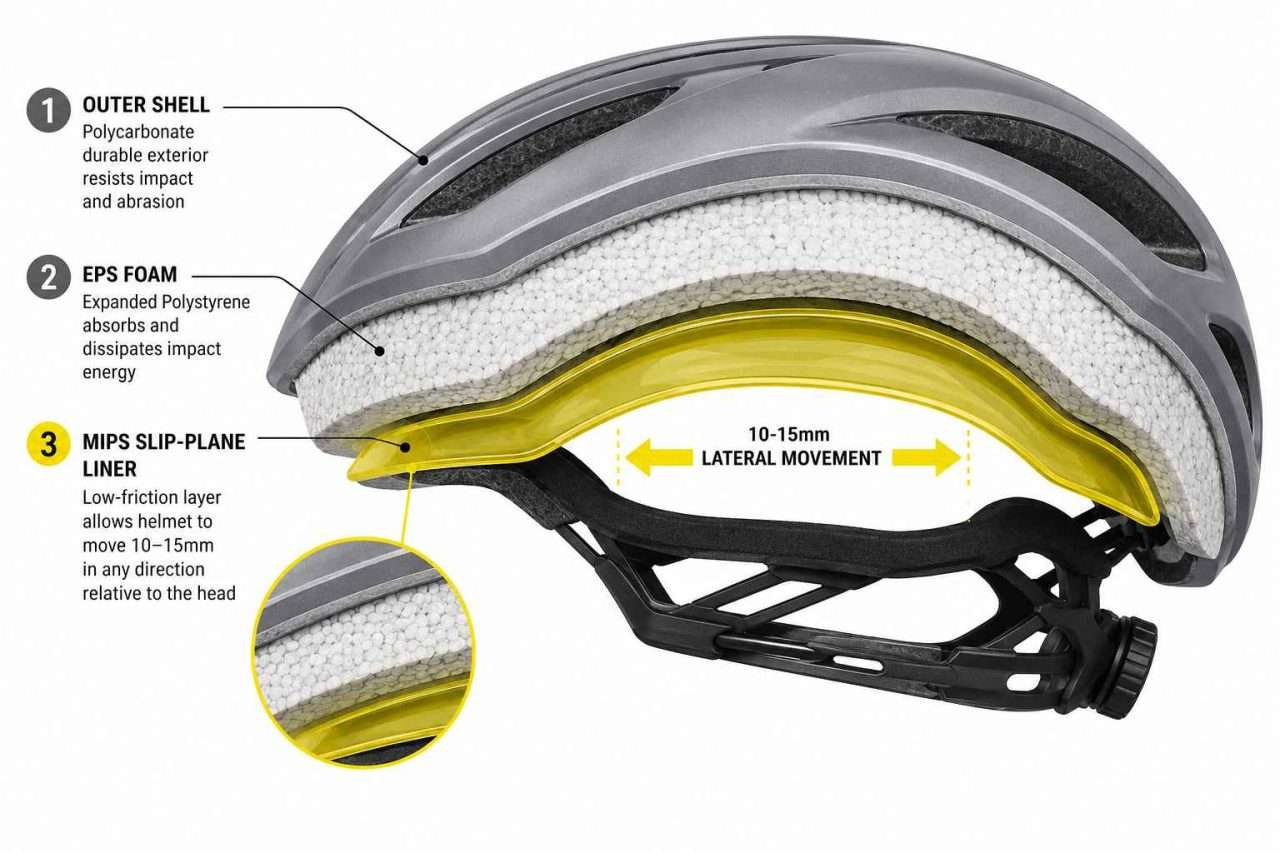
Before we get into the money side, it helps to understand what you’re buying. A standard bicycle helmet is built to handle linear forces, the straight-on hits that can crack your skull. The outer shell, usually made from polycarbonate, spreads the impact across a wider area.
Underneath that sits a layer of EPS foam (Expanded Polystyrene), that white packaging material you’ve seen protecting appliances in shipping boxes. When your head hits the ground, the EPS crushes and absorbs the energy.
The problem is that most real-world cycling crashes aren’t straight-on. They’re oblique impacts, where your head hits the pavement at an angle and slides. That angled contact generates rotational forces that twist your brain inside your skull.
Your brain floats in cerebrospinal fluid, which normally acts as a shock absorber. But a sudden jolt can stretch and tear the brain’s nerve fibers, causing diffuse axonal injury (DAI) or subdural hematoma. These are the injuries that lead to concussion and more serious traumatic brain injury (TBI).
MIPS addresses this with a slip plane, a thin low-friction layer between the EPS liner and your head. On impact, this layer allows the helmet shell to move 10 to 15 mm independently of your skull, redirecting some of that rotational energy before it reaches your brain. Think of it like the way your scalp slides over your skull if you bump your head on a low doorway.
The concept was developed in the mid-1990s in Stockholm, Sweden, by neurosurgeon Hans von Holst of the Karolinska Institute and biomechanics researcher Peter Halldin at the Royal Institute of Technology (KTH Stockholm).
Is MIPS Worth It? What Does the Independent Testing Show?
This is where the rubber meets the road. MIPS AB, the company behind the technology, claims their system can reduce the impact of rotational forces by greater than10%. But you shouldn’t have to take a manufacturer’s word for it, and thankfully, you don’t have to.
Several independent testing bodies have put MIPS helmets through their paces.
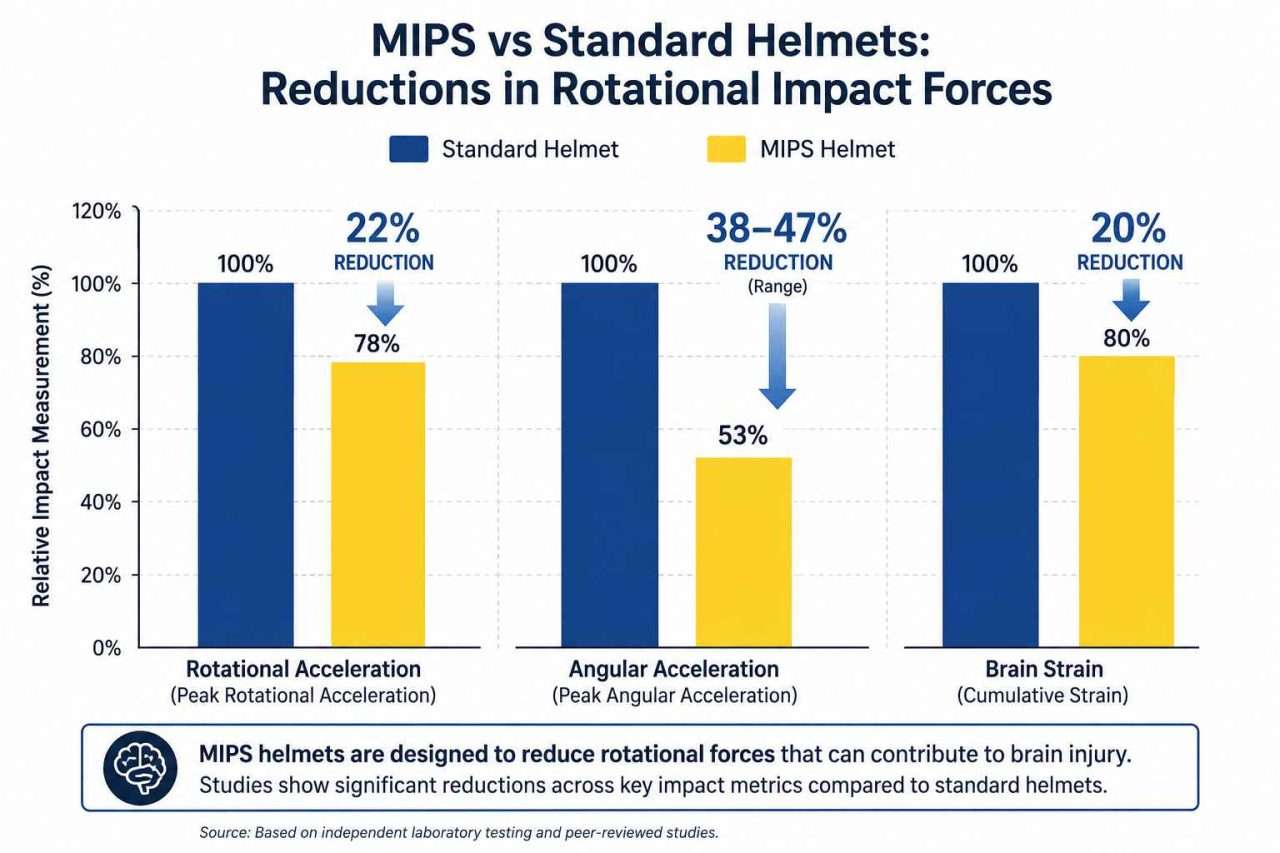
A peer-reviewed study published in the Annals of Biomedical Engineering (2019) compared helmets with different rotation-damping systems against standard helmets using oblique impact tests. The MIPS helmets showed a 22% reduction in peak rotational acceleration compared to the control helmets. A separate 2022 study found even larger reductions, with MIPS cutting peak angular acceleration at the front and side, but not the crown or rear.
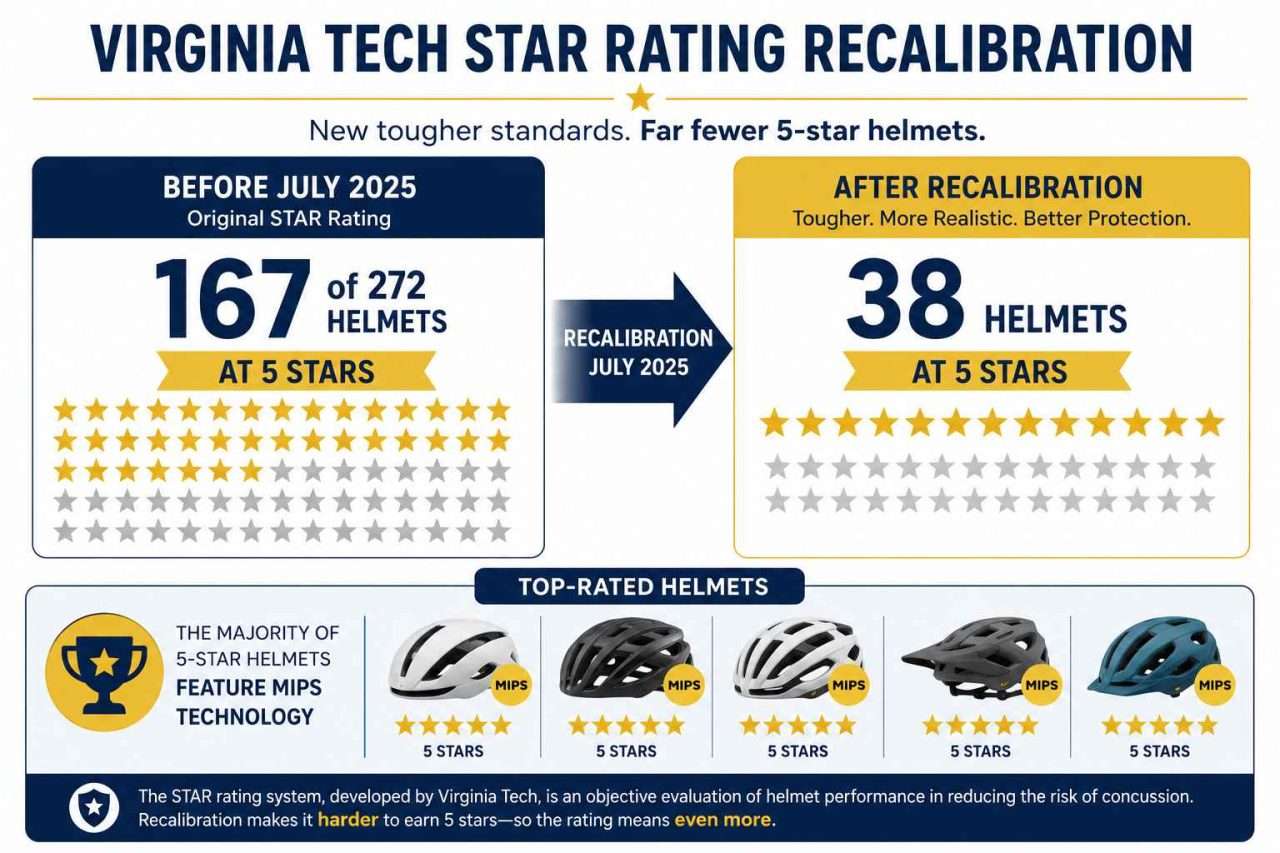
The Virginia Tech Helmet Lab runs one of the most respected independent helmet rating programs in the world. Their STAR rating system tests helmets across 24 impact scenarios that simulate real-world bicycle crashes, measuring both linear acceleration and rotational velocity.
After a July 2025 recalibration that raised the bar for five-star ratings, only 38 out of 272 tested helmets kept their top rating. The two highest-rated helmets both used MIPS technology.
Then there’s the Folksam Insurance Group in Sweden, which has conducted more than 16 consumer helmet tests since 2012 in partnership with the Research Institutes of Sweden (RISE). Their testing includes oblique impact tests alongside the standard perpendicular ones. In their results, MIPS-equipped helmets performed up to 36% better than the average helmet for adults and up to 44% better for children’s helmets.
Are There Caveats to the MIPS Evidence?
There are, and being straight about them actually makes the overall case stronger. The Snell Foundation, a respected independent testing body, conducted its own evaluation and found no significant improvement from MIPS using their testing method.
MIPS co-founder Peter Halldin responded publicly, noting that the test method Snell used (a linear impactor) wasn’t designed to show MIPS’s benefit, and that MIPS’s own internal testing with linear impactors produced the same result. The slip plane is designed to work in angled, sliding impacts, not straight-on hits.
The Bicycle Helmet Safety Institute (BHSI) has also raised fair questions about whether the Virginia Tech test methodology, which uses a “sticky” headform with tight straps, may favor MIPS helmets by coupling the headform more tightly to the helmet than what happens in real crashes. A 2020 study found that adding a realistic scalp layer to the test headform eliminated the measurable difference between MIPS and non-MIPS helmets.
So, is the science settled? Not entirely. But the weight of evidence from multiple independent sources points in the same direction: MIPS provides measurable reductions in rotational forces under oblique impact conditions, which is the type of impact most likely in a cycling crash.
The question remains whether those lab reductions translate to fewer concussions on real roads. That’s harder to prove, and nobody has done it conclusively yet. For a deeper look at this question, our article on whether bike helmets work covers the broader effectiveness data.
How Much More Does a MIPS Helmet Actually Cost?
This is where the cost-benefit math gets interesting. When MIPS first appeared on bicycle helmets, the price premium was typically $10 to $25 over the non-MIPS version of the same helmet. As the technology has become more widespread, that range has shifted.
According to MIPS AB’s own corporate filings, the premium for a Mips-equipped helmet starts at around $15 to $20 and goes up from there. Some third-party sources report premiums closer to $20 to $40 for bicycle helmets.
The point being, the actual premium depends heavily on where the helmet sits in the market. At the budget end, you can pick up a Giro Register MIPS or a Trek Solstice MIPS for under $80.
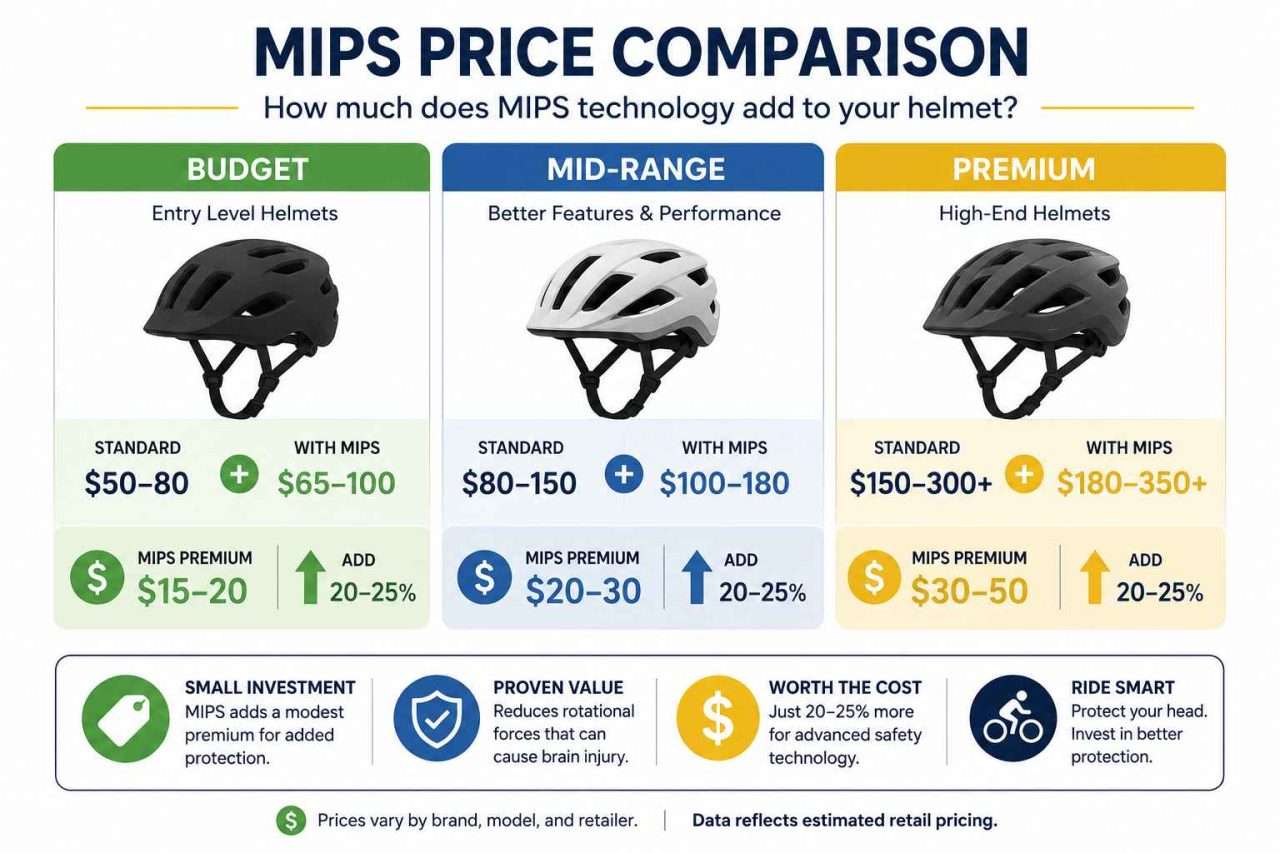
At the premium end, a MIPS-equipped road helmet from POC, Smith, or Bell can run $150 to $300, but most of that price is going toward lighter materials, better ventilation, and aerodynamics, not the MIPS liner itself. In many cases, the MIPS version of a helmet costs about 15 to 25% more than its non-MIPS twin.
To put that in perspective: if a standard helmet costs $60 and the MIPS version costs $80, you’re paying an extra $20 for a technology that independent labs have shown reduces rotational forces by 20 to 40% in oblique impacts. That’s roughly the price of two coffees and a muffin.
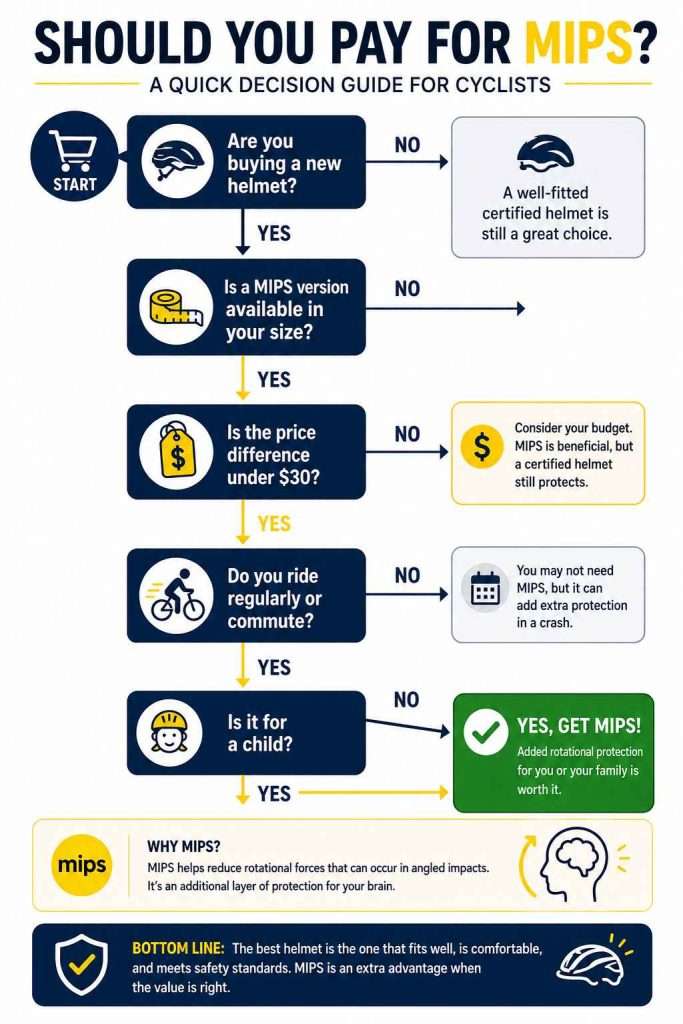
Do I Need a MIPS Helmet, or Will Any Certified Helmet Do?
Let’s be clear about something first: any helmet that meets the CPSC (Consumer Product Safety Commission) standard in the US, or EN 1078 in Europe, will protect your head in a crash. These safety standards for bicycle helmets set minimum requirements for impact absorption, and every helmet on a US store shelf has to pass them, whether it costs $30 or $300. A certified helmet without MIPS is far, far better than no helmet at all.
The question is whether you want that additional layer of rotational protection on top of the baseline. And that depends on a few things.
If you ride regularly, commute in traffic, or ride at speed, the odds of being involved in the kind of angled, sliding impact that MIPS is designed for increase. If you’re buying a helmet for a child, the developing brain is more vulnerable to rotational injury, and kids fall more often. If you’re a weekend rider on quiet trails, the risk is lower, but it’s never zero.
One thing worth noting: helmet fit matters more than any technology inside it. A well-fitted helmet without MIPS will protect you better than a MIPS helmet that’s too loose, sits crooked, or has unbuckled straps.
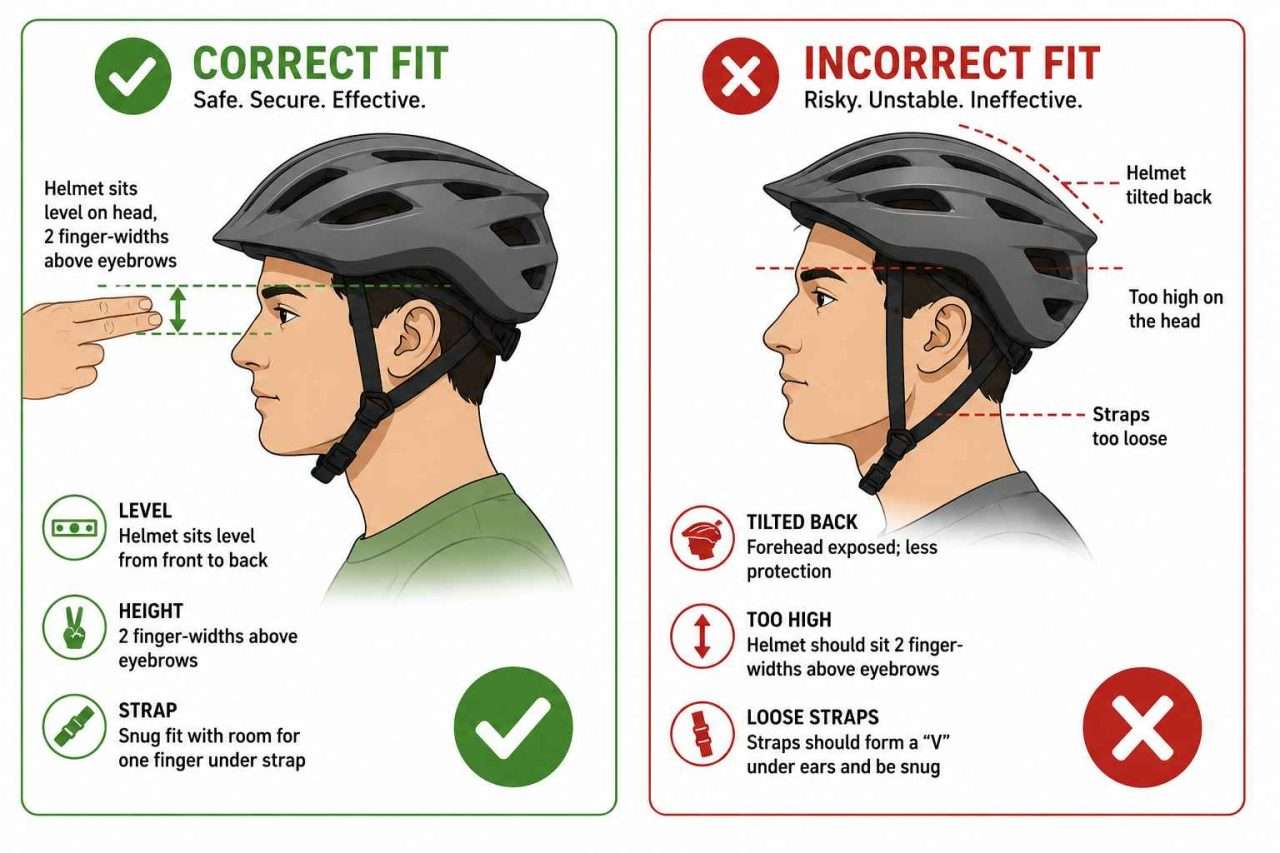
Get the fit right first. Then, if MIPS is available at a price you’re comfortable with, it’s a sensible addition.
What About Alternatives to MIPS?
MIPS isn’t the only game in town. Bontrager’s WaveCel uses a collapsible cellular structure inside the helmet that flexes on angled impact. Lazer’s KinetiCore builds crumple zones directly into the EPS foam, eliminating the need for a separate liner.
POC originally developed their own system called SPIN (Shearing Pad Inside) but has largely transitioned to MIPS in their current lineup. Kask takes a different approach entirely, using their WG11 testing protocol to verify rotational performance without adding a separate slip-plane layer.
In December 2025, MIPS AB acquired Koroyd, a company known for its honeycomb impact-absorption technology used in helmets from brands like Smith. That acquisition means Koroyd is now a MIPS subsidiary, not a competitor. The combined technologies could lead to helmets that address both linear and rotational forces more effectively.
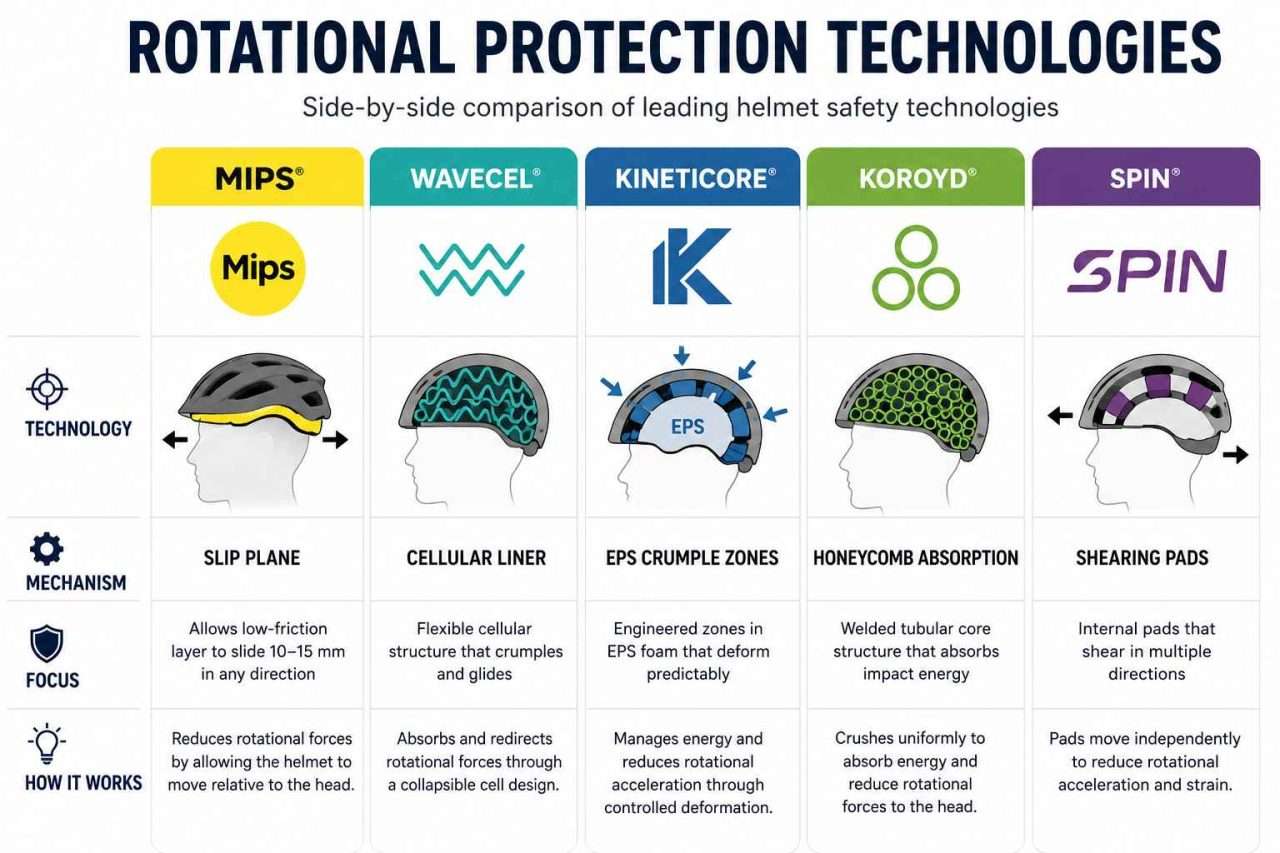
The takeaway here is that MIPS is the most widely adopted and independently tested rotational protection system available, but it’s not the only option. If you find a helmet with WaveCel, KinetiCore, or another system that fits well and scores highly in Virginia Tech’s testing, that’s a perfectly valid choice too.
Is MIPS Just a Marketing Ploy by Helmet Manufacturers?
A cynic might suggest that MIPS is just a clever way for helmet companies to charge more for a thin piece of plastic. And honestly, that’s a reasonable thought.
But consider this: MIPS AB is an independent company headquartered in Stockholm that licenses its technology to helmet brands. It doesn’t make helmets. It sells a component, and the helmet brands decide whether to include it.
Over 180 brands across bicycle, motorcycle, equestrian, construction, ski, and ice hockey helmets have chosen to do so.
The technology is backed by three decades of research conducted in partnership with KTH and the Karolinska Institutet. More than 50 million MIPS-equipped helmets have been sold worldwide.
That kind of adoption across an entire industry, from budget brands to premium manufacturers like Bell, POC, Smith, and Giro, goes well beyond marketing hype. When competitors like Bontrager develop their own alternative systems rather than ignoring the problem, that tells you the underlying science of rotational protection is taken seriously.
Not only that, but mandatory standards are catching up. New testing requirements for rotational impact are planned to be introduced in both the US (through CPSC updates) and Europe (through EN 17950:2024). When regulators start writing rotational testing into law, it’s a strong signal that this isn’t just a marketing story.
So, Is MIPS Worth It?
Here’s where common sense needs to prevail. You can’t put a dollar value on your brain. But if you could, the math looks pretty straightforward.
For an extra $15 to $30 on a bicycle helmet, you get a technology that multiple independent testing bodies have shown reduces rotational forces in the kind of impacts most likely to happen in a cycling crash. It’s not a guarantee against concussion, and no helmet manufacturer, including MIPS, claims that it is. But it tilts the odds in your favor.
If you’re shopping on a tight budget and the choice is between a well-fitted, certified helmet without MIPS and a poorly-fitted MIPS helmet, buy the one that fits. There are quality helmets available without MIPS that will protect you well.
But if you can stretch to the MIPS version of the same helmet, the evidence says it’s money well spent. And if you’re looking for the sweet spot between protection and price, we’ve put together a list of affordable MIPS options if you decide it’s worth it.
So, is MIPS worth it? For an extra $20 on the only thing standing between your brain and the pavement, yes, it is.
Frequently Asked Questions
How much does MIPS help?
The point being, MIPS doesn’t make a helmet invincible, and it won’t guarantee you walk away from every crash without a concussion. What it does is add a measurable layer of protection against the kind of rotational brain movement that standard helmets weren’t originally designed to address. Virginia Tech’s Helmet Lab consistently ranks MIPS-equipped helmets among the highest performers in their STAR rating system, which specifically evaluates a helmet’s ability to reduce both linear and rotational impact forces.
How much is a MIPS helmet?
At the lower end, helmets like the Specialized Align II MIPS and the Giro Register MIPS can be found in the $50 to $80 range and still include proper CPSC certification alongside MIPS protection. At the upper end, premium helmets from brands like POC, Giro, and Specialized pack in lighter weight, better ventilation, and more aerodynamic designs on top of the MIPS liner. So, much of what you’re paying for in an expensive helmet is comfort, weight savings, and airflow rather than a higher level of MIPS protection itself.
Is MIPS worth it for kids?
Kids’ MIPS helmets are more affordable than you might expect. Models like the Giro Scamp II MIPS (for toddlers) and the Giro Tremor MIPS (for older kids) sit in the $50 to $75 range. That’s a pretty small price to pay for an extra layer of protection for your child’s brain. Several alternative anti-rotation systems like Lazer’s KinetiCore and Bontrager’s WaveCel are also available in kids’ helmets and serve a similar purpose.
The one thing that matters more than any technology, though, is fit. A MIPS helmet that’s too big or too small won’t protect your kid properly. Get the fit right first, then choose a helmet with MIPS or a similar rotational protection system at your price point.
Are MIPS helmets more comfortable?
Early MIPS designs did have a downside. The original plastic slip-plane liner could partially block vents and reduce airflow, which made some helmets feel a bit warmer. Newer versions like MIPS SL, MIPS Air Node, and MIPS Integra have addressed this by using lighter, more breathable designs that leave vents open. If you’re buying a current-model helmet, the MIPS liner shouldn’t affect ventilation or comfort in any meaningful way.
One thing worth mentioning is that adding a MIPS liner can very slightly change the internal fit of a helmet, occasionally making it feel a touch tighter. Most manufacturers account for this during design, but it’s a good reason to always try a helmet on before you buy.
Is MIPS worth it for skiing?
The price premium for MIPS in a ski helmet is typically modest. Budget-friendly ski helmets with MIPS, like the Giro Ratio MIPS, are available at around half the cost of high-end options, and Virginia Tech’s snow sport helmet ratings give you a way to compare safety performance across models. When you consider the speed involved in skiing and the unforgiving surfaces you can hit (ice, hard-packed snow, trees, lift towers), paying an extra $20 to $40 for rotational impact protection is common sense.
