MIPS Helmet Technology: What 50 Million Helmets Use
The Short Version: MIPS (Multi-directional Impact Protection System) is a licensed helmet safety technology designed to reduce rotational head motion during angled impacts. It uses a low-friction layer inside the helmet that slides 10–15 mm on impact, redirecting rotational forces away from the brain.
More than 180 helmet brands integrate MIPS across over 1,000 models spanning cycling, motorcycling, equestrian, snow sports, and construction. MIPS is not a certification or safety standard — it is a proprietary component sold to manufacturers. Over 50 million MIPS-equipped helmets have been sold worldwide.
If you’ve looked inside a helmet recently, you’ve probably noticed a thin yellow plastic liner sitting between your head and the foam. That’s a MIPS (Multi-directional Impact Protection System) slip-plane, and it’s one of the most significant developments in helmet safety in the last thirty years.
The problem is, most people can’t tell you what it actually does. “Extra protection” is about as far as the explanation usually goes, which isn’t much help when you’re trying to figure out whether it’s worth paying more for.
If you’ve seen the MIPS logo on helmets and want to understand what it actually does, you’re in the right place. Let’s take a look at how MIPS helmet technology works, where it came from, and what the different versions mean for you as a rider.
What Is MIPS Helmet Technology?
MIPS stands for Multi-directional Impact Protection System. It’s a helmet safety technology, not a helmet brand and not a safety certification. MIPS is an ingredient that helmet manufacturers license and install into their own helmets, similar to how Gore-Tex works in jackets.
If you want to understand why MIPS is a technology, not a safety certification, that’s worth a read on its own.
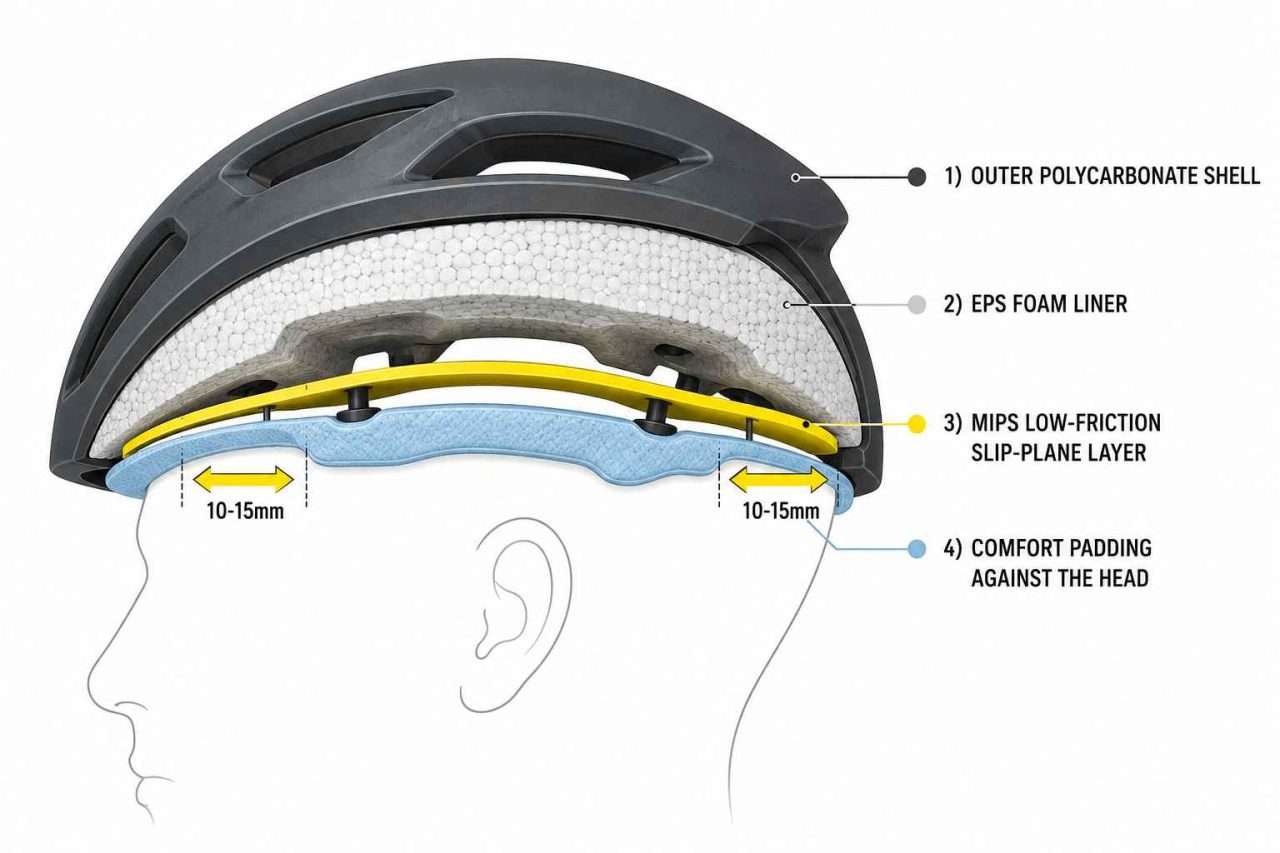
At its simplest, MIPS helmet technology is a low-friction layer (the slip-plane) inside a helmet that sits between the helmet’s EPS (Expanded Polystyrene) foam liner and your head. You’ll know it when you see it. In most helmets, it’s a thin, yellow polycarbonate sheet, though newer versions use different materials and are sometimes nearly invisible.
The slip-plane is connected to the inside of the helmet by elastomeric attachments, small rubber-like anchors, that allow the slip-plane to move about 10 to 15 millimeters in any direction. That movement is the whole point. When your head hits the ground at an angle, the outer helmet shell can move slightly relative to your head, reducing the rotational force that reaches your brain.
How Does the MIPS Slip-Plane Actually Work?
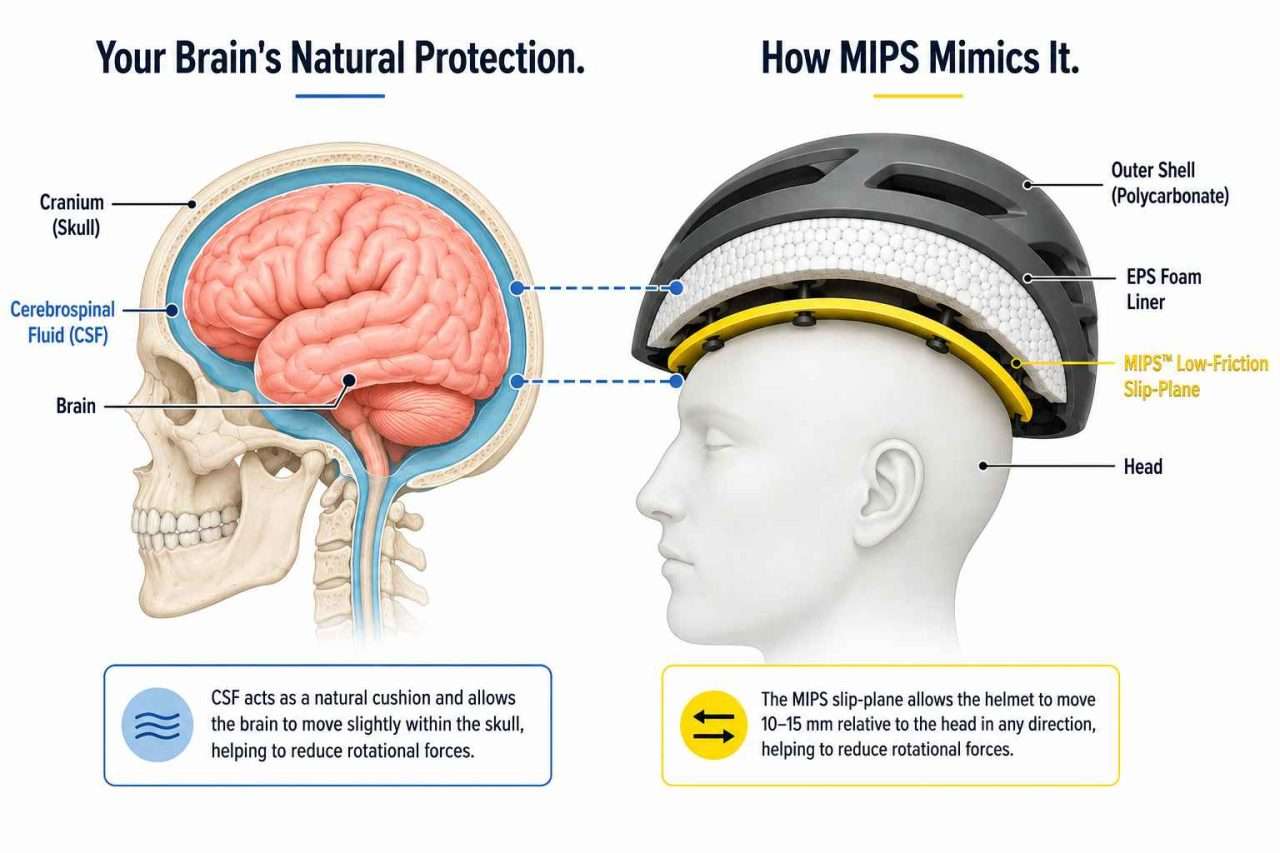
To understand MIPS, it helps to understand what your brain is already doing to protect itself. Your brain doesn’t sit pressed against the inside of your skull. It floats in Cerebrospinal Fluid (CSF), a clear liquid that acts as a natural shock absorber.
The CSF keeps your brain suspended, giving it a small buffer of movement inside your cranium during everyday bumps and jolts.
The MIPS slip-plane mimics this natural protection. The low-friction layer allows the helmet’s outer shell to move independently of the inner liner during an angled impact, the same way CSF allows your brain to move slightly within your skull. The point being, the sudden rotational jolt from a crash gets partially absorbed by that 10 to 15 mm of movement rather than transferring directly into your head.
That sounds technical, so here’s a hands-on way to see it for yourself.
The Fist Demonstration: Try This at Home
Make a fist with your right hand. That’s your head. Now wrap your left hand tightly around the fist, that’s a traditional helmet with no MIPS.
Press both hands down onto a desk and slide them forward, simulating a fall where your head hits the ground at an angle. Feel how the outer hand drags the inner fist into rotation? That jarring twist is rotational force being transferred straight to “your brain.”
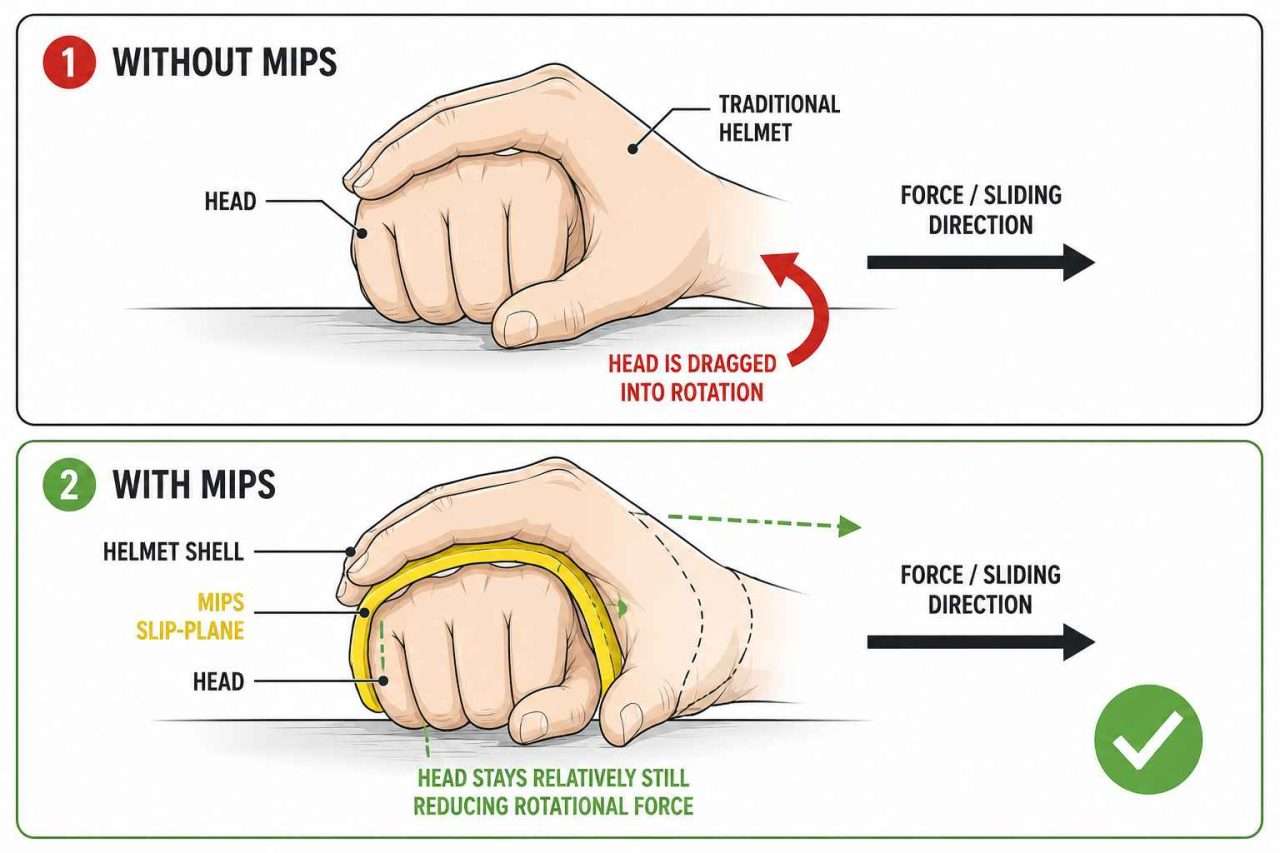
Now try it with three hands (grab a friend or use a flat surface). Your right fist is still your head. A middle layer (your friend’s hand or a cloth) wraps loosely around the fist, representing the MIPS slip-plane.
Your left hand wraps around the outside as the helmet shell. This time, when you slide both onto the desk, the outer “shell” hand slides, but the loose middle layer lets it move independently. Your fist barely twists at all.
That’s the MIPS concept in ten seconds. The outer shell absorbs the slide and rotation from the impact surface, and the slip-plane lets it do that without dragging your skull along for the ride.
What Problem Was MIPS Designed to Solve?
Traditional helmets are designed and tested primarily for linear impacts, straight-on hits where your head drops vertically onto a flat surface. Think of an apple falling from a tree. That’s linear motion, straight line, no rotation.
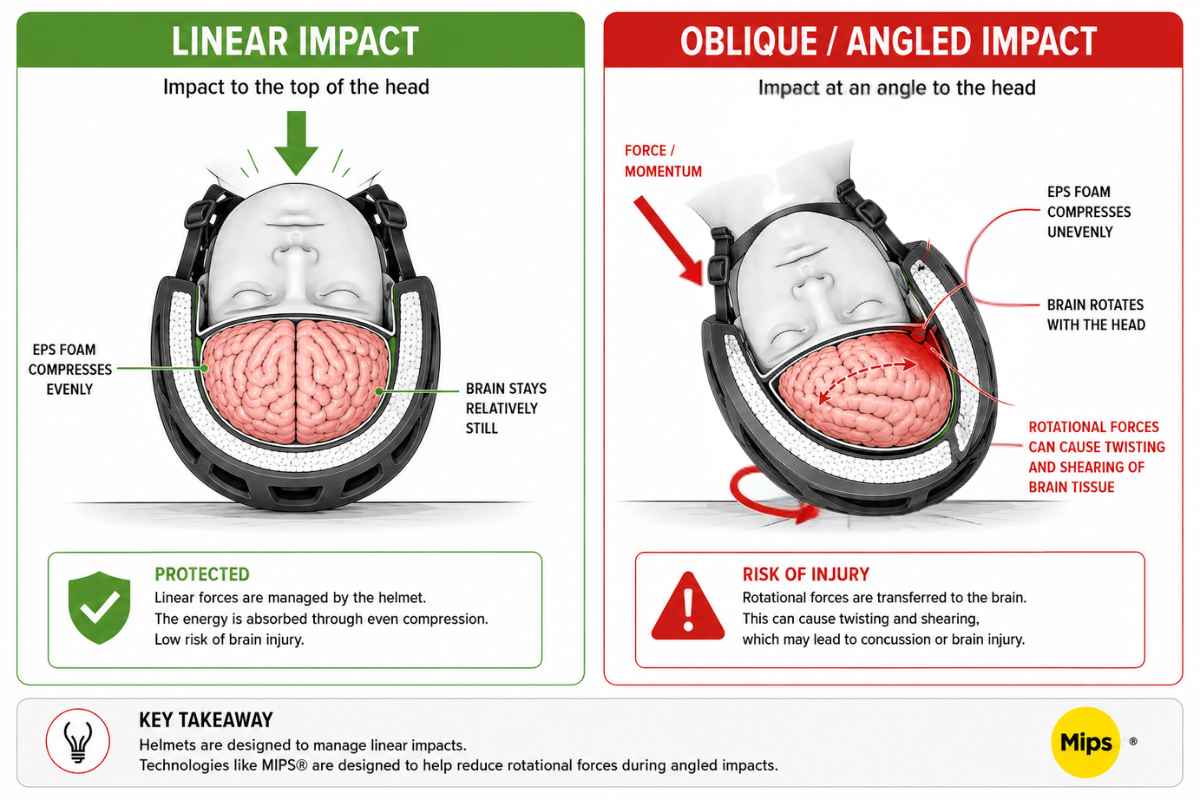
A standard helmet’s EPS foam liner does a solid job of crushing on impact and absorbing that straight-line energy.
The problem is, most real-world cycling crashes don’t work that way. When a cyclist falls, their head doesn’t drop straight down like that apple. Forward momentum means the head hits the ground at an angle, rotating as it makes contact.
This oblique impact generates rotational forces that twist the brain inside the skull, and research has shown that the brain is more sensitive to rotational motion than linear motion.
Rotational forces can stretch and shear brain tissue, potentially leading to concussions, diffuse axonal injury, and subdural hematoma. Standard helmet certifications like CPSC and EN 1078 have historically only tested for linear impacts. That left a gap between what helmets were certified to protect against and what actually happens in most crashes.
MIPS was designed to address that gap.
Who Created MIPS and How Did It Get Here?
The story starts in the mid-1990s with a Swedish neurosurgeon named Hans von Holst. Working at the Karolinska Institute in Stockholm, von Holst kept treating patients who had suffered serious brain injuries despite wearing helmets. The helmets had done their job against skull fractures, but the brain trauma was still happening.
He wanted to know why.
In 1995, von Holst recruited Peter Halldin, a doctoral student in biomechanics from KTH Royal Institute of Technology in Stockholm. Together with a third co-founder, Svein Kleiven, they spent years researching, testing, and fundraising. It was slow going, but they were onto something important.
In 2001, Mips AB, the company, was officially formed with five biomechanics specialists. Thousands of tests followed. It took another six years before the first marketable MIPS product reached the public: an equestrian helmet in 2007, produced in-house under the name MIPS BPS 1.0 (Brain Protection System).
From idea to product, it was a twelve-year journey.
How Did MIPS Go from Equestrian Helmets to Everywhere?
The original plan was for Mips AB to manufacture and sell their own helmets. That changed in 2010 when the company pivoted to what’s called an ingredient brand model, the approach that ended up transforming the entire helmet industry.
Instead of making helmets, Mips AB would license the technology to existing helmet manufacturers. The updated system, MIPS BPS 2.0, was designed as a framework that brands could integrate into their own production chains.
The pivot paid off. By the end of 2013, eight helmet brands were using MIPS across 30 helmet models. In early 2014, a partnership with BRG Sports (the parent company of Bell and Giro) doubled the brand roster almost overnight.
From there, growth accelerated quickly.
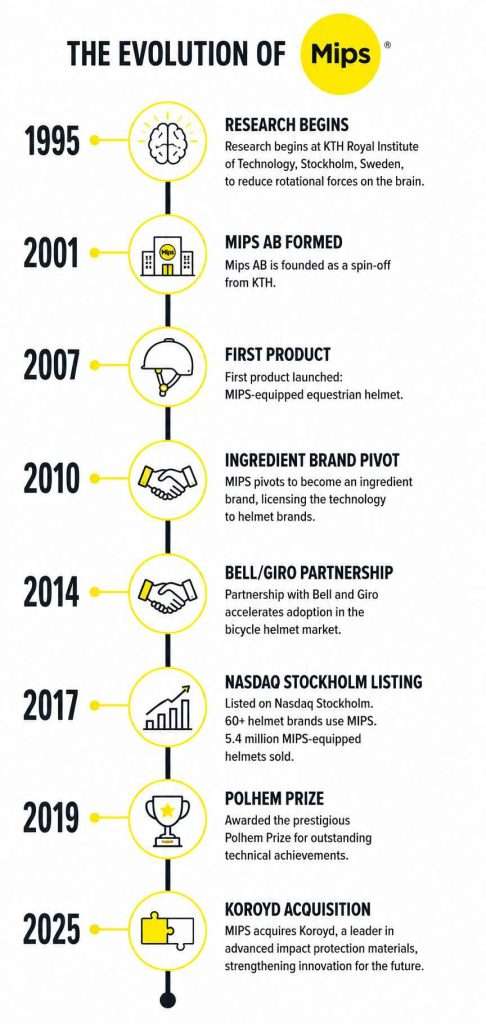
Here’s how the timeline played out:
- 1995: Hans von Holst and Peter Halldin begin research at KTH Royal Institute of Technology, Stockholm
- 2001: Mips AB formed with five neuroscience experts
- 2007: First MIPS product released (equestrian helmet, BPS 1.0, produced in-house)
- 2010: Pivoted to ingredient brand model with BPS 2.0, targeting bike and snow helmets
- 2013: 8 brand partners, 30 helmet models
- 2014: BRG Sports (Bell/Giro) partnership, doubling the roster
- 2016: MIPS accepted into motorcycle helmets
- 2017: Mips AB listed on Nasdaq Stockholm. Year-end: 60 brand partners, 302 models, 5.4 million units sold
- 2018: Rock climbing helmets added. 9.2 million cumulative units sold
- 2019: Ice hockey helmets added. Founders awarded the Swedish Engineers’ Polhem Prize, Sweden’s oldest and most prestigious technical award
- 2025: Mips AB acquired Koroyd (EUR 40 million), now a subsidiary within the Mips Group
As of 2026, Mips Group works with more than 180 helmet manufacturers, and the MIPS safety system has been integrated into well over 1,000 helmet models worldwide. More than 50 million MIPS-equipped helmets have been sold across cycling, motorcycle, snow sports, equestrian, rock climbing, ice hockey, and construction.
Not bad for a neurosurgeon’s research project.
What Are the Different Types of MIPS?
If you’ve been helmet shopping recently, you may have noticed that “MIPS” doesn’t always look the same from one helmet to the next. That’s because Mips AB offers several different versions of their safety system, each designed for different helmet types and integration needs.
All of them meet the same safety criteria for redirecting rotational motion. The differences are in weight, ventilation, and how visible the system is inside the helmet.
Here are some of what’s currently available:
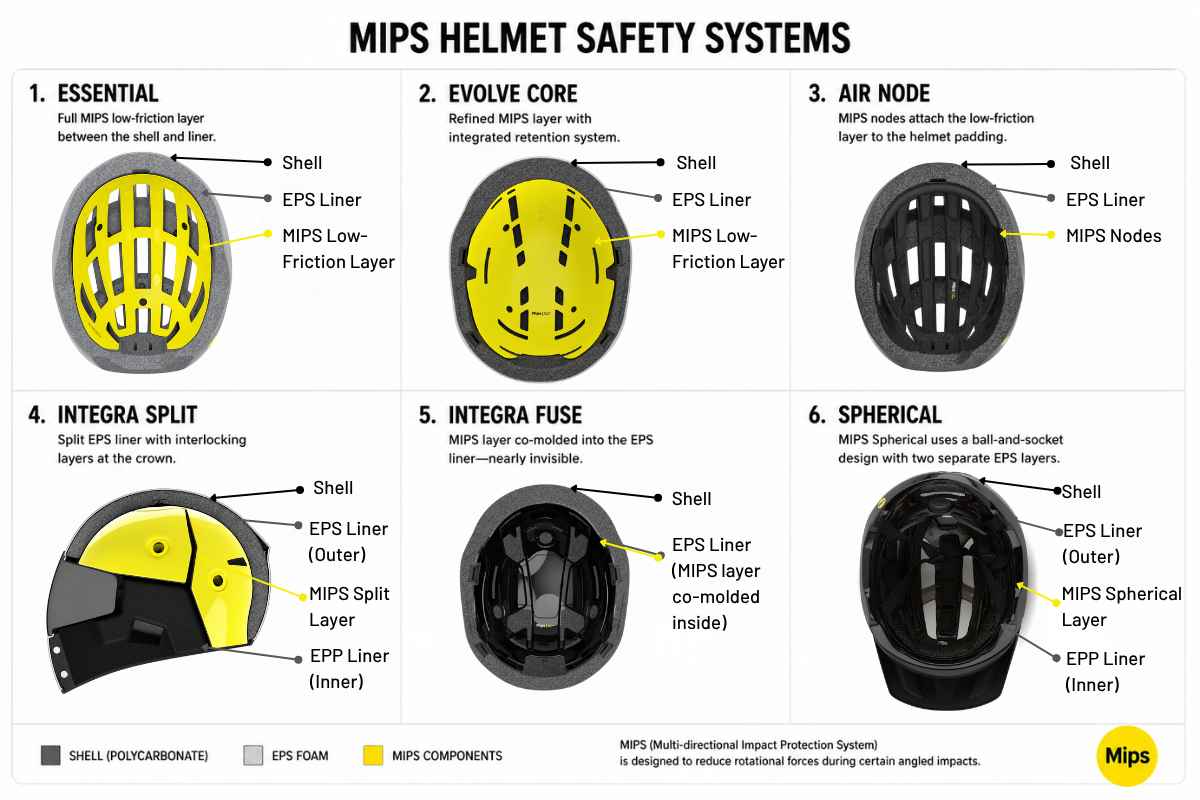
| MIPS System | How It Works | Best For |
|---|---|---|
| Essential | The original full-coverage yellow slip-plane liner. Simple, robust, cost-effective. | Budget-friendly helmets across all categories. A solid entry point to MIPS protection. |
| Evolve Core | Refined slip-plane with improved fit, lighter construction, and better ventilation. Works with dial retention systems. | The most widely used MIPS system. Found in mid-range bike, snow, equestrian, and moto helmets. |
| Air Node / Air Node Pro | Low-friction layer laminated into the padding, connected by hook-and-loop “nodes” that release during angled impacts. Adds almost no weight. | Lightweight, highly ventilated helmets. Popular in road and cross-country cycling helmets. |
| Integra Split | Splits the inner EPS liner into front and rear sections that interlock at the crown. The split sections slide relative to the fixed outer layer. | Helmets where full integration with the foam liner is required. Common in motorcycle and premium cycling helmets. |
| Integra Fuse | Co-molds the low-friction layer directly into the EPS foam structure. Nearly invisible inside the helmet. | Premium helmets where a clean interior and maximum ventilation are priorities. |
| Integra TX | Integrated into the comfort padding and attached via existing hook-and-loop fabric inside the helmet. Invisible when worn. | Motorcycle, equestrian, and snow helmets where comfort padding integration is preferred. |
| Elevate / Elevate Pro | Rotation-reducing insert designed to fit standard hard hat harness setups. | Construction and industrial safety helmets. |
| Spherical | Ball-and-socket design using two separate EPS foam layers that rotate relative to each other. Developed by Bell/Giro in partnership with MIPS. No traditional yellow liner. | Premium road, mountain bike, and snow helmets from Bell and Giro. |
The question people ask most often is “which one is safest?” The answer from Mips AB is that all of their systems are engineered to meet the same safety criteria for redirecting rotational motion. The differences are about how the system integrates with different helmet designs, not about one being safer than another.
How Does MIPS Spherical Work?
MIPS Spherical deserves its own explanation because it works differently from every other MIPS system. Developed at the Bell and Giro Dome laboratory in partnership with Mips AB, Spherical does away with the traditional yellow polycarbonate slip-plane altogether.
Instead, the helmet uses two separate layers of EPS foam. An outer layer is bonded to the helmet shell, and an inner layer sits against your head. Between the two foam layers is a MIPS low-friction interface that allows them to rotate relative to each other.
Bell and Giro describe it as a “ball-and-socket design,” which is actually a pretty good way to picture it.
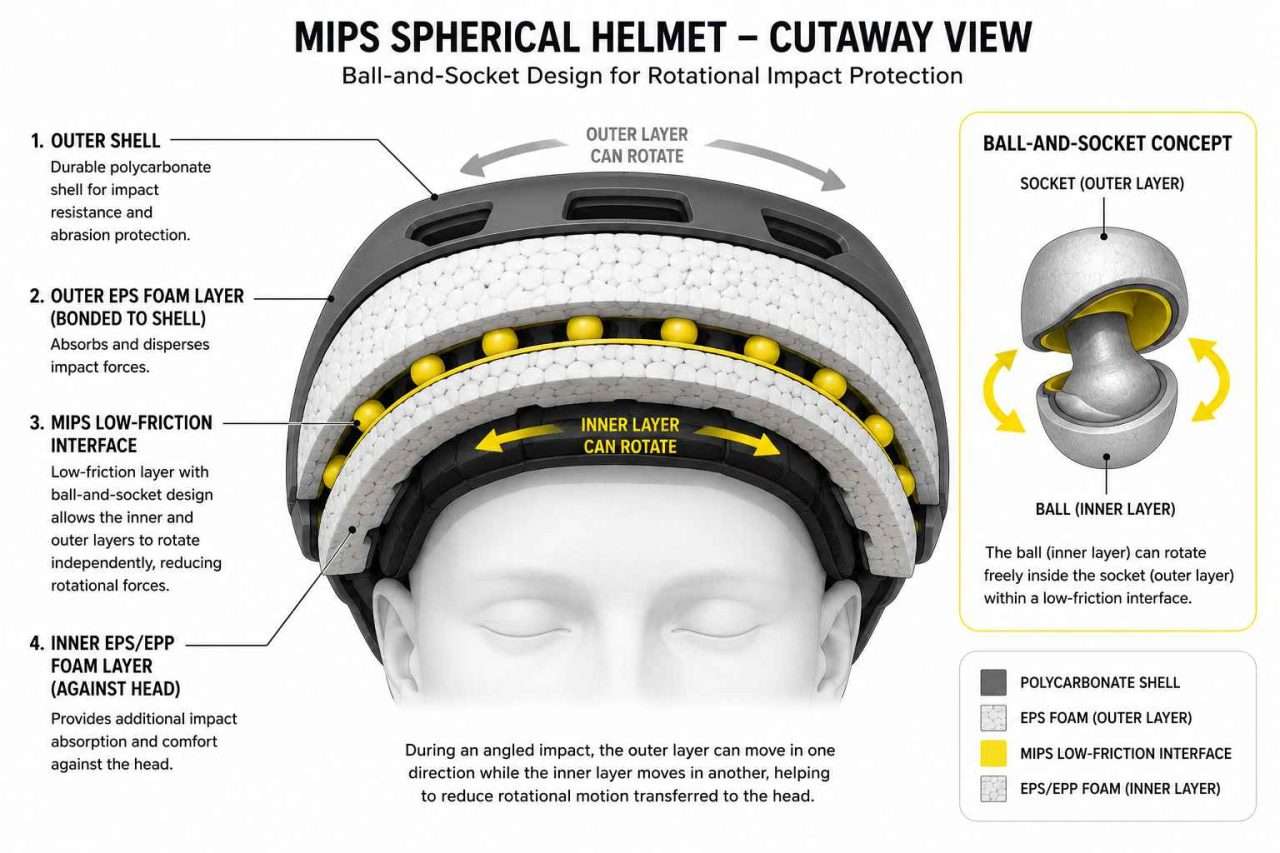
The advantage of this approach is that the rotational protection is built into the helmet’s core structure rather than added as a separate component. That means less internal volume is taken up, ventilation channels stay clear, and the interior looks and feels cleaner. You’ll find MIPS Spherical in helmets like the Giro Eclipse, Giro Aether, and Bell Super DH.
Is MIPS a Safety Standard?
No. This is one of the most common misconceptions, so it’s worth being clear about it. MIPS is a technology, not a certification.
A MIPS-equipped helmet still needs to pass the same mandatory safety certifications as any other helmet, such as CPSC in the US or EN 1078 in Europe. The MIPS system is an additional layer of protection on top of those baseline standards.
Think of it this way: CPSC certification tells you the helmet can handle a straight-on impact. MIPS adds protection against the rotational forces that those certifications have historically not tested for. One doesn’t replace the other.
For a fuller explanation, take a look at what MIPS certification actually means.
Where Can You Find MIPS Helmets?
MIPS technology is available across just about every type of helmet you can think of: road cycling, mountain biking, commuting, motorcycle, ski and snowboard, equestrian, rock climbing, ice hockey, and even construction hard hats. If you see a helmet with a round yellow dot and the MIPS logo on the shell, it has the system inside. Some newer versions with Integra or Air Node systems may not have a visible yellow liner, but the MIPS branding will still be on the helmet.
With more than 180 brand partners, you’ll find MIPS in helmets from Giro, Bell, Smith, POC, Fox Racing, Specialized, Trek/Bontrager, Lazer, Scott, Giant, and many more.
RELATED: Affordable MIPS Bicycle Helmets
Stay safe with MIPS helmet technology. Choose from best brand bicycle helmets that enhance your biking experience, ensuring the best in bike helmet safety.
So, Is MIPS Worth Your Attention?
Here’s where common sense comes in. The science behind MIPS is solid. It was developed over more than a decade by neuroscientists and biomechanics researchers, tested more than 50,000 times at the MIPS testing center in Stockholm, and independently validated by organizations like Virginia Tech’s helmet lab.
The founders won Sweden’s oldest and most prestigious engineering award for it.
MIPS is not the only rotational protection technology out there. Competitors like WaveCel, SPIN, KinetiCore, and others have entered the market with their own approaches to the same problem. But MIPS has the longest track record, the largest installed base, and the broadest independent testing history.
At the end of the day, the most important thing is that your helmet is on your head. But if you’re choosing between two otherwise similar helmets and one has MIPS, the common sense answer is pretty clear. Your brain is the only one you’ve got, and it doesn’t bounce.
MIPS Helmet Technology FAQs
Does MIPS Technology Really Work?
A peer-reviewed study published in the Annals of Biomedical Engineering found that MIPS reduced peak rotational acceleration by 39% and peak rotational velocity by up to 32% compared to the same helmet without MIPS. Virginia Tech’s independent STAR rating system has also consistently shown MIPS-equipped helmets performing well, with MIPS models frequently occupying the top spots in their bicycle helmet rankings.
With over 180 brand partners and more than 50 million MIPS-equipped helmets sold worldwide, the technology has serious traction in the industry. That said, no helmet can guarantee you won’t get a concussion. MIPS reduces the risk of rotational brain injury. It doesn’t eliminate it.
How Often Should You Replace a MIPS Helmet?
MIPS themselves recommend the 3 to 5 year replacement window. Once that EPS foam has been compressed in a crash, it can’t spring back and do its job again. Even a light fall where you walked away feeling fine may have compressed the foam internally without leaving any visible sign on the outside.
One more thing worth checking: if any of the small tabs holding the MIPS liner in place have come loose or broken, that’s also a sign it’s time for a new helmet. Don’t risk it, replace it.
Are MIPS Helmets Actually Better?
Virginia Tech’s independent STAR ratings have repeatedly shown MIPS helmets dominating the top spots. But here’s the caveat: MIPS isn’t the only anti-rotation technology out there. Some non-MIPS helmets score just as well in independent testing thanks to alternatives like Bontrager’s WaveCel or Kask’s WG11 testing protocol.
The point being, a well-designed non-MIPS helmet can still be a great helmet. But all else being equal, adding MIPS to a helmet design does make it measurably better at handling the rotational forces that cause concussions.
What Does MIPS Helmet Mean?
The system adds a thin, low-friction liner inside the helmet, positioned between the EPS (Expanded Polystyrene) foam and the comfort padding against your head. During an angled impact, this liner allows the helmet to rotate 10 to 15mm relative to your head, redirecting rotational energy away from your brain. The design mimics the way cerebrospinal fluid works inside your skull, letting the brain move slightly rather than absorbing the full force of a rotational impact.
MIPS operates as an ingredient brand, meaning they don’t make helmets themselves. Instead, they supply the technology to over 180 helmet manufacturers, and it’s now found in helmets across cycling, skiing, equestrian sports, motorsports, and even construction.
