There Is No MIPS Certification: Why 180+ Brands Use It
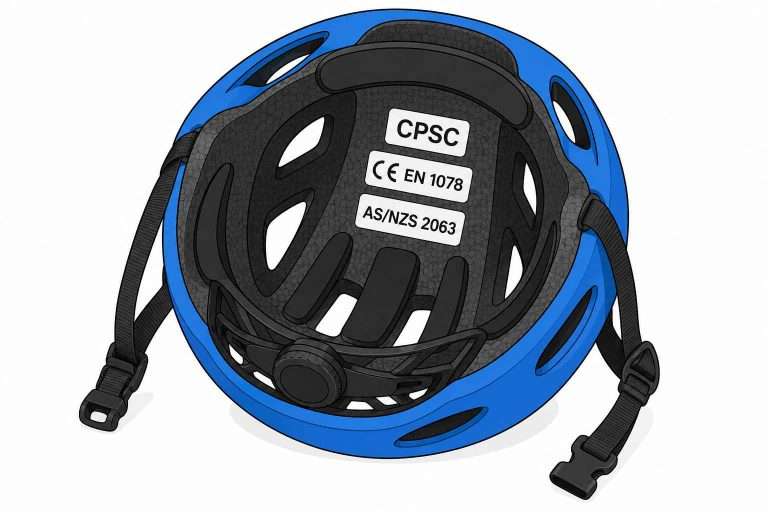
The Short Version: MIPS is not a helmet certification or safety standard. It is a patented component technology that helmet manufacturers license and build into helmets that already meet required standards like CPSC or EN 1078.
No testing body certifies a helmet “to MIPS.” MIPS AB supplies a low-friction liner designed to reduce rotational forces during angled impacts. Over 180 helmet brands across cycling, snow sports, motorcycling, and other categories currently integrate the system into their products.
MIPS gets talked about like a safety certification. You see it on the box, on the sticker, in the product listing, and it’s easy to assume it sits alongside CPSC or EN 1078 as something a helmet has to pass. It doesn’t.
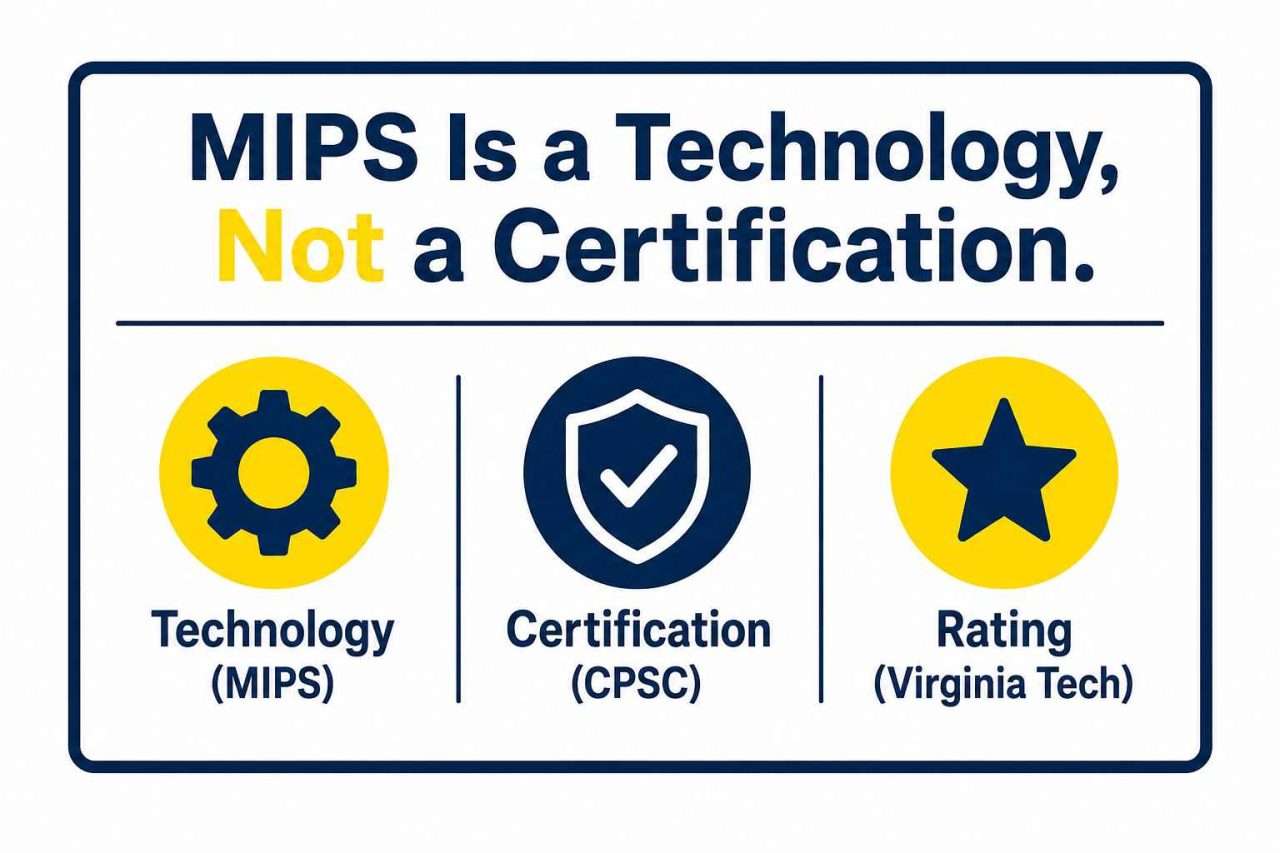
MIPS (Multi-directional Impact Protection System) is a technology, not a certification. No governing body tests for it. No helmet “passes” or “fails” a MIPS standard. It’s a component that a manufacturer licenses and installs inside a helmet, and the distinction matters more than you’d think.
Let’s take a look at why that difference is important and what it means for you and your next helmet purchase.
What Does MIPS Stand for in Helmets?
MIPS stands for Multi-directional Impact Protection System. It’s a patented technology developed by a Swedish company called Mips AB, headquartered in Stockholm and listed on the Nasdaq Stockholm stock exchange. The company doesn’t make helmets.
It makes a component that goes inside helmets, and it licenses that component to helmet manufacturers around the world.
Think of it like ‘Intel Inside’ on a computer. Intel doesn’t make the computer, but its processor sits inside and the sticker goes on the outside. MIPS works the same way.
It’s an ingredient brand. The yellow dot you see on a MIPS-equipped helmet is telling you that Mips AB’s technology has been built into that particular helmet model by the manufacturer who licensed it.
As of 2025, more than 180 helmet brands use MIPS technology across cycling, snow sports, equestrian, motorcycle, climbing, and even construction helmets. That’s brands like Giro, Bell, Fox, Smith, Specialized, Trek, POC, Scott, and Lazer, among many others. When you see “MIPS” on any of their helmets, you’re seeing a technology add-on, not a regulatory stamp of approval.
So What Does MIPS Mean on a Helmet?
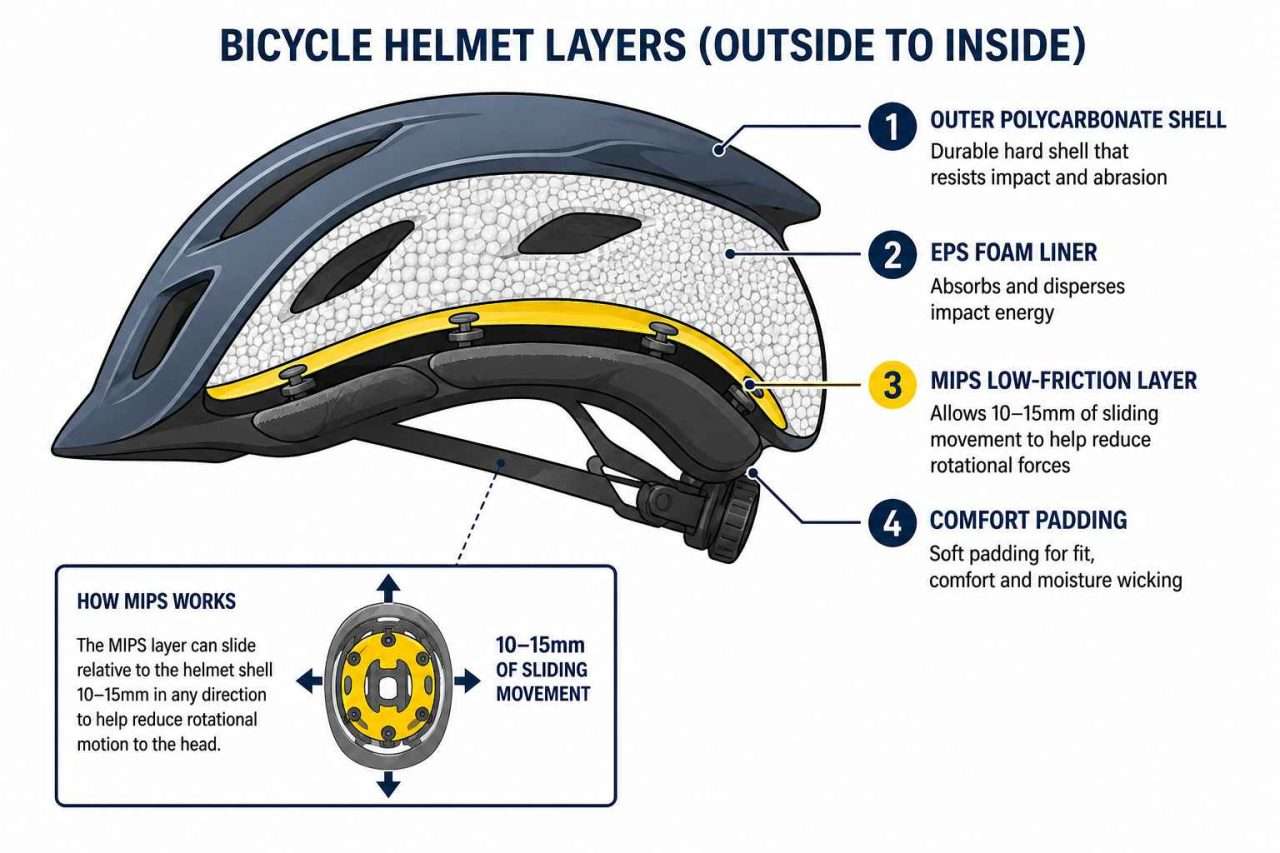
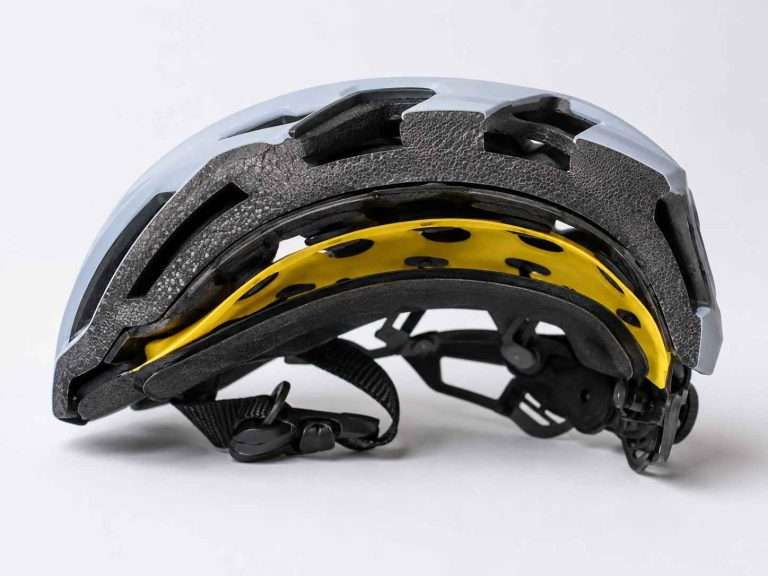
At its simplest, MIPS is a low-friction layer that sits inside the helmet, typically between the comfort padding and the EPS (Expanded Polystyrene) foam liner. EPS is that rigid white foam you’ll recognize from the packaging inside appliance boxes or the material that keeps your takeout coffee warm. It’s the part of the helmet that absorbs impact energy.
The MIPS layer is designed to move 10 to 15 millimeters in any direction relative to your head during a crash. Why? Because most real-world cycling crashes aren’t straight-down, top-of-the-head impacts.
They’re angled. Your head hits the road, a curb, or a car at an angle, and that creates rotational forces, the kind that twist and stretch brain tissue.
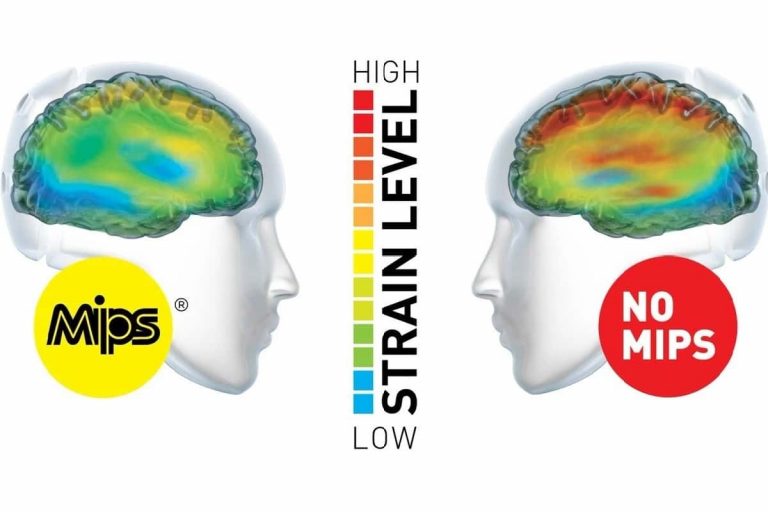
Rotational motion is particularly dangerous because the brain has shear properties similar to water or gel. When the head rotates suddenly, different parts of the brain move at different speeds, and that stretching of tissue is what researchers believe causes concussions and more severe traumatic brain injuries (TBI). The MIPS low-friction layer is designed to allow the helmet to slide slightly on impact, reducing the rotational force transferred to your head.
The point being, MIPS addresses a specific type of crash force (rotational motion from angled impacts) that traditional helmet safety certifications like CPSC don’t test for. That’s the value proposition. But it’s still a technology choice made by the helmet manufacturer, not a regulatory requirement.
Where Did MIPS Come From?
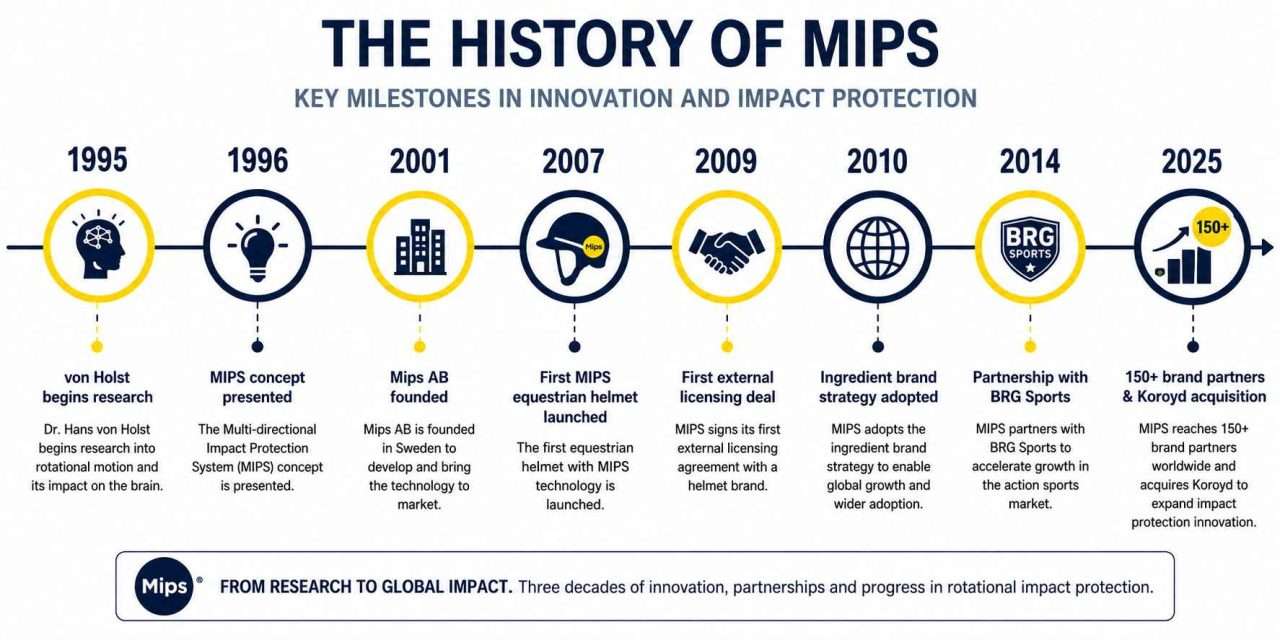
The story starts in 1995, when Swedish neurosurgeon Hans von Holst at the Karolinska Institute in Stockholm started questioning whether helmets were actually doing enough to prevent brain injuries. He reached out to KTH Royal Institute of Technology, which led to a collaboration with researcher Peter Halldin, who began his doctorate on the biomechanics of head and neck injuries.
By 1996, von Holst and Halldin had presented their concept. Their insight was that many crash impacts are angled, not straight-on, and the rotational forces from those angled impacts were causing brain injuries that traditional helmets weren’t designed to address. Their solution was to mimic the brain’s own natural protection, the cerebrospinal fluid, by placing a low-friction layer inside the helmet.
Mips AB was formally founded in 2001, and the first helmet equipped with the MIPS system, an equestrian helmet, launched on the Swedish market in 2007. The company signed its first external licensing agreement in 2009.
In 2010, Mips AB made a strategic decision to operate exclusively as an ingredient brand, licensing its technology to helmet manufacturers rather than selling its own branded helmets. That licensing model is how MIPS ended up inside helmets from over 180 brands.

Is MIPS a Safety Standard Like CPSC?
No, and this is the most important distinction to understand. MIPS is not a safety standard and it’s not a certification. It’s not a pass/fail test that a helmet has to clear before it can be legally sold.
A safety certification like CPSC 16 CFR Part 1203 is a mandatory federal requirement. Every bicycle helmet manufactured or imported for sale in the United States must meet CPSC’s testing requirements. That means surviving specific impact tests at defined drop heights, meeting g-force thresholds, and keeping the chin strap intact.
If a helmet doesn’t pass CPSC, it can’t legally be sold in the US. CPSC is a government-mandated safety floor.
MIPS is a commercial technology that a helmet manufacturer chooses to license and install. There’s no law requiring it and no government agency behind it. A helmet with MIPS still has to pass CPSC (or EN 1078 in Europe, or AS/NZS 2063 in Australia) to be legally sold.
MIPS doesn’t replace any of those certifications. It sits on top of them as an additional feature.
To put it in everyday terms: CPSC certification is like a building code that your house has to meet, or it doesn’t get signed off. MIPS is more like upgrading your insulation. It might make the house better, but it’s not the building code itself.
MIPS vs CPSC vs Virginia Tech: What’s the Difference?
This is where things can get genuinely confusing for a helmet buyer, so here’s a comparison table that lays it out.
| MIPS | CPSC 16 CFR Part 1203 | Virginia Tech STAR Rating | |
|---|---|---|---|
| What is it? | A licensed technology (low-friction layer inside the helmet) | A mandatory federal safety certification for bicycle helmets sold in the US | An independent academic helmet rating system |
| Who’s behind it? | Mips AB, a publicly traded Swedish company | US Consumer Product Safety Commission (government agency) | Virginia Tech Helmet Lab (university research program) |
| Is it required by law? | No | Yes, for all bicycle helmets sold in the US | No |
| What does it test or address? | Rotational force reduction from angled impacts | Linear impact attenuation, positional stability, retention, field of vision | Both linear acceleration and rotational velocity across 24 impact tests |
| Does it test for rotational forces? | Addresses rotational forces by design (not a pass/fail test) | No | Yes |
| Pass/fail or rating? | Neither (it’s a component, not a test) | Pass/fail | 1 to 5 star rating |
| Can a helmet have all three? | Yes. A helmet can be CPSC certified, feature MIPS technology, and carry a Virginia Tech rating. They are not mutually exclusive. | ||
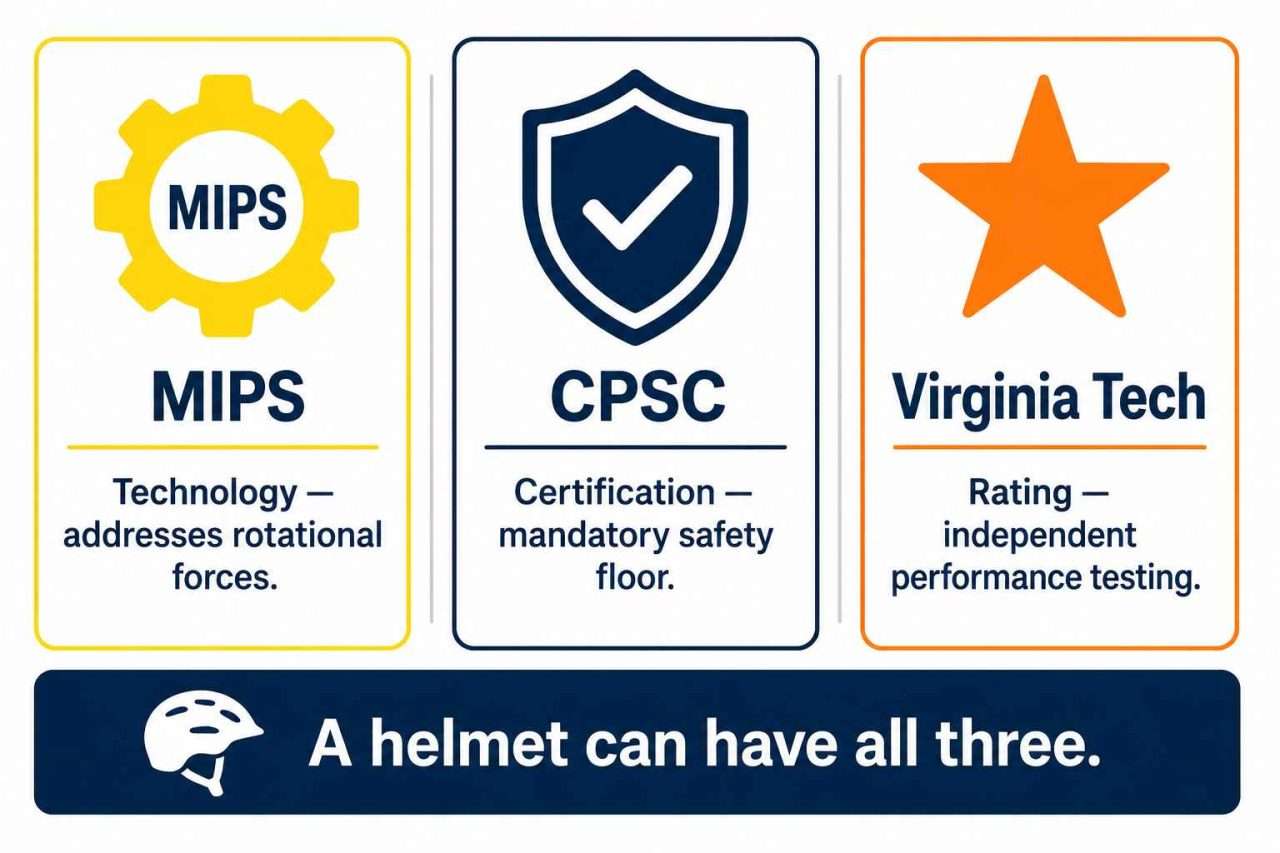
The take-away here is simple. CPSC tells you the helmet is legal. Virginia Tech tells you how well it performed in independent testing.
MIPS tells you it has a specific technology installed to address rotational forces. They’re three completely different things, and understanding that distinction will make you a much sharper helmet buyer.
For a broader look at how all bicycle helmet safety standards work and relate to each other, take a look at our complete guide to bicycle helmet safety standards.
How Do You Spot MIPS on a Helmet?
Identifying whether a helmet has MIPS is straightforward once you know what to look for. On the outside of the helmet, look for a small yellow dot, usually on the rear or side of the shell. This is the MIPS brand marker, similar to how you’d spot an Intel sticker on a laptop lid.
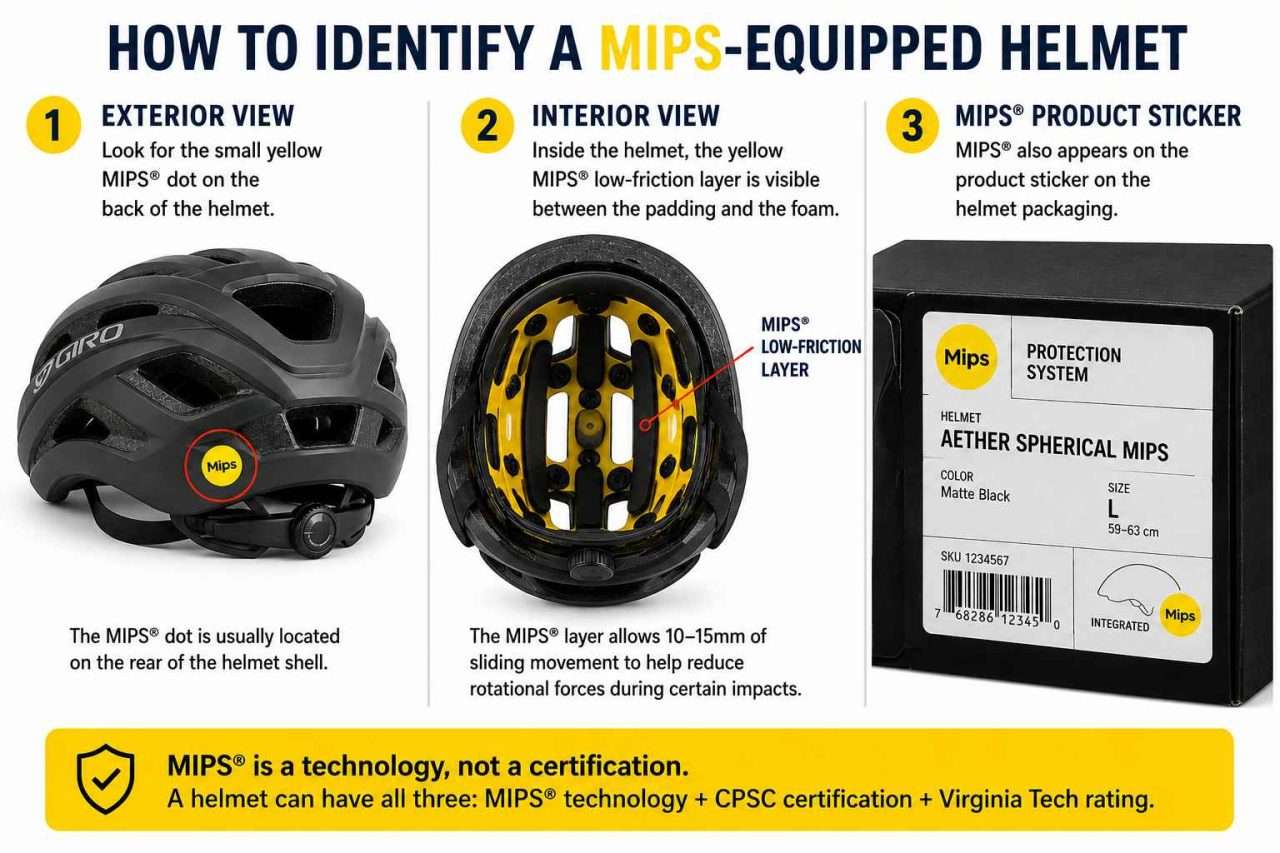
Inside the helmet, you’ll often see a thin yellow or sometimes translucent plastic liner sitting between the comfort pads and the EPS foam. That’s the low-friction layer. Not all MIPS implementations look the same, though.
Giro’s Spherical helmets, for example, use a ball-and-socket design with two separate EPS foam layers rather than a visible plastic liner. The concept is the same (one layer moves relative to the other), but the hardware looks different.
Helmet packaging and product pages will also state “MIPS” or “MIPS-Equipped” prominently. This is marketing, not certification language. It means the helmet manufacturer has licensed and integrated MIPS technology into that specific model and size, and every model-size combination is individually tested at the Mips AB test laboratory in Sweden before integration is approved.
Is a MIPS Certified Bike Helmet Safer Than One Without MIPS?
This is the question everyone really wants answered, and the honest answer is: it depends, and there are caveats.
There is peer-reviewed research suggesting that helmets with low-friction layers like MIPS can reduce rotational forces transferred to the head during angled impacts. A 2019 study published in the Annals of Biomedical Engineering found that MIPS and similar technologies (including POC’s SPIN system) provided measurable improvements in absorbing rotational energy compared to control helmets without such systems.
On the other hand, the Bicycle Helmet Safety Institute (BHSI) notes that a 2020 study in Traffic Injury Prevention found no statistically significant benefit from rotational mitigation technologies when the test headform included a realistic scalp layer. That’s a meaningful finding because it suggests the scalp may already provide some of the sliding function that MIPS aims to replicate.
The question remains whether laboratory improvements translate directly to fewer real-world brain injuries. No large-scale field study has definitively proven that MIPS-equipped helmets reduce concussion rates in actual cycling crashes. That doesn’t mean the technology is useless, but it does mean the evidence is still developing and common sense should guide your decision alongside the data.
Does MIPS Only Apply to Bicycle Helmets?
Not by a long shot. While cycling helmets are the category where most people first encounter the MIPS brand, the technology now appears across snow sports, equestrian, motorcycle, climbing, and even construction safety helmets.
In the industrial safety space, construction helmets from brands like Ergodyne and HexArmor integrate MIPS technology while also meeting their own mandatory certification standards, ANSI/ISEA Z89.1 in the US and EN 397 in Europe. Again, MIPS is the add-on technology, not the certification itself. The construction helmet still has to pass ANSI or EN 397 on its own merits.
In December 2025, Mips AB expanded further by acquiring Koroyd, a Monaco-based impact protection company, for EUR 40 million. Koroyd is now a Mips AB subsidiary, and the two technologies are complementary: MIPS addresses rotational forces while Koroyd uses a collapsible cellular structure to manage impact energy.
What Should You Actually Look for When Buying a Helmet?
First and foremost, make sure any bicycle helmet you buy carries a valid safety certification for your country. In the US, that means CPSC 16 CFR Part 1203, in Europe it’s EN 1078, and in Australia it’s AS/NZS 2063.
That’s non-negotiable. Without it, the helmet isn’t legally compliant and hasn’t been tested to meet minimum safety requirements.
Beyond that baseline certification, a technology like MIPS is a reasonable upgrade to consider if you’re a regular rider. Most MIPS-equipped bicycle helmets cost only $15 to $30 more than their non-MIPS equivalents. That’s not exactly breaking the bank for what the research suggests could be added protection against rotational forces.
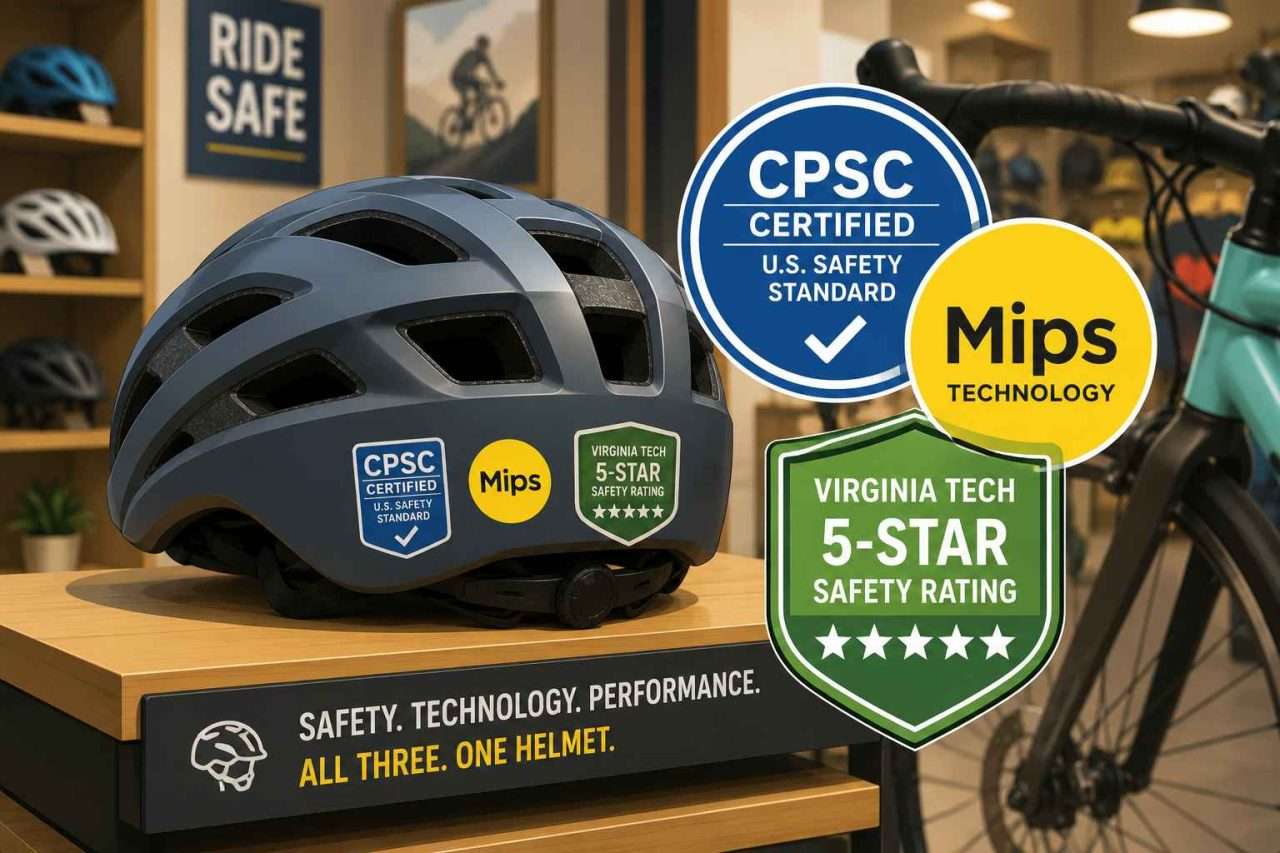
And don’t overlook independent testing. The Virginia Tech STAR rating system is the most respected independent helmet evaluation available, testing for both linear and rotational performance. A helmet with a 5-star Virginia Tech rating and CPSC certification gives you both the mandatory safety floor and evidence of above-average performance.
Some of those 5-star helmets happen to have MIPS. Some don’t. The rating is what matters most when comparing one helmet to another.
For a detailed look at how MIPS rotational protection actually works at the mechanical level, our technology explainer has you covered.
So, to circle back to where we started: MIPS is not a certification. It’s a commercially licensed technology developed by a Swedish company, built into helmets by the manufacturers who choose to use it. It doesn’t replace your helmet’s actual safety certification and it doesn’t guarantee concussion prevention.
What it does is add a specific engineering approach to reduce rotational forces in angled impacts. Your helmet’s safety certification is the floor. Everything on top of that floor, MIPS included, is an informed choice.
Frequently Asked Questions
Is MIPS necessary for a bike helmet?
That said, the CPSC test only measures straight-on, linear impacts. Many real-world bike crashes involve angled impacts that twist your head, and that rotational force is what research has linked to concussions. MIPS and similar technologies are specifically designed to reduce those rotational forces, so while they’re not “necessary” in a legal sense, they address a real gap in what standard testing covers.
The point being, a CPSC-certified helmet without MIPS is still far better than no helmet at all. But if you can swing the extra $15 to $30 for a MIPS-equipped model, you’re getting a meaningful layer of added protection against the kind of impacts you’re most likely to experience.
Which bike helmet should I buy?
A good place to start is the Virginia Tech Helmet Lab’s bicycle helmet ratings. They independently test helmets for both linear and rotational impact performance and rate them on a 5-star scale. Look for a helmet rated 4 or 5 stars and you’ll know it performed well in real-world impact scenarios.
The single most important thing, though, is fit. A top-rated helmet that sits wrong on your head won’t do its job. Measure your head circumference just above your ears, check the manufacturer’s size chart, and make sure it sits level and snug without pressure points. If it doesn’t fit, send it back and try another one.
Does a bike helmet need MIPS?
So technically, no, your bike helmet doesn’t “need” MIPS. But here’s the common sense argument: most cycling crashes don’t involve your head dropping straight down onto a flat surface. You slide, you tumble, you hit the pavement at an angle. Those angled impacts create rotational forces that strain and stretch brain tissue, and that’s the mechanism most closely linked to concussion. MIPS adds a low-friction layer inside the helmet that allows it to slide about 10 to 15mm on impact, reducing some of that rotational energy before it reaches your brain.
Your helmet doesn’t “need” MIPS the way it needs to be CPSC-certified. But MIPS addresses a type of impact force that standard certification testing doesn’t even measure, and that’s worth knowing when you’re choosing between two helmets on the shelf.
Why get a MIPS helmet?
MIPS (Multi-directional Impact Protection System) uses a thin, low-friction liner inside the helmet that lets it rotate slightly on impact, about 10 to 15mm in any direction. That small movement helps redirect rotational energy away from your brain. Independent testing backs this up. The Virginia Tech Helmet Lab tests helmets for both linear and rotational impact performance, and helmets with MIPS consistently rank among the top performers.
The cost difference is usually modest. You can find well-reviewed MIPS helmets starting around $50 to $75. When the price gap between a standard helmet and one with MIPS is that small, and the technology targets the exact forces most associated with concussion, it’s a pretty straightforward decision.
Why are MIPS helmets better?
Independent testing supports this. The Virginia Tech Helmet Lab rates bicycle helmets on a 5-star scale that accounts for both linear and rotational impact performance. Helmets with MIPS or similar rotational protection systems consistently dominate the top of those rankings. When Virginia Tech first started rating bike helmets in 2018, only 4 out of 30 helmets earned 5 stars. By 2025, that number had jumped to 167 out of 272, largely driven by the widespread adoption of rotational protection technologies.
It’s worth noting that MIPS isn’t the only system that does this. Lazer’s KinetiCore, POC’s SPIN pads, and Bontrager’s WaveCel all tackle rotational forces in different ways. The point being, look for a helmet with some form of rotational protection, not just a specific brand name.
Which helmets have MIPS?
MIPS isn’t just a feature on high-end helmets either. Budget-friendly models like the Specialized Align II and the Giro Fixture MIPS II come in well under $100 and use the same core MIPS technology found in premium helmets. The easiest way to tell if a helmet has MIPS is to look for the yellow MIPS logo on the outside and the characteristic yellow low-friction liner on the inside.
If you want to compare specific models, the Virginia Tech Helmet Lab’s bicycle ratings page lists hundreds of tested helmets with their safety scores, and you can filter by features to find MIPS-equipped options that suit your riding style and budget.
Are MIPS bike helmets safer?
The caveat is this: no helmet is concussion-proof. Virginia Tech says so directly on their ratings page, and it’s important not to overclaim. A MIPS helmet reduces your risk of concussion in certain impact scenarios, but it can’t eliminate it. Every crash is different, and factors like impact speed, angle, and your own biology all play a role.
Not only that, but MIPS isn’t the only way to get rotational protection. Lazer uses KinetiCore, which builds crumple zones directly into the foam. Bontrager uses WaveCel, a collapsible cellular structure. Some high-scoring helmets from Kask use no slip-plane system at all and still test well. So, are MIPS helmets safer than a basic helmet with no rotational protection? The data strongly suggests they are. Are they automatically the safest helmet you can buy? Not necessarily. Check the Virginia Tech ratings and let the numbers do the talking.