10 Rotational Impact Protection Systems Explained
The Short Version: Rotational impact protection systems are helmet technologies designed to reduce rotational forces transferred to the brain during angled impacts. At least 10 distinct systems are currently used in bicycle helmets, including MIPS, WaveCel, KinetiCore, SPIN, Koroyd, and the Release Layer System.
Each system uses a different mechanical approach — slip liners, collapsible cellular structures, integrated crumple zones, or exterior rolling mechanisms — to allow the helmet to move relative to the head on impact. Standard EPS foam primarily addresses linear forces. These technologies add a second layer of defense against concussion-causing brain rotation.
Traditional bicycle helmets were designed to stop your skull from cracking open after a fall. They do that well. However, most cycling crashes don’t involve a straight-down hit like an apple falling from a tree.
More often than not, your head hits the ground at an angle, it slides, and the sudden change in direction sends rotational forces through your brain. That twisting motion causes a specific type of damage that old-school foam alone was never built to handle.
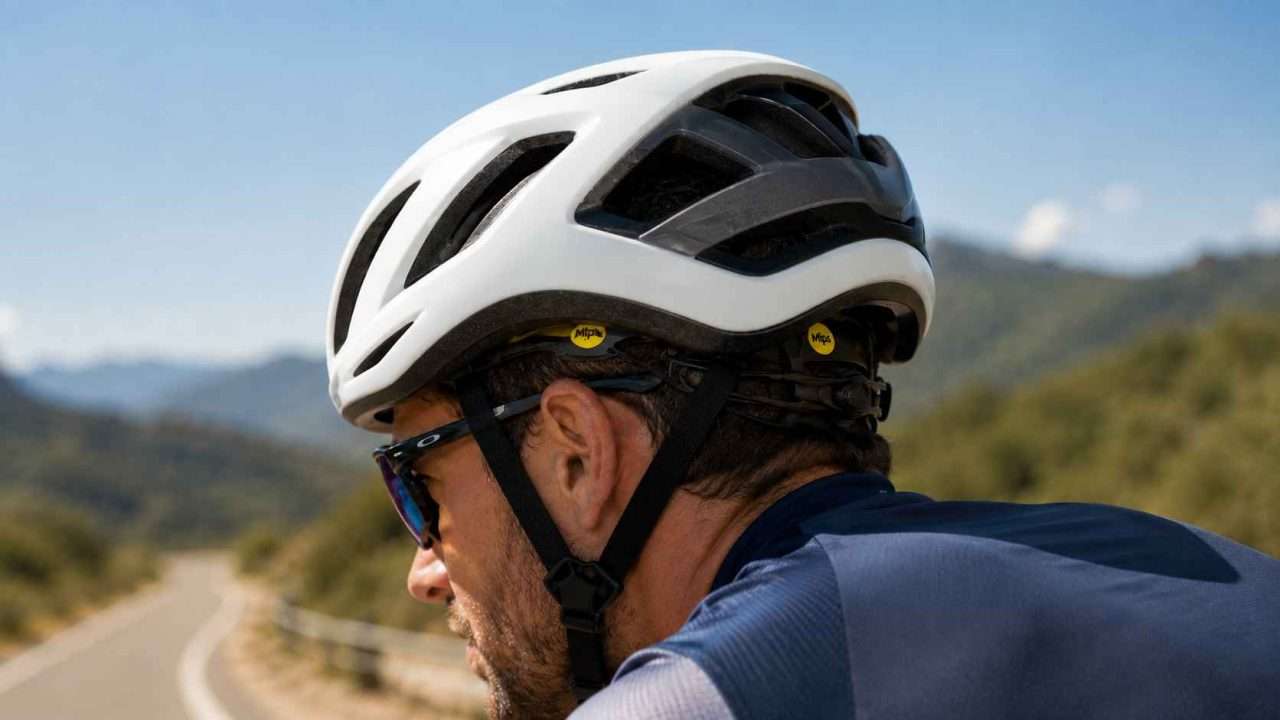
Enter MIPS. You’ve heard of MIPS. You’ve probably seen the stickers on a variety of helmets. You’ve heard that MIPS can provide ‘extra protection’, but you’re still not sure what it’s all about. So, what if I were to tell you that there are now at least 10 different ‘Rotational Impact Protection Systems’ available offering that ‘extra protection’?
So now you’re wondering, what are these rotational protection technologies, how do they differ, and do they actually work? Let’s take a look.
What Are Rotational Forces and Why Should You Care?
Every bicycle helmet sold in the US has to pass the CPSC standard (16 CFR Part 1203). That standard tests for linear impact, meaning a straight-on hit. Drop a helmeted headform onto a flat anvil, measure the g-forces, and if the number stays below the threshold, the helmet passes.
Simple enough.
The problem is that real-world cycling crashes rarely produce a clean, perpendicular impact. Research consistently shows that the majority of cycling accidents involve oblique collisions, where the head strikes the ground at an angle. When that happens, two things occur simultaneously: the linear force tries to dent your skull inward, and the angular force tries to rotate your brain inside it.
Traditional EPS (Expanded Polystyrene) foam, that white packaging material you’ve seen protecting your new TV in the box, handles the first force well. It crushes on impact, absorbing energy. But it does almost nothing about the second.
Rotational impact protection systems are technologies designed specifically to address those angular forces. They sit inside (or in some cases, outside) the helmet and work to reduce the amount of rotational acceleration that reaches your brain during an angled hit. The differences between them come down to how they achieve that goal.
How Does Rotational Force Actually Injure Your Brain?
Your brain floats inside your skull in cerebrospinal fluid (CSF), a clear liquid that acts as a natural shock absorber. Think of it like an egg yolk suspended in egg white inside the shell. Under normal conditions, the CSF cushions your brain against everyday bumps and jolts.
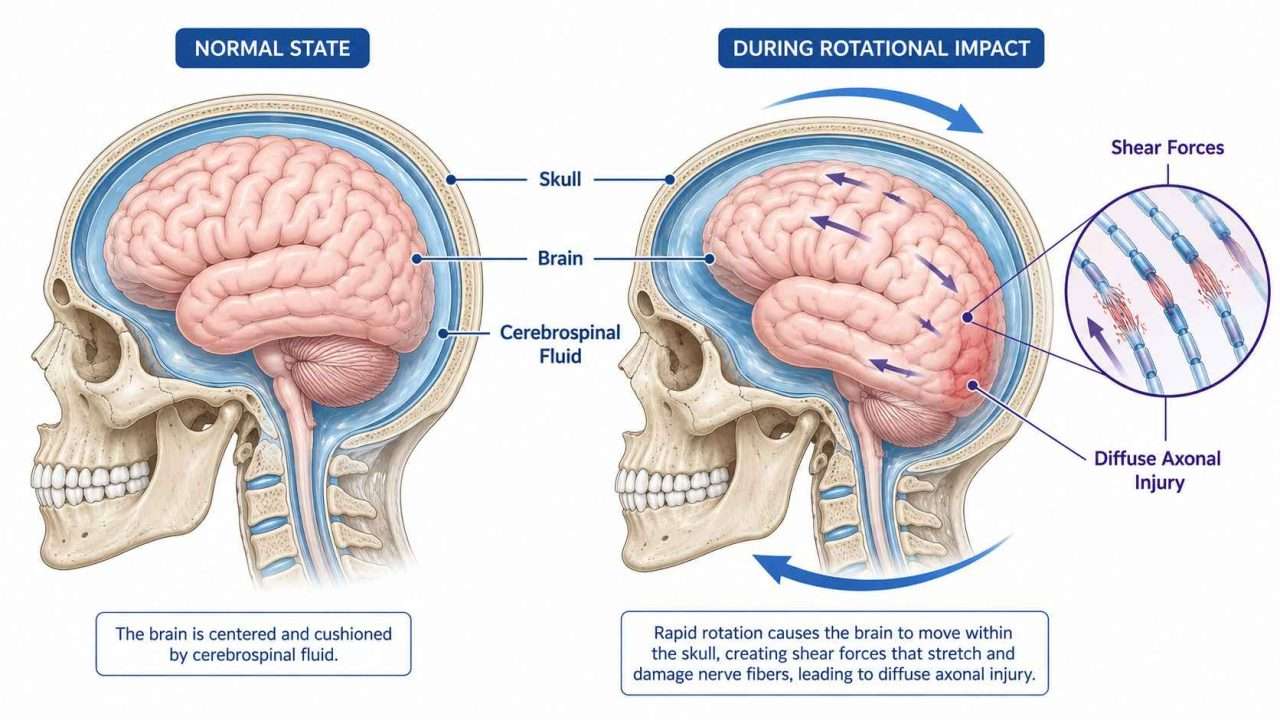
But when your head suddenly rotates from an angled impact, the skull stops or changes direction while the brain, suspended in that fluid, keeps moving. This creates shear forces, stretching and tearing the delicate nerve fibers that connect different parts of your brain. The medical term is diffuse axonal injury (DAI), and it’s the mechanism behind most concussions and many traumatic brain injuries (TBI).
Unlike a skull fracture, which shows up on an X-ray, diffuse axonal injury is invisible to most imaging. You can walk away from a crash looking perfectly fine and still have damage that takes weeks or months to heal.
The Head Injury Criterion (HIC) has been used for decades to assess head injury risk, but it was originally developed around linear acceleration. As research into the science behind rotational brain injuries has advanced, scientists now measure angular acceleration and angular velocity as separate, equally important indicators of brain injury risk. That shift in understanding is what sparked the entire rotational protection industry.
Where Did Rotational Impact Protection Start?
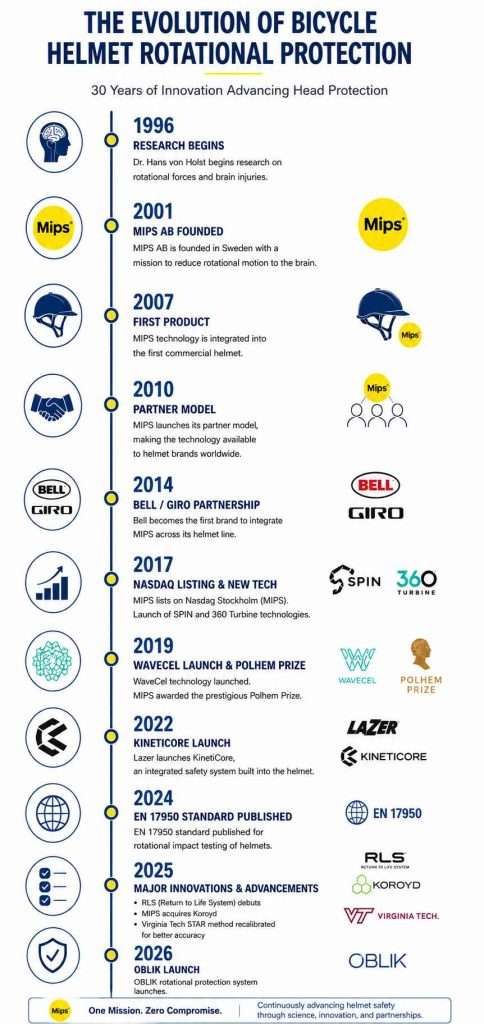
The story begins in the mid-1990s with a Swedish neurosurgeon named Hans von Holst. Working with helmeted accident victims, von Holst noticed something troubling: patients were still suffering serious brain trauma despite wearing helmets that had done exactly what they were designed to do. The shells were intact, the foam had crushed properly, but the patients’ brains were damaged anyway.
He realized that the rotational component of impacts was being completely ignored.
In 1995, von Holst recruited Peter Halldin, a doctoral student in biomechanics at KTH Royal Institute of Technology in Stockholm, to help find a solution. What followed was years of research, testing, and fundraising.
In 2001, they formed MIPS AB (Multi-directional Impact Protection System) with a team of five biomechanics specialists, and the serious R&D work accelerated to thousands of tests.
It took twelve years from the initial idea to the first marketable product. In 2007, MIPS released the BPS (Brain Protection System) in an equestrian helmet, produced in-house under their own brand. By 2010, they made a business model pivot that changed the industry: instead of manufacturing their own helmets, they released the BPS as a component framework that partner brands could install in their own production lines.
That decision opened the floodgates.
By the end of 2013, eight helmet brands had signed on, with MIPS installed in 30 models. In early 2014, a partnership with BRG Sports (parent company of Bell and Giro) doubled the brand count. MIPS expanded into road motorcycle helmets in 2016, listed on Nasdaq Stockholm in 2017 with 60 brand partners and 302 helmet models, expanded into rock climbing in 2018, and added ice hockey in 2019.
On November 6, 2019, founders Peter Halldin, Hans von Holst, and Svein Kleiven received the Swedish Engineers Polhem Prize at the Polhemsfesten in Stockholm for their contribution to helmet safety.
In December 2025, Mips AB acquired Koroyd for EUR 40 million, bringing together rotational and linear impact protection under one roof. More on that below.
How Does the MIPS Slip-Plane System Work?
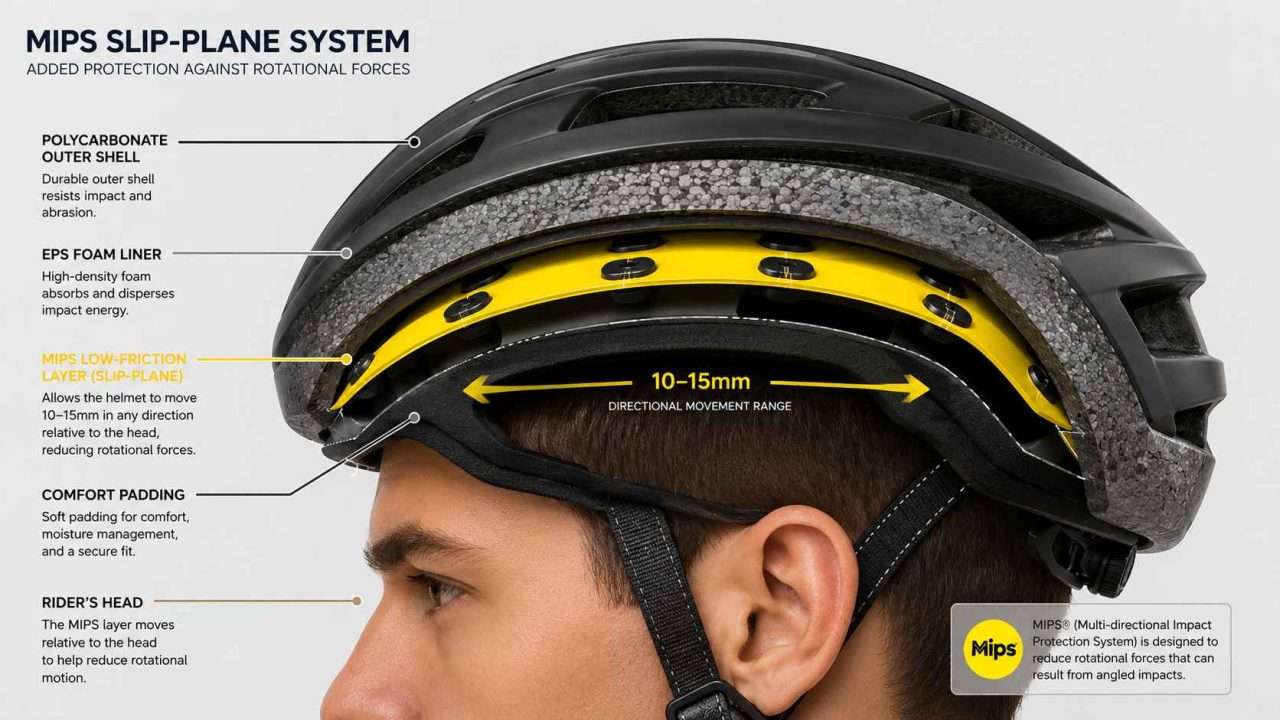
The core concept behind MIPS is surprisingly intuitive. Your brain has a built-in protection system: it floats in cerebrospinal fluid, which allows it to move slightly within the skull. MIPS mimics that principle by adding a low-friction layer between the helmet’s EPS foam liner and your head.
Here’s a simple way to feel how it works. Make a fist with one hand (that’s your head). Cover it tightly with your other hand (that’s a traditional helmet).
Now push both hands onto a desk and slide sideways, as if simulating a crash. Your outer hand drags your fist into rotation, and that jarring twist is what reaches your brain. Now picture a third layer between them: a slippery surface that lets the outer shell slide 10 to 15 millimeters in any direction without dragging your head along for the ride.
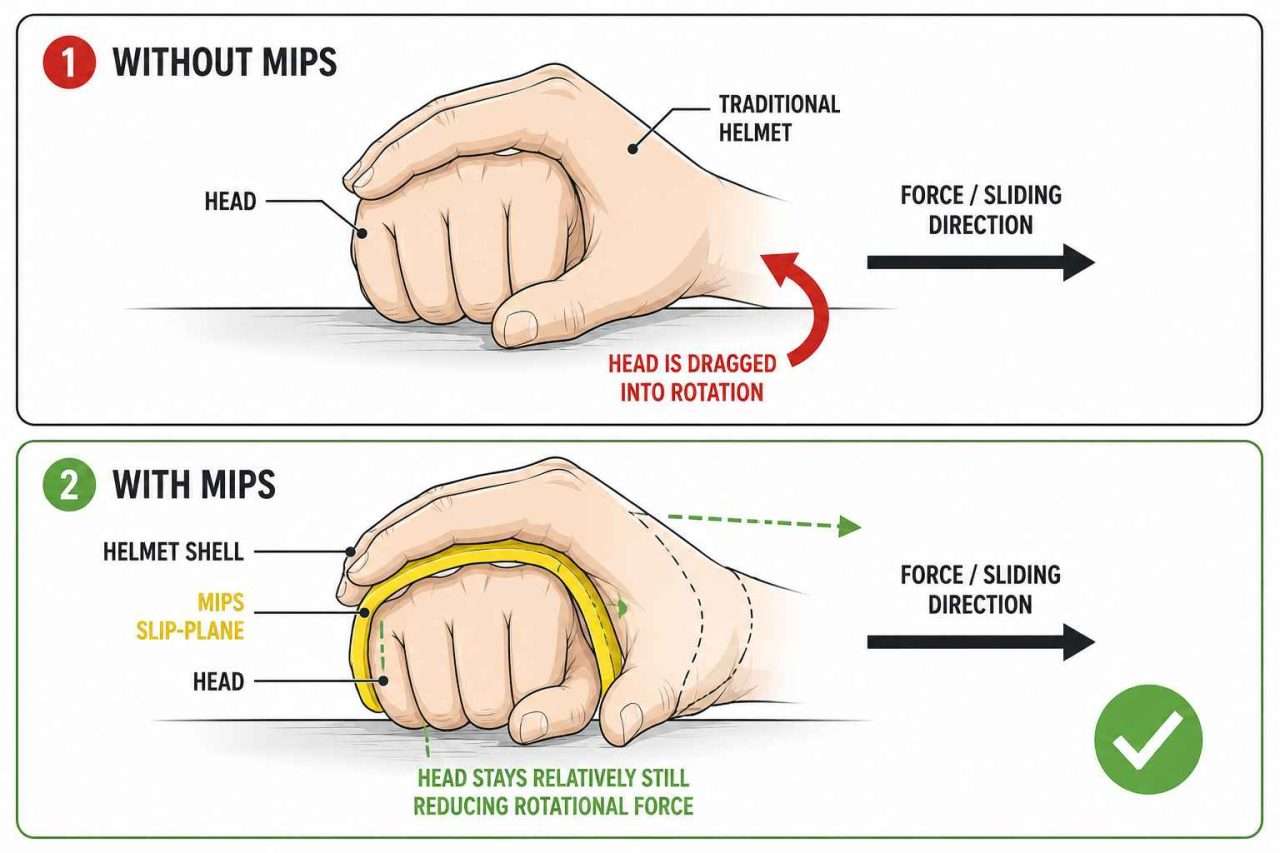
That’s the slip-plane. The outer shell can move front-to-back, side-to-side, or in any combination, absorbing and redirecting rotational energy before it reaches your skull.
For a deeper look at the mechanics, product variants, and the full founding story, see our dedicated breakdown of how the MIPS slip-plane system works. It’s also worth understanding why MIPS is a technology, not a safety certification, something that causes a lot of confusion among buyers.
What Other Rotational Protection Technologies Are Available?
MIPS opened the door, but the competition has followed with some genuinely different approaches. Not all of these work the same way, and that’s actually a good thing. Different engineering solutions tackle the same physics problem from different angles.
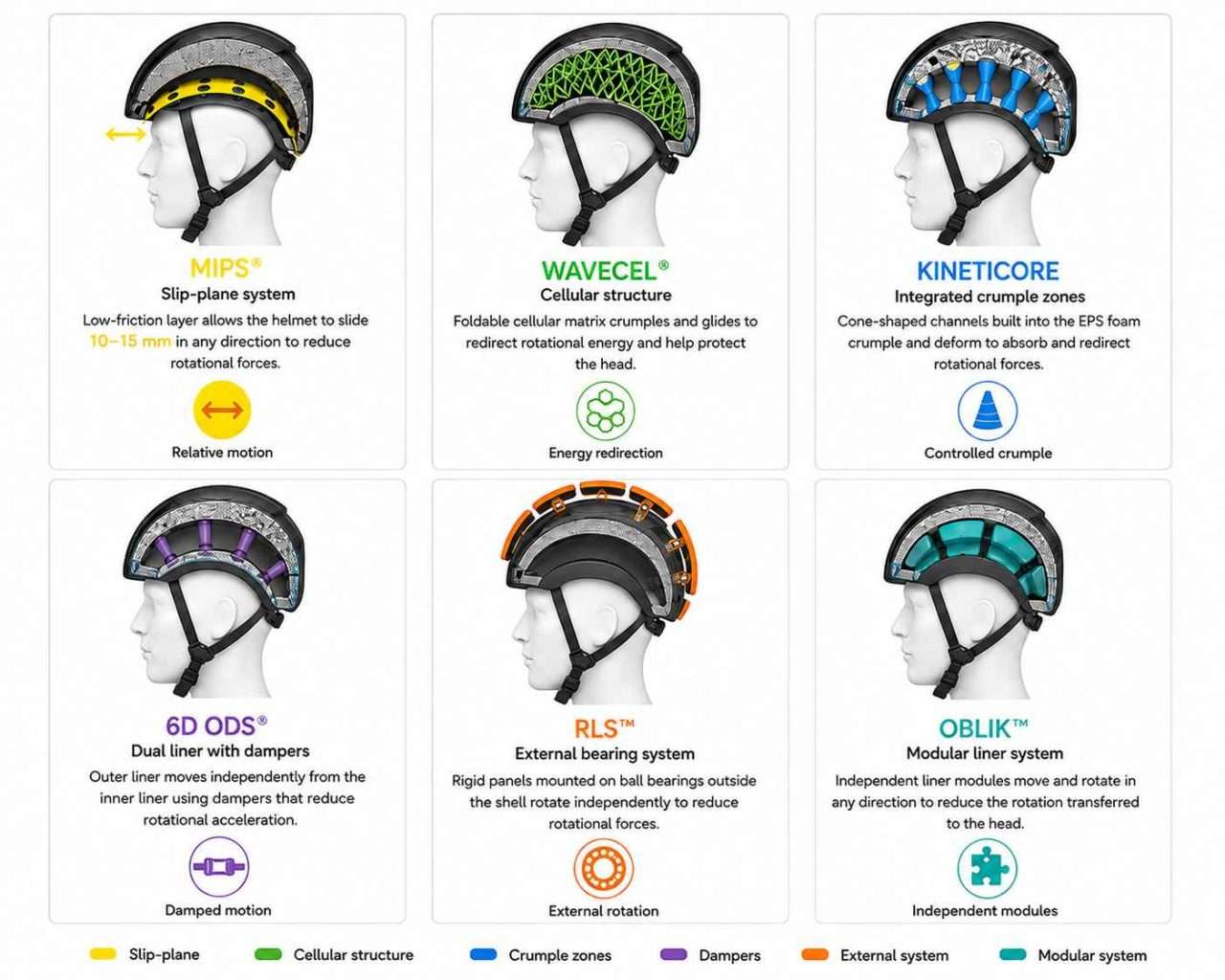
Here’s a rundown of the major players.
WaveCel (Bontrager / Trek)
WaveCel is a collapsible cellular structure that lines the inside of the helmet, replacing most of the traditional EPS foam. Think of it like a network of hundreds of tiny, interconnected shock absorbers. On impact, the material goes through three stages: the cells flex to reduce initial friction, then crumple like a car’s crumple zone to absorb energy, then glide to redirect rotational force away from your head.
It was developed by Dr. Michael Bottlang, a biomedical engineer, and Dr. Steve Madey, an orthopedic surgeon, and was the first helmet technology to receive funding from the US National Institutes of Health.
POC SPIN (Shearing Pad INside)
Swedish brand POC developed SPIN as an in-house alternative to MIPS, using silicone-filled pads placed at strategic locations inside the helmet. During an angled impact, the silicone shears, allowing the helmet to move relative to the head. The advantage was simplicity: it added almost no weight, didn’t block ventilation, and allowed for a closer-fitting helmet.
However, after a patent dispute with MIPS in 2017 (settled in 2018), POC announced it would phase out SPIN and transition back to MIPS, specifically the co-developed MIPS Integra system. You can still find older POC models with SPIN, but new POC helmets use MIPS.
Koroyd (Now a MIPS Subsidiary)
Koroyd uses a lattice of thousands of tiny, thermally welded tubes (imagine a cross-section of a honeycomb). On impact, the tubes crush in a controlled, progressive manner, absorbing linear energy very efficiently. Koroyd was primarily designed to handle straight-on forces rather than rotational ones, which is why many helmets that use Koroyd (like certain Smith and Endura models) also include a MIPS liner for rotational protection.
Since Mips AB acquired Koroyd in December 2025, the two technologies are now under the same roof. The combination of Koroyd for linear energy absorption and MIPS for rotational protection is a pairing to watch closely.
Lazer KinetiCore
KinetiCore takes a different approach entirely. Instead of adding a separate layer or component to the helmet, Lazer built the rotational protection directly into the EPS foam itself. Cone-shaped “controlled crumple zones” are molded into the foam structure.
On impact, these cones buckle and deform, absorbing both linear and rotational energy simultaneously. Because the system is integrated rather than added on, KinetiCore helmets tend to be lighter (Lazer claims 24% lighter in some models) and use less plastic than their previous MIPS-equipped versions.
6D ODS (Omni-Directional Suspension)
6D’s ODS system uses a dual-liner design connected by elastomeric isolation dampers. The inner EPS liner sits inside an outer EPP (Expanded Polypropylene) liner, which you’ll recognize from reusable packaging and bottle caps. The dampers between the two layers allow the inner liner to move independently in all six degrees of freedom: forward, backward, left, right, up, down, plus rotation around each axis.
This system was originally developed for motocross and won the Grand Prize in the NFL’s Head Health Challenge III. It’s now in its fifth generation.
RLS (Release Layer System)
RLS flips the script on most rotational protection systems by working on the outside of the helmet rather than the inside. Developed by engineers in London and first brought to market by Canyon in their Deflectr helmet, RLS uses external panels that sit on top of hundreds of tiny polycarbonate ball bearings (about 2mm across). On impact, the panels release and roll, redirecting rotational energy away from the brain.
Testing at the University of Strasbourg found that RLS-equipped helmets reduced peak rotational velocity by an average of 57 to 66 percent compared to the same helmets without RLS.
Pikio Oblik
The newest arrival on the scene, Oblik comes from Canadian startup Pikio Labs. Instead of a single foam liner, Oblik splits the shock-absorbing structure into independently moving modules connected by a flexible nodal system. Think of it as breaking the helmet’s interior into smaller pieces that can each respond to the direction and severity of an impact independently.
The Pikio Si helmet, the first to feature Oblik, scored 4.61 on Virginia Tech’s STAR rating system in early 2026, more than two points ahead of the next best helmet. That’s not an incremental improvement.
Leatt 360° Turbine
Leatt, the South African company best known for neck braces, developed its 360° Turbine Technology in-house. Small, disc-shaped turbines made from Armourgel (a non-Newtonian material that hardens on impact) are placed directly against the skull inside the helmet. On impact, the turbines deform and bend, working both as a slip-plane for rotational forces and as an energy absorber for low-speed linear hits.
Leatt claims the system reduces rotational acceleration by up to 40% and linear impact at concussion level by up to 30%. Every Leatt helmet includes this technology, including their most affordable models.
Kali LDL (Low Density Layer)
Kali Protectives uses a Low Density Layer, a softer, lower-density foam layer that sits between the main EPS liner and the rider’s head. The idea is that this softer layer compresses during lower-energy impacts, the kind that are most commonly associated with concussions, while the denser EPS handles higher-energy hits. Kali has long been a proponent of addressing the full spectrum of impact energies rather than focusing on a single threshold.
How Do These Technologies Compare Side by Side?
With this many systems on the market, a comparison table helps cut through the noise. Keep in mind that independent lab results (particularly from Virginia Tech’s STAR rating system) are the most reliable performance indicator, but they test specific helmet models, not technologies in isolation. A MIPS helmet from one brand can score very differently from a MIPS helmet from another.
| Technology | Mechanism | Position in Helmet | Handles Rotational? | Handles Linear? | Typical Price Premium |
|---|---|---|---|---|---|
| MIPS | Low-friction slip-plane (10–15mm movement) | Internal, between foam and head | Yes | No (EPS handles this) | $10–$25 over non-MIPS equivalent |
| WaveCel | Collapsible cellular structure (flex, crumple, glide) | Internal, replaces most EPS | Yes | Yes | $20–$50 over standard models |
| SPIN (POC, phasing out) | Silicone-filled shearing pads | Internal, pad-based | Yes | No | $20–$40 over non-SPIN |
| Koroyd | Thermally welded tube lattice (crush-on-impact) | Internal, replaces or supplements EPS | Minimal (pairs with MIPS) | Yes | $30–$60 (premium helmets) |
| KinetiCore (Lazer) | Integrated EPS crumple zone cones | Built into the foam structure | Yes | Yes | Comparable to MIPS models |
| 6D ODS | Dual-liner with elastomeric dampers (6 degrees of freedom) | Internal, between two liners | Yes | Yes | $50–$100+ (premium segment) |
| RLS | External panels on polycarbonate ball bearings (release and roll) | External, on the outer shell | Yes | No (EPS handles this) | $20–$40 (limited models) |
| Pikio Oblik | Modular independently-moving liner modules with flexible nodes | Internal, replaces single foam liner | Yes | Yes | $379 (premium, DTC only) |
| Leatt 360° Turbine | Armourgel disc turbines (deform, bend, slip) | Internal, against the skull | Yes | Yes (low-speed) | Included in all Leatt models |
| Kali LDL | Low-density foam layer (compresses at lower energy thresholds) | Internal, between EPS liner and head | Partial (reduces low-energy transfer) | Yes (low-to-mid speed) | Included in Kali models |
One pattern worth noting: the newer systems (KinetiCore, RLS, Oblik) tend to integrate rotational protection more deeply into the helmet’s structure rather than adding it as a separate component. Whether integrated or add-on approaches perform better in practice depends heavily on the specific helmet design.
RELATED: Are Expensive Bike Helmets Worth It?
Price vs protection explained. Let’s break down the facts so you can make a smart choice and enjoy peace of mind when cycling.
Is the MIPS Slip-Plane Still the Market Leader?
In terms of market share, yes, and it’s not even close. By the end of 2017, MIPS was in 302 helmet models across 60 brand partners with 5.4 million cumulative units sold. By the end of 2018, that figure had grown to 9.2 million.
The numbers have only climbed since. The acquisition of Koroyd in late 2025 further strengthened Mips AB’s position as the dominant player in helmet safety technology.
But market share and performance are two different things. The question of whether MIPS is worth the extra cost depends on how you look at it. MIPS helmets consistently perform well in Virginia Tech testing, but they don’t always hold the top spot.
The Pikio Si with Oblik technology and the Canyon Deflectr with RLS have both outscored MIPS-equipped helmets in recent testing rounds. What MIPS does have is ubiquity: you can find a MIPS helmet in almost any style, any size, and at almost any price point. That availability matters when you’re talking about a technology that only works if people actually buy and wear it.
For a practical buying guide across price points, take a look at the current MIPS helmet options and our guide to MIPS options for mountain biking.
What’s Changing With Helmet Safety Standards in 2026?
For decades, no mandatory helmet safety standard anywhere in the world tested for rotational impact. That gap is finally closing. The European Committee for Standardization (CEN) has published EN 17950:2024, a test method that measures both translational and rotational kinematics when a helmeted headform strikes an angled anvil.
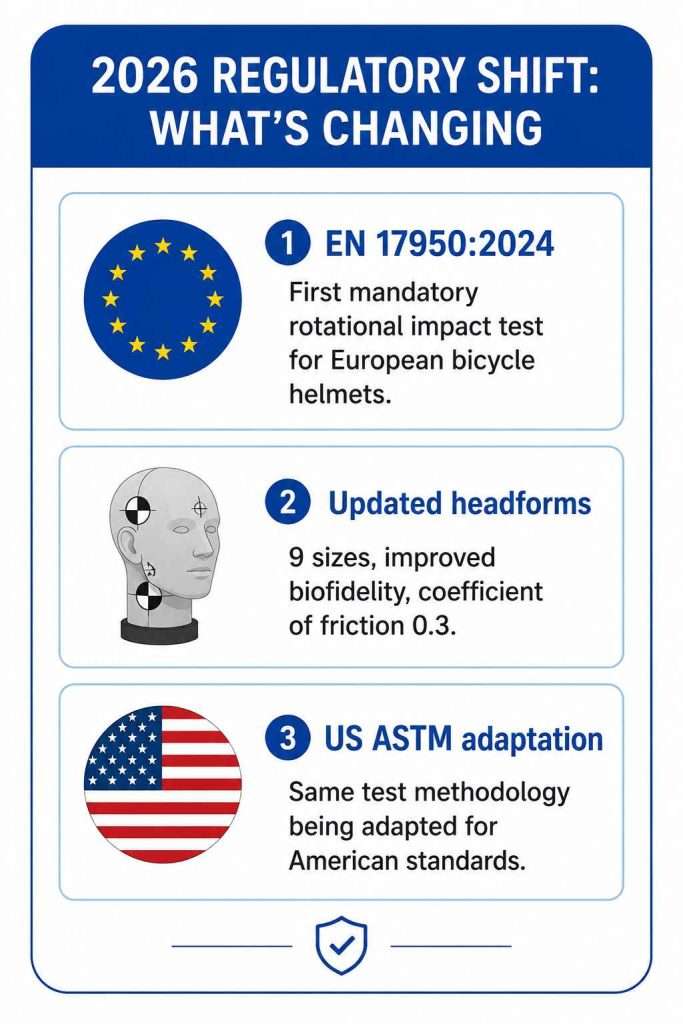
This standard is designed to replace the existing EN 1078 for bicycle helmets, and when it does, every helmet sold in Europe will need to pass mandatory oblique impact testing for the first time.
The updated standard also introduces improved headforms based on real-world human head data, with nine sizes ranging from 47 to 63 cm. These headforms are designed to be more biofidelic, meaning they behave more like an actual human head during testing, particularly when it comes to rotational movement. In the US, the ASTM has been working with the same research group to adapt the EN 17950 test methodology for American standards, though no firm implementation timeline has been announced.
The point being, rotational testing is moving from voluntary add-on to regulatory requirement. Technologies like MIPS, WaveCel, KinetiCore, RLS, and Oblik, which were developed ahead of the standards, are now positioned to become necessities rather than premium options.
How Do You Choose the Right Rotational Protection System?
With all these competing technologies, the common sense approach is to focus on outcomes rather than mechanisms. Here’s what that looks like in practice.
First, check the Virginia Tech STAR ratings. This is the most respected independent helmet testing program available to consumers, and it measures both linear and rotational performance. Virginia Tech’s bicycle helmet rating program, originally launched in 2018 in collaboration with the Insurance Institute for Highway Safety, was recalibrated in July 2025.
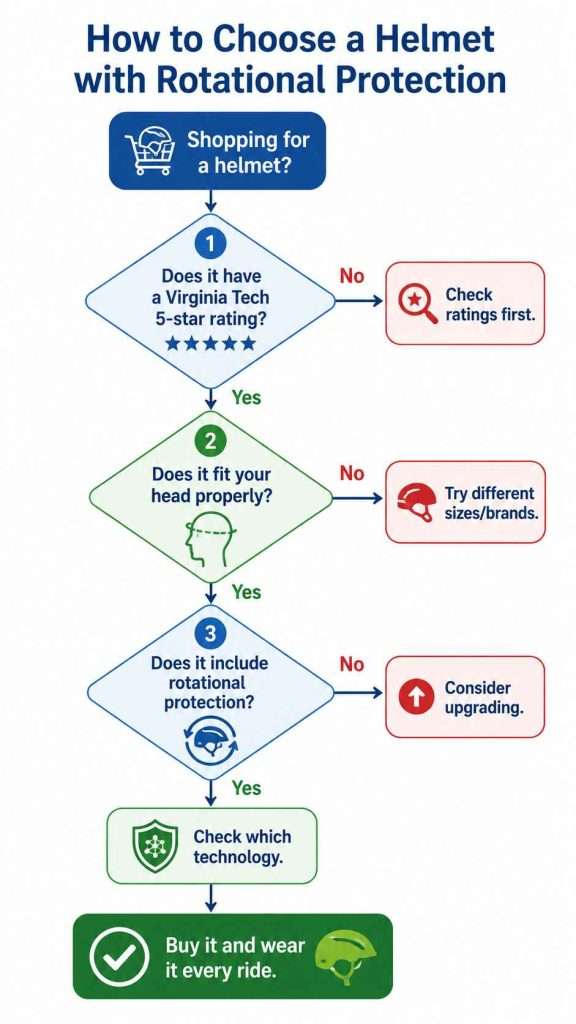
The bar went up significantly, making a 5-star rating genuinely meaningful. Look for helmets that score well under the current (post-recalibration) system, not the old one.
Second, fit matters more than any technology label. A rotational protection system only works if the helmet stays properly positioned on your head. A loose helmet can shift on impact, and a tight one can concentrate force on pressure points.
No amount of MIPS or WaveCel or Oblik can compensate for a helmet that doesn’t fit your head.
Third, don’t get locked into brand loyalty. The best-performing helmet on Virginia Tech’s list might not be from the brand you’ve been buying for years. The Pikio Si, from a company most people hadn’t heard of six months ago, currently holds the top spot.
RELATED: What Are Bicycle Helmets Made Of?
Curious about bike helmets? What are bike helmets made of? Learn about the bike helmet material that keeps your head protected while cycling.
The Canyon Deflectr with RLS, from a brand better known for bikes than helmets, is right behind it. Check the safety standards for bicycle helmets to understand what each certification tells you, and what it doesn’t.
And finally, understand that rotational protection is just one ingredient in the safest bicycle helmet equation. It sits alongside proper fit, certified construction, adequate coverage, and the basic question of whether you actually wear the thing every time you ride. As our overview of whether bike helmets work makes clear, the best helmet in the world only protects you if it’s on your head.
What Does the Future of Rotational Protection Look Like?
The field is moving faster now than at any point in its history. When Hans von Holst first identified the rotational injury gap in the mid-1990s, he was essentially a lone voice. Thirty years later, every major helmet brand either licenses a rotational protection technology or has developed one in-house.
The Mips AB acquisition of Koroyd signals a future where linear and rotational protection may be engineered as integrated systems from the ground up, rather than bolted together from separate technologies.
The regulatory shift matters too. Once EN 17950 and its ASTM equivalent become mandatory requirements (rather than voluntary benchmarks), helmet manufacturers who haven’t invested in rotational protection will be forced to catch up. That should push innovation further and, with any luck, drive prices down as the technology becomes standard rather than premium.
So, there’s no single “best” rotational protection technology. There are multiple solid approaches, each with trade-offs. Your job as a buyer is straightforward: check the independent test scores, get a helmet that fits your head, and wear it.
Common sense hasn’t changed just because the engineering has gotten smarter.
Protect the only brain you’ve got.
Frequently Asked Questions
What is rotational impact protection?
Technologies like MIPS (Multi-directional Impact Protection System) address this by building a low-friction layer inside the helmet. In a crash, that layer allows the helmet to move 10 to 15 mm independently of your head, redirecting rotational energy away from your brain. Think of it like the cerebrospinal fluid that already surrounds your brain inside your skull. The MIPS layer is doing a similar job, acting as a buffer between your head and the helmet shell.
MIPS isn’t the only system out there. WaveCel, SPIN, and Koroyd’s own designs all take different engineering approaches to the same problem. What they share is the goal of reducing rotational acceleration, which standard helmet foam was never designed to handle on its own.
Can you get a head injury while wearing a helmet?
Helmets are very effective at preventing skull fractures and reducing the force of direct blows. Where they have historically fallen short is in managing rotational forces from angled impacts, which are the kind that cause concussions and diffuse axonal injuries. High-speed collisions, impacts involving motor vehicles, or crashes where forces exceed the helmet’s design limits can still result in serious injury even when the helmet does its job and absorbs a significant portion of the blow.
The point being, a helmet is a layer of protection, not a force field. It dramatically improves your odds, but it works best as part of a common sense approach: proper fit, timely replacement, and riding within your ability all matter.
What is a rotational head injury?
The most common result is a concussion, but more severe rotational injuries can cause what doctors call diffuse axonal injury (DAI). That’s when the connecting nerve fibers in your brain’s white matter get stretched or torn. According to the National Institutes of Health, angular acceleration during rapid deceleration is the primary force behind DAI, and rotation in the side-to-side (coronal) plane tends to cause the most severe damage.
What makes rotational injuries particularly tricky is that symptoms don’t always show up right away. Someone can walk away from a crash feeling shaken but seemingly okay, only to develop headaches, confusion, or cognitive problems hours or even days later. If you hit your head in a crash, even if you feel fine, go and see your doctor.
Does helmet padding prevent rotational brain injuries?
The problem is that EPS crushes in a straight line. When your head hits a surface at an angle, which is what happens in most cycling crashes, the foam resists the compression while the road surface grips the helmet exterior. Your skull keeps rotating underneath, and the brain, suspended in fluid, lags behind and then snaps back. Standard foam doesn’t redirect that twisting energy.
That’s exactly why technologies like MIPS, WaveCel, and SPIN were developed. They add a second layer of defense specifically targeting rotational forces, working alongside the EPS rather than replacing it. The EPS handles the linear punch, and the rotational protection system handles the twist. One doesn’t work as well without the other.
Is MIPS safer than a regular helmet?
That said, it’s worth keeping some perspective. A MIPS helmet is still built around the same EPS foam and shell construction as a regular helmet. It meets the same mandatory CPSC certification requirements. What MIPS adds is a specific layer of protection against rotational forces that standard helmets don’t address. It’s an important addition, but it isn’t magic.
So, is it worth the price premium? If you’re buying a new helmet anyway, yes. A MIPS-equipped helmet gives you measurably better protection against the kind of angled impacts that cause most concussions, and the cost difference is often modest. But a perfectly fitted non-MIPS helmet that you actually wear will protect you far better than a MIPS helmet sitting in your garage.
Which helmet is best for safety?
After that, the best comparison tool available is the Virginia Tech Helmet Lab’s STAR rating system. Virginia Tech independently tests helmets for both linear acceleration and rotational velocity and assigns star ratings based on how well they reduce concussion risk. They recommend choosing a helmet rated 4 or 5 stars. The lab operates as part of Virginia Tech’s service mission and is independent of helmet manufacturers.
Here’s the common sense part though: even a top-rated helmet won’t protect you if it doesn’t fit. A loose helmet can shift on impact. A helmet that’s too tight concentrates force on pressure points. Make sure it sits level on your head, the straps form a V under each ear, and only one finger fits between the chin strap and your chin. Then replace it after any crash or every five years, whichever comes first. Get the fit right, check the certification, look at the Virginia Tech rating, and you’re in good shape.
