Dual Certified Helmets: Two Standards, Broader Coverage
The Short Version: A dual certified helmet meets two separate safety standards – most commonly CPSC for bicycle use and ASTM F1492 for skateboarding, or ASTM F2040 for ski/snowboarding. CPSC tests for a single high-energy impact, while ASTM F1492 tests for repeated lower-energy hits using denser foam construction.
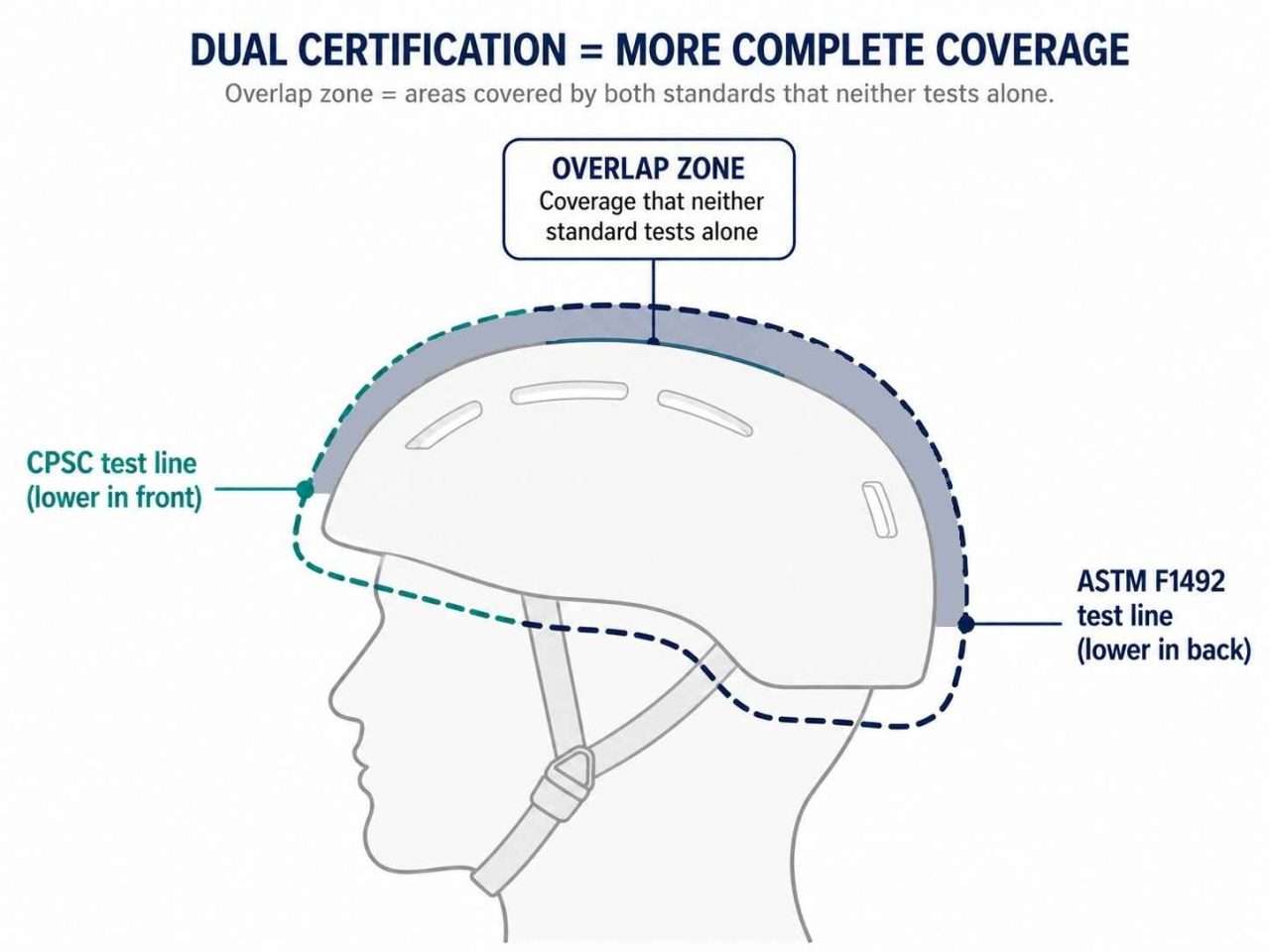
Dual certification also provides broader head coverage. The CPSC standard sets a lower test line across the front of the helmet, and ASTM F1492 sets a lower test line at the back. A “multi-sport” label is not the same as dual certification – always check for both certification stickers inside the helmet.
A few years back, my daughter wanted to ride her bike to the skate park, do some skating, and then ride home. Simple enough. Except she had two helmets hanging in the garage: one for her bike and one for her skateboard.
The idea of carrying a spare helmet in a backpack for a ten-minute ride didn’t thrill her. “Can’t I just wear one?” she asked. Good question.
The short answer is yes, but only if that one helmet carries the right certification stickers for both activities. That’s what a dual certified helmet is: a single helmet that has been independently tested and certified to meet the safety standards for two different sports or activities.
Not a helmet that simply looks like it belongs in two worlds. A helmet that has actually passed the tests for both.
So what does dual certification actually involve, and why can’t you just use any helmet for everything? Let’s take a look.
What Does Dual Certified Actually Mean?
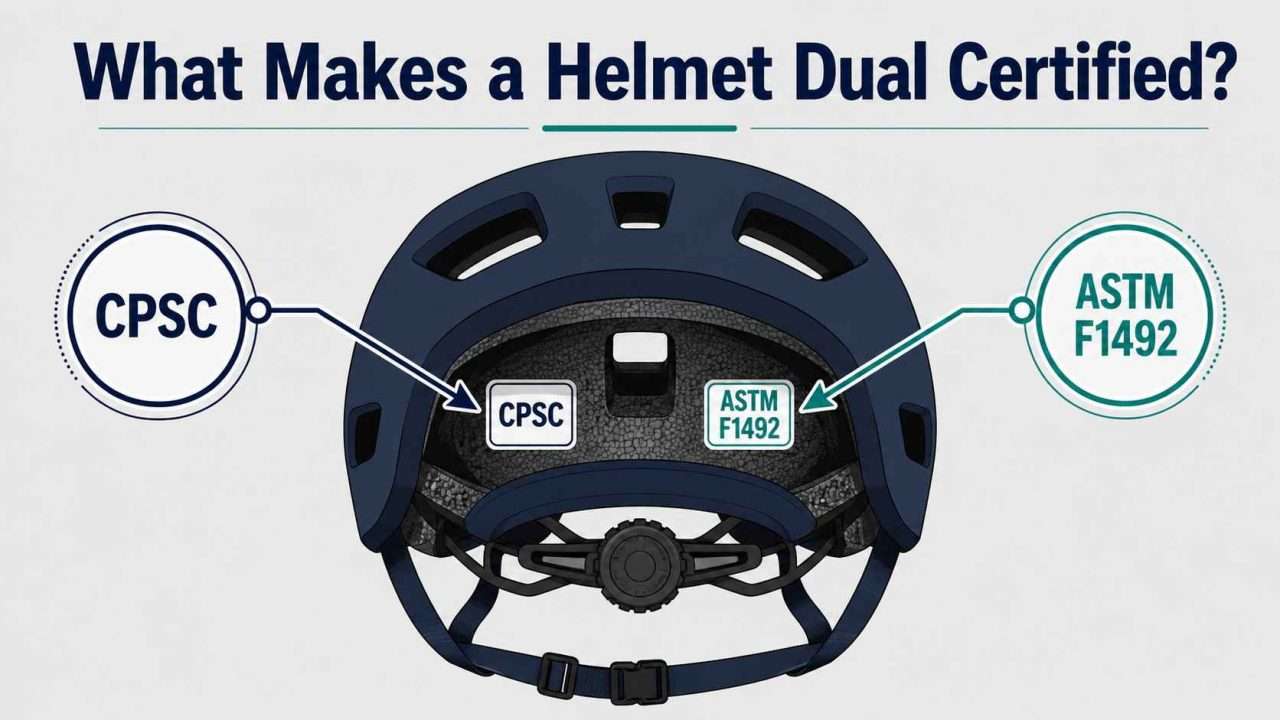
A dual certified helmet carries two certifications shown on one or more labels inside, one for each standard it has passed. Each certification represents a different set of lab tests, designed around the specific types of crashes that happen in that sport. A helmet that meets only one standard may protect your head perfectly well in one activity but leave gaps in another.
Here’s why that matters. Different sports produce different kinds of impacts. A cyclist typically crashes once, at relatively high speed, hitting pavement head-first.
A skateboarder falls far more often, usually at lower speeds, and frequently hits the back of the head. A skier crashes on hard-packed snow often at substantial speed on very hard surfaces. Each safety standard is built around those specific crash patterns, with different drop heights, different impact locations, and different pass/fail thresholds.
The point being, a helmet certified for cycling has proven it can handle one big hit. A helmet certified to ASTM F1492 has been tested to withstand multiple lower-energy impacts under lab conditions. A dual certified helmet can do both.
Which Sports Share Dual Certification?
Not every combination of sports has a dual certification path. The most common pairings you’ll see on the market are bike and skate, bike and ski/snowboard, and ski and mountaineering. Here’s how the standards break down across those combinations.
Dual-Certification Matrix: Which Standards Apply?
| Activity Combination | Standard 1 | Standard 2 | Impact Type |
|---|---|---|---|
| Bike + Skateboard | CPSC 16 CFR Part 1203 | ASTM F1492 | Single-impact (bike) + Multi-impact (skate) |
| Bike + Ski/Snowboard | CPSC 16 CFR Part 1203 | ASTM F2040 or EN 1077 | Single-impact (both) |
| Ski + Mountaineering | PCSR-001 (ski touring) | EN 12492 and/or UIAA | Single-impact (ski) + Multi-impact (climbing) |
| Bike + Bike (US + EU) | CPSC 16 CFR Part 1203 | EN 1078 | Single-impact (both) |
That last row deserves a quick note. Some manufacturers market helmets as “dual certified” when they carry both CPSC (the US bicycle standard) and EN 1078 (the European bicycle and skateboard standard). That’s technically two certifications, but the Bicycle Helmet Safety Institute (BHSI) points out that almost any CPSC-certified helmet will also pass the easier EN 1078 standard.
So “CPSC + EN 1078” on its own doesn’t mean the helmet is certified for skateboarding in the US. You need the ASTM F1492 sticker for that.
What Is a Dual Certified Bike and Skate Helmet?
This is the most common type of dual certified helmet, and the one where misleading marketing is the biggest problem. A true dual certified bike and skate helmet carries both CPSC certification (for cycling) and ASTM F1492 (ASTM International) certification for skateboarding and trick roller skating.
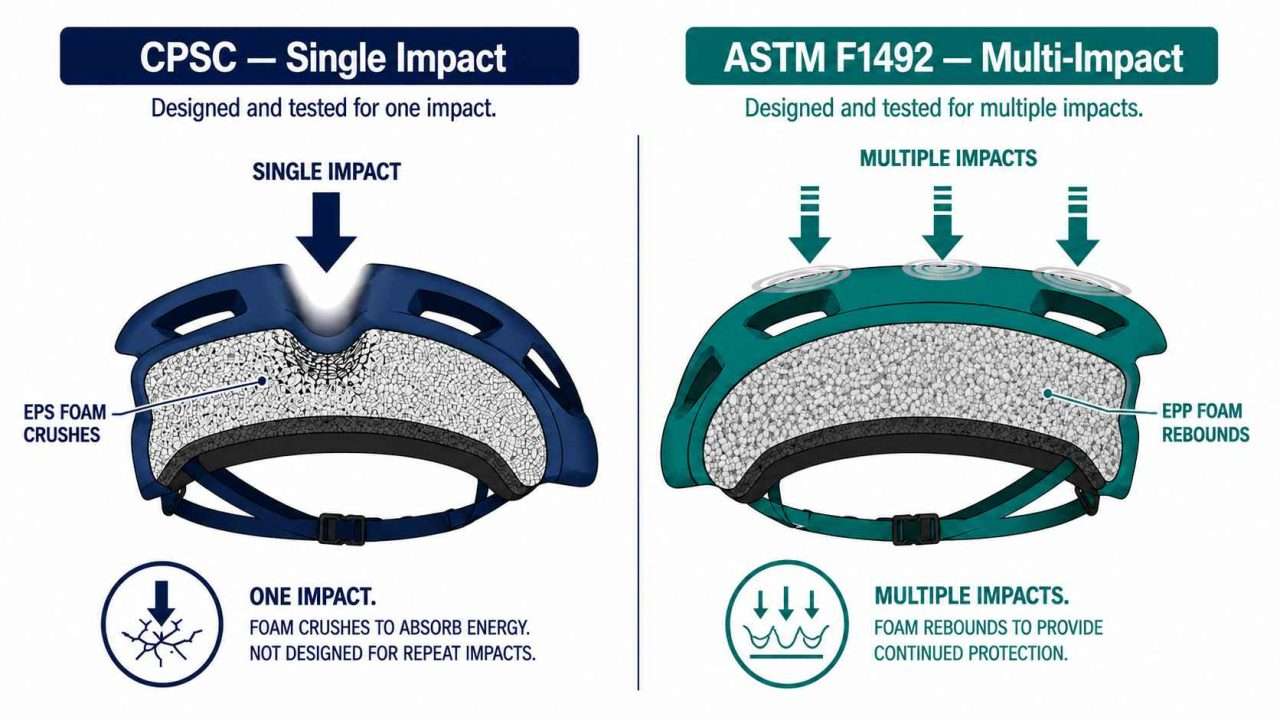
The two standards test for fundamentally different crash scenarios. CPSC tests simulate a single high-energy impact: the helmet is dropped from around 2 meters onto steel anvils, and the accelerometer inside the headform must not exceed 300g. The foam crushes on impact and does its job.
ASTM F1492 tests simulate the repeated lower-energy falls that skateboarders experience, dropping the helmet multiple times in the same location. The helmet must continue to meet the performance requirements throughout the prescribed series of laboratory impacts.
Here’s something that often gets overlooked. The two standards also test different areas of the helmet. According to BHSI, the CPSC test line (the line below which the helmet isn’t tested) sits lower at the front, while the ASTM F1492 test line sits lower at the back.
A dual certified helmet has to meet both test lines, which means it provides verified protection across a larger area of your head than either single certification alone.
Why Does the “Skate-Style” Label Trip People Up?
Walk into any big-box store and you’ll find helmets that look exactly like skate helmets (round dome shape, lower profile, coverage around the back of the head) but are certified only to the CPSC bicycle standard. These are legally sold as bike helmets, and some are marketed for “recreational roller skating” or even described as “multi-sport.” They are not certified for skateboarding.
There is no US federal law requiring skateboard helmets to meet any standard at all, although individual skateparks, schools, competitions, insurers, or local jurisdictions may impose their own helmet requirements. The CPSC bicycle helmet regulation only applies to helmets marketed for cycling. A manufacturer can legally sell any helmet for skateboarding without meeting a single safety standard, as long as they don’t market it for bike use.
So the certification sticker inside the helmet is the only thing you can rely on. If it doesn’t say ASTM F1492, then it hasn’t been tested for skateboarding, no matter what the box says.
Which Brands Make Dual Certified Bike and Skate Helmets?
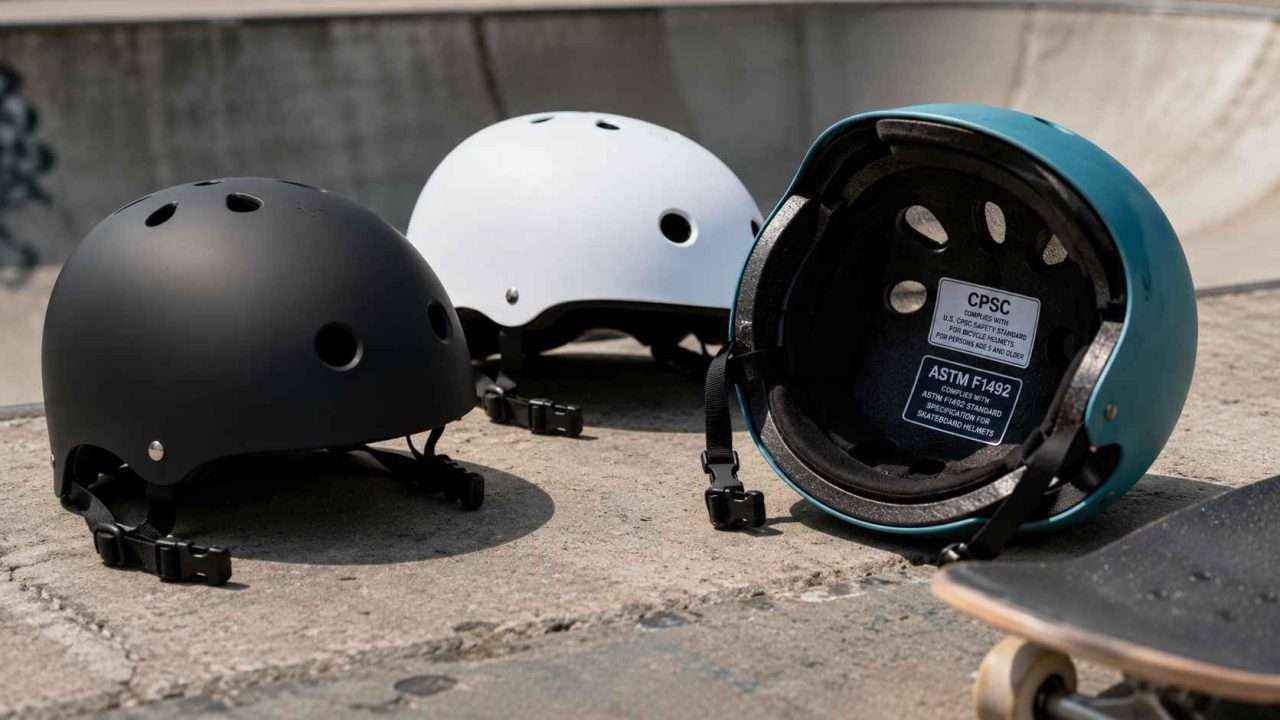
Several well-known brands offer helmets carrying both CPSC and ASTM F1492 certification. Triple Eight makes the Gotham (including a version with MIPS (Multi-directional Impact Protection System) technology), the Brainsaver Dual Certified, and the Lil 8 for kids. Thousand offers CPSC, ASTM F1492, and CE EN 1078 certification across their Heritage collection.
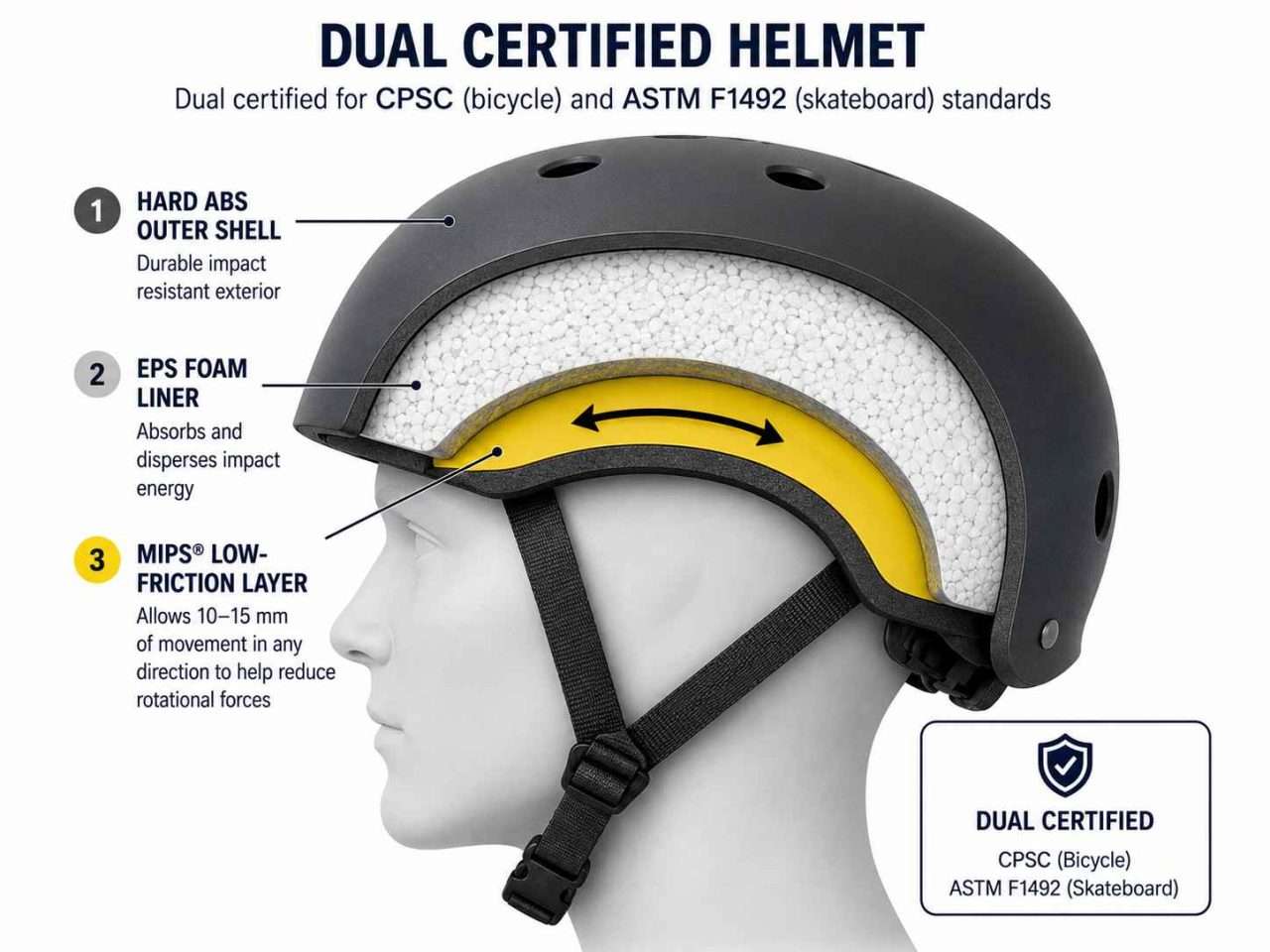
These helmets typically feature a hard ABS (Acrylonitrile Butadiene Styrene) outer shell, which is the same type of tough plastic used in LEGO bricks and hard-shell suitcases. Inside, you’ll find EPS (Expanded Polystyrene) foam, the same white foam your takeout coffee cup is made from, engineered at a higher density to handle both the single big hit and repeated smaller ones.
What About Dual Certified Bike and Ski Helmets?
Bike and ski helmets might seem like an odd pairing at first, but it makes sense if you think about it – they are often marketed as all-season helmets. Both cycling and skiing are single-impact activities, meaning you’re most likely to crash once and crash hard. Both use EPS foam liners.
The main differences are in ventilation, ear coverage, and compatibility with goggles.
A dual certified bike and ski helmet carries CPSC certification for cycling and ASTM F2040 (or EN 1077) for recreational snow sports. ASTM F2040 is actually a demanding standard.
It tests helmets across multiple conditions including extreme cold (as low as minus 28°C) and after water immersion, because a ski helmet that turns brittle in freezing temperatures isn’t much use. The peak acceleration threshold is 300g, the same as CPSC.
If you snowboard rather than ski, the same certification applies. The ASTM F2040 standard covers all “nonmotorized recreational snow sports,” so a bike and ski dual certified helmet works just as well for snowboarding. Both activities are single-impact certified, so the helmet should be replaced after any hard crash, regardless of which sport you were doing at the time.
Is There Such a Thing as a Dual Certified MIPS Helmet?
Yes. MIPS (Multi-directional Impact Protection System) is a technology, not a certification or a safety standard. It’s a low-friction layer inside the helmet designed to reduce rotational forces during angled impacts, the kind that can cause concussions and diffuse brain injuries.
MIPS can be built into any helmet regardless of which certification standards it meets.
The Triple Eight Gotham Dual Certified MIPS is a good example. It carries both CPSC and ASTM F1492 certification for bike and skate use, with the added rotational impact protection of a MIPS liner. Current mandatory standards (CPSC, ASTM F1492, ASTM F2040) do not test for rotational impact at all, so a dual certified helmet with MIPS technology addresses a type of force that neither of its certifications even measures.
That said, MIPS adds roughly $20 to $30 to the price of a helmet, and the dual certified MIPS options are still limited compared to single-certified MIPS bike helmets. Whether that extra cost is worth it depends on how you ride. If you’re commuting on a bike and hitting the skate park on weekends, a dual certified MIPS helmet covers all your bases with one purchase.
Do Dual Certified Helmets Handle Multiple Impacts?
This is where it gets a bit tricky, and it’s worth understanding clearly. The answer depends on which certification you’re talking about.
The ASTM F1492 side of a dual certified bike and skate helmet is tested through repeated impacts as specified by ASTM F1492. The helmet is dropped repeatedly, and it must keep the g-force below the threshold each time. That’s the skateboarding certification doing its job, because skateboarders fall a lot.
The CPSC side is a single-impact standard. EPS foam, the liner material in most helmets, crushes permanently on impact. It doesn’t spring back.
That’s how it absorbs the energy: by destroying itself so your skull doesn’t have to. After one significant cycling crash, the foam has done its job and the helmet needs to be replaced, even if it looks fine on the outside.
So a dual certified bike and skate helmet can handle multiple lower-energy skate falls, but it should still be replaced after any single hard cycling crash. The dual certification doesn’t make it immortal. It means the helmet has proven it can handle both types of impact scenarios, not that it can survive unlimited punishment.
How Do You Know If a Helmet Is Truly Dual Certified?
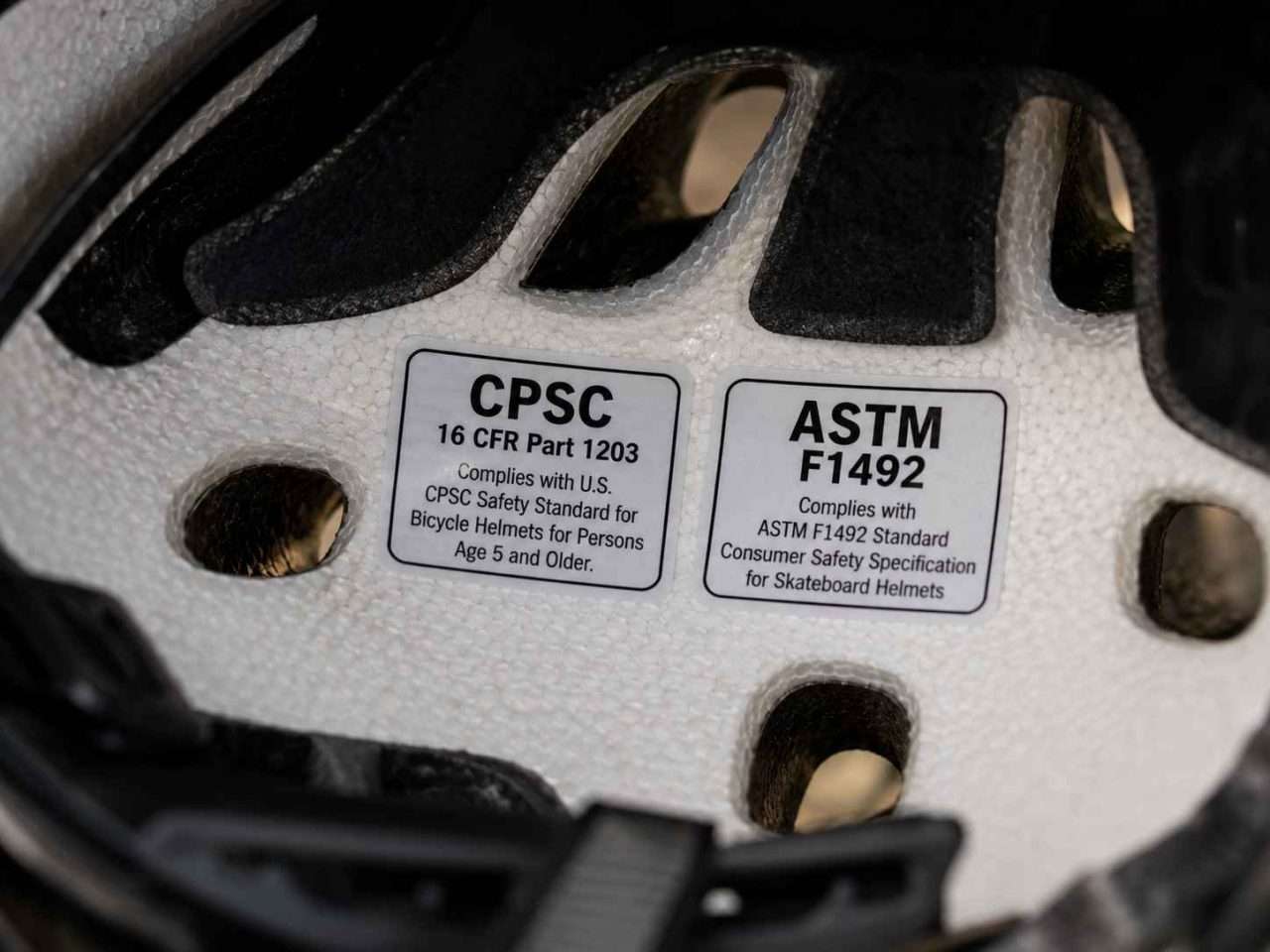
Flip the helmet over and look inside. Every legitimate certification must be printed on a sticker or label inside the helmet itself. For a bike and skate dual certified helmet, you’re looking for two separate lines: one referencing CPSC (or “16 CFR Part 1203”) and one referencing ASTM F1492. If either sticker is missing, the helmet is not dual certified for those activities, regardless of what the marketing on the box claims.
One thing the Bicycle Helmet Safety Institute flags is that some helmet models may be ASTM F1492 certified in certain sizes but not others. If a manufacturer uses one shell size and varies the foam thickness for different head sizes, the largest size with the thinnest foam may not pass the skateboard standard. Always check the sticker in the specific helmet you’re buying, not just the product listing online.
The CPSC’s “Which Helmet for Which Activity” guide is a useful reference for matching helmets to sports. It confirms that a CPSC-compliant bicycle helmet can also be used for recreational inline skating, roller skating, and kick scootering. But for skateboarding and trick roller skating, you need the ASTM F1492 certification.
Does DOT Certification Apply to Bicycle Helmets?
No. DOT (Department of Transportation) certification, formally known as FMVSS 218, applies exclusively to helmets for motorized vehicles: motorcycles, mopeds, and powered scooters. It has nothing to do with bicycle helmets.
A dual certified bicycle helmet will never carry a DOT sticker, and you wouldn’t want it to, because DOT motorcycle helmets are designed for substantially different impact conditions and testing requirements, making them heavier and less suitable for normal bicycle riding.
If you see a helmet marketed for e-bikes with DOT certification, that’s a motorcycle helmet being repurposed for e-bike use. It’s probably overkill for a standard pedal-assist e-bike, and it certainly isn’t dual certified in the way we’re discussing here.
Can You Use a Dual Certified Helmet for Scootering?
For kick scooters (non-motorized), a CPSC-certified bicycle helmet is all you need. The CPSC includes kick scootering as an approved activity for bicycle helmets. So any dual certified bike and skate helmet will cover scootering automatically through its CPSC certification.
Powered scooters are a different story. At higher speeds, you may need a DOT-certified motorcycle helmet depending on your state’s laws and the scooter’s top speed. Dual certified bike and skate helmets are not designed for motorized use.
Is a Dual Certified Helmet Worth It?
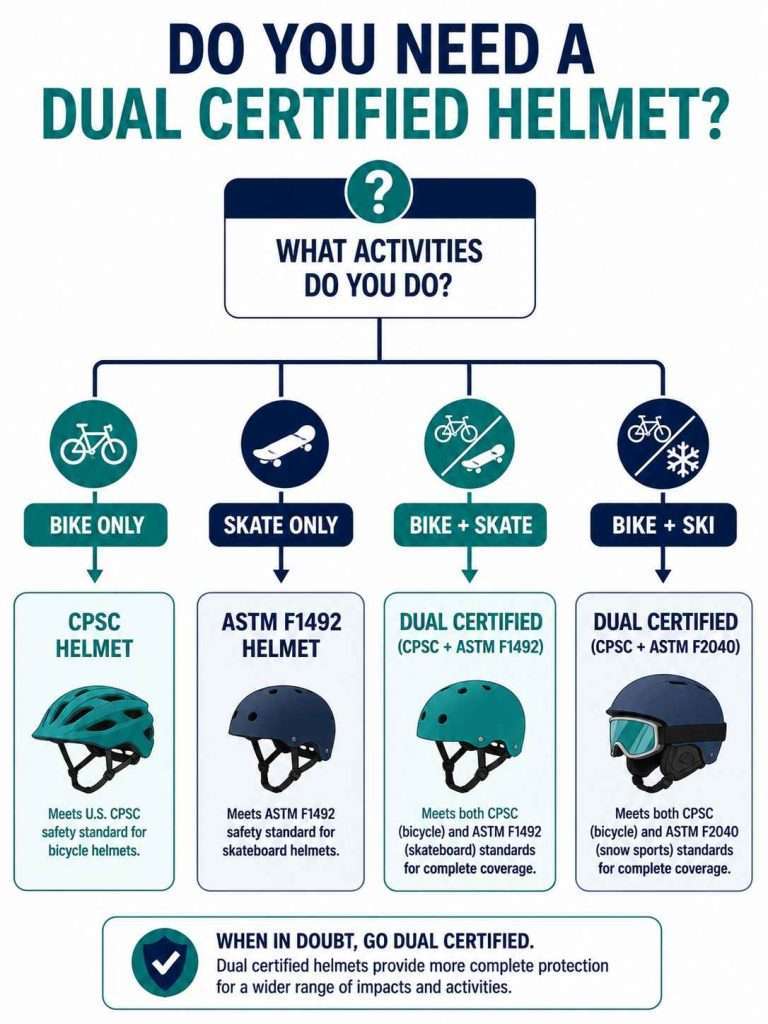
If you only ride a bicycle, a standard CPSC-certified bike helmet is all you need, and you’ll get better ventilation and lighter weight than most dual certified options. If you only skateboard, a dedicated ASTM F1492 skate helmet will do the job. Dual certification makes the most sense when you genuinely participate in both activities and would rather own one helmet than two.
For parents, a dual certified helmet is often the most practical choice. Kids tend to hop between bikes, scooters, skateboards, and roller skates without much warning. Having one helmet that’s certified for all of those activities means you don’t have to worry about which lid they grabbed on the way out the door.
So, common sense: if you ride and skate, get a dual certified helmet. If you ride and ski, get one certified for both. Check the stickers and replace it after any hard impact.
Don’t let a marketing label convince you that a “skate-style” bike helmet is the same thing as a certified skate helmet. Your head is worth the extra thirty seconds it takes to flip the helmet over and read the label.
For a broader look at how all of these testing standards compare, take a look at our complete guide to bicycle helmet safety standards.
Frequently Asked Questions
What Does Dual Certification Mean for a Helmet?
This is worth paying attention to because a “skate-style” helmet is not the same thing as a certified skateboard helmet. Some helmets look like skate helmets but only carry the CPSC bicycle certification. There’s actually no U.S. law requiring a skateboard helmet to meet any standard at all, so the certification sticker inside is the only thing you can rely on. If the ASTM F1492 sticker isn’t there, it hasn’t been tested for skateboarding, no matter what the marketing says.
A dual-certified bike and ski helmet works the same way. It carries a cycling standard (like CPSC) alongside a snow sports standard (like ASTM F2040 or EN 1077B). Both tests must be passed independently before the helmet can carry both certifications.
What Are the Benefits of Dual Certified Helmets?
But the real benefit is in the protection. Each certification tests different things, and a dual-certified helmet has to pass both. Take a bike/skate helmet as an example: the CPSC bicycle standard tests the front of the helmet lower on the head than the ASTM F1492 skateboard standard does, while the skateboard standard tests lower in the back. So a dual-certified helmet ends up with broader tested coverage overall than either single certification provides on its own.
There’s also the multi-impact factor. ASTM F1492 requires the helmet to handle multiple lower-force impacts (the kind skateboarders deal with), while CPSC tests for a single high-energy impact (the kind cyclists face at speed). A dual-certified helmet has to manage both scenarios. That said, “multi-impact rated for skateboarding” does not mean you can keep using it after a hard bike crash. After any significant impact while cycling, replace the helmet.
Is MIPS Worth It in a Multi-Sport Helmet?
If you’re using a multi-sport helmet across activities like cycling, skateboarding, and commuting, MIPS makes even more sense. You’re exposing yourself to different types of falls across different surfaces, and angled impacts are common in all of them. Many brands now offer dual-certified helmets with MIPS built in. The price bump for MIPS is typically $20 to $30 over a non-MIPS version of the same helmet, which is a pretty small price to pay for meaningful brain protection.
What Helmets Are Available as Dual Certified?
For bike and snow dual certification, the Bern Watts 2.0 is a standout. It carries CPSC, EN 1078 (European bike/skate), and EN 1077B (European snow) certifications, and comes in both summer and winter liner versions so you can swap between seasons. Bern also offers a MIPS version. The K2 Route and Retrospec Traverse are other solid options for bike/ski use.
