Ski Helmet Safety Statistics: What Helmets Do and Don’t Stop
The Short Version: Ski helmet safety statistics show that helmets reduce head injury risk among skiers and snowboarders by 35%, according to a 2010 CMAJ meta-analysis. Helmet use at U.S. ski areas hit a record 91% in 2024–25.
Head injuries account for up to 19% of all ski and snowboard injuries. Traumatic brain injury is the leading cause of death and serious injury among skiers and snowboarders. The same meta-analysis found no increased neck-injury risk from helmet use. U.S. helmet use stood at 25% in 2002–03.
Stand in any lift line in Colorado, Vermont, or Utah this winter and count the bare heads. You’ll run out of them before you run out of fingers. Helmets have gone from oddity to uniform in about two decades, and yet the number of people killed on American ski slopes each season hasn’t budged much at all.
That contradiction is the most important thing to understand about ski helmet safety statistics. The numbers show helmets doing a very good job at some things and almost nothing at others.
I’ve skied in a helmet for years, and I retired one after a backward slam on a frozen groomer left a dent in the foam liner I could press my thumb into. So I’m not neutral on the subject, but I’m also not interested in pretending a helmet does more than it does. Common sense says you should know what the data actually shows, so let’s take a look.
What Do Ski Helmet Safety Statistics Actually Tell Us?
The short answer is that helmets reduce head injuries, they don’t stop most deaths, and they don’t reliably prevent concussion. All three of those statements are backed by solid research, and a fair reading of the ski helmet safety statistics needs all three side by side.
Most of the U.S. figures come from the National Ski Areas Association (NSAA), the trade group for American ski resorts. Its data covers incidents inside resort boundaries during operating hours only, so backcountry deaths, after-hours accidents, and medical events such as heart attacks are left out of the count. Keep that in mind any time you see a “total” ski death number quoted.
Now, a cynic might point out that the NSAA represents the resorts, so why trust its numbers? Fair question. The same fact sheets report the highest catastrophic injury rate in a decade and a fatality rate that rose last season, which isn’t what you’d publish if good PR were the only goal.
Here’s the snapshot before we get into the detail.
| Measure | Figure | Source |
|---|---|---|
| U.S. helmet use, 2024/25 | 91% (up from 25% in 2002/03) | NSAA, 2025 |
| Helmet use, ages 17 and under | 96% (98% for ages 10 to 14) | NSAA, 2025 |
| Lower odds of head injury with a helmet | 35% (OR 0.65) | Russell et al., 2010 |
| Effect on concussion | Not statistically significant (OR 1.28) | Agar et al., 2023 |
| U.S. resort fatalities, 2024/25 | 50 (0.81 per million visits) | NSAA, 2025 |
| Fatal incidents not wearing a helmet | 16% | NSAA, 2025 |
| Catastrophic injuries, 2024/25 | 63 (1.02 per million visits) | NSAA, 2025 |
| Leading cause of death | Tree collisions (nearly half) | NSAA, 2025 |
How Has Ski Helmet Usage Changed in 20 Years?
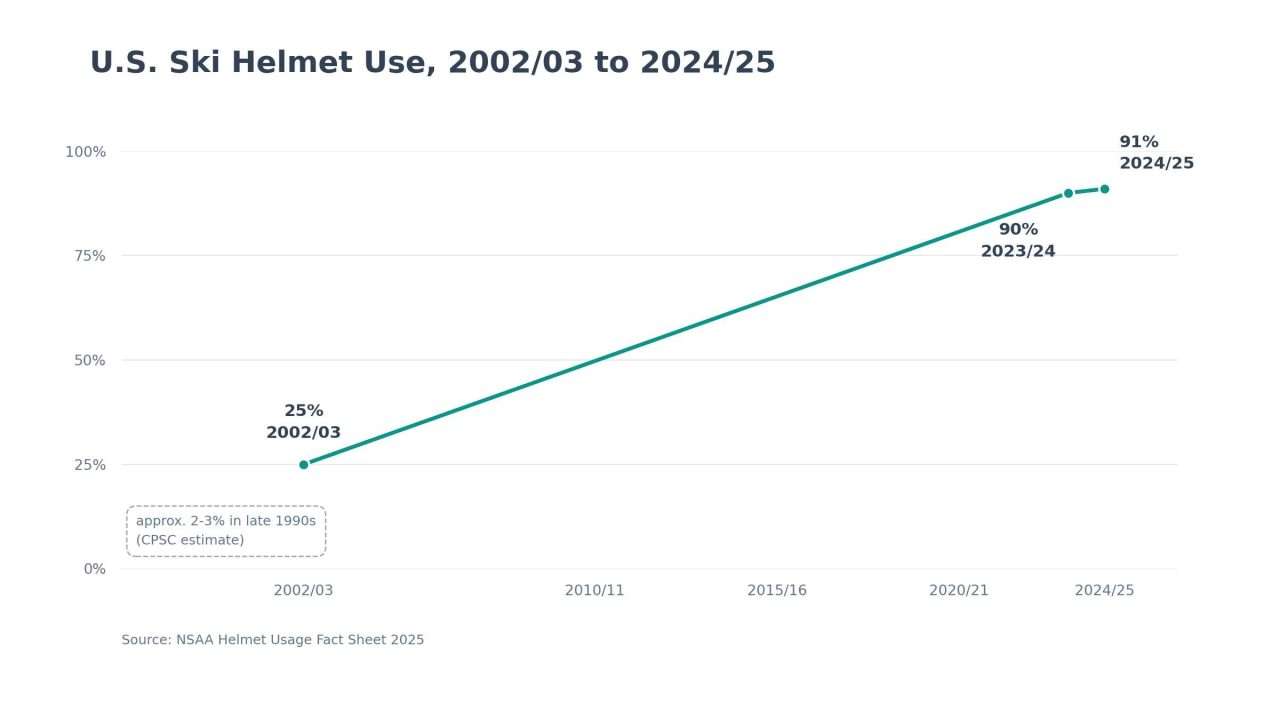
Ski helmet usage in the United States has climbed from one in four skiers to roughly nine in ten. According to the NSAA, helmet use rose from 25% in the 2002/03 season to an all-time high of 91% in 2024/25. That’s one of the biggest voluntary safety shifts in any recreational sport.
Go back a little further and the change is even starker. When the Consumer Product Safety Commission (CPSC) studied ski helmets in 1999, its staff estimated that only two to three percent of alpine skiers and snowboarders actually wore one. Back then, a helmet on the slopes marked you as either a racer or a little bit odd.
So what changed? Not the law, because there still isn’t a U.S. state that makes adults wear one. It was education, peer pressure, better-looking helmets, and plenty of parents who got tired of arguing about it.
The NSAA says the remaining holdouts are mostly young adults. Its own analysis points to skiers and riders aged 18 to 34, especially males, as the group with the most room to improve. (Funny how the group most convinced of its own invincibility is the one least likely to buckle up.)
Here’s how the published U.S. ski helmet statistics on usage line up across the years:
- Late 1990s: roughly 2% to 3% (CPSC staff estimate, 1999)
- 2002/03: 25% (NSAA)
- 2023/24: 90% (NSAA)
- 2024/25: 91%, a national record (NSAA)
Are Kids More Likely to Wear Ski Helmets Than Adults?
Yes, and by a comfortable margin. NSAA data shows 96% of participants aged 17 and under wore helmets in 2024/25, with ages 10 to 14 even higher at 98%. Even the 65-and-over crowd came in at 92%, beating the overall average, so much for the idea that Grandpa is the holdout!
That wasn’t always the case. The NSAA says that in 2002, only 63% of kids aged 9 and under wore helmets, and fewer than half of all kids 17 and under did. Its Lids on Kids campaign gets a lot of the credit for turning that around without a single state mandate.
It matters, because children appear to get more benefit from a helmet than adults. In the Russell meta-analysis covered below, studies that included children under 13 showed an odds ratio of 0.41 for head injury, which is well under the adult figure. The CPSC also estimated that 53% of head injuries to children under 15 could be addressed by a helmet, compared with 44% across all ages.
Treat that CPSC figure as historical, by the way. It’s based on 1998 emergency room data and on where the head was struck, not on outcomes.
What Does the Research Say About Ski Helmet Effectiveness?
One of the most widely cited pieces of evidence on ski helmet effectiveness is a 2010 meta-analysis by Kelly Russell, Josh Christie, and Brent Hagel at the University of Calgary, published in the Canadian Medical Association Journal (CMAJ). A meta-analysis pools many separate studies into one estimate.
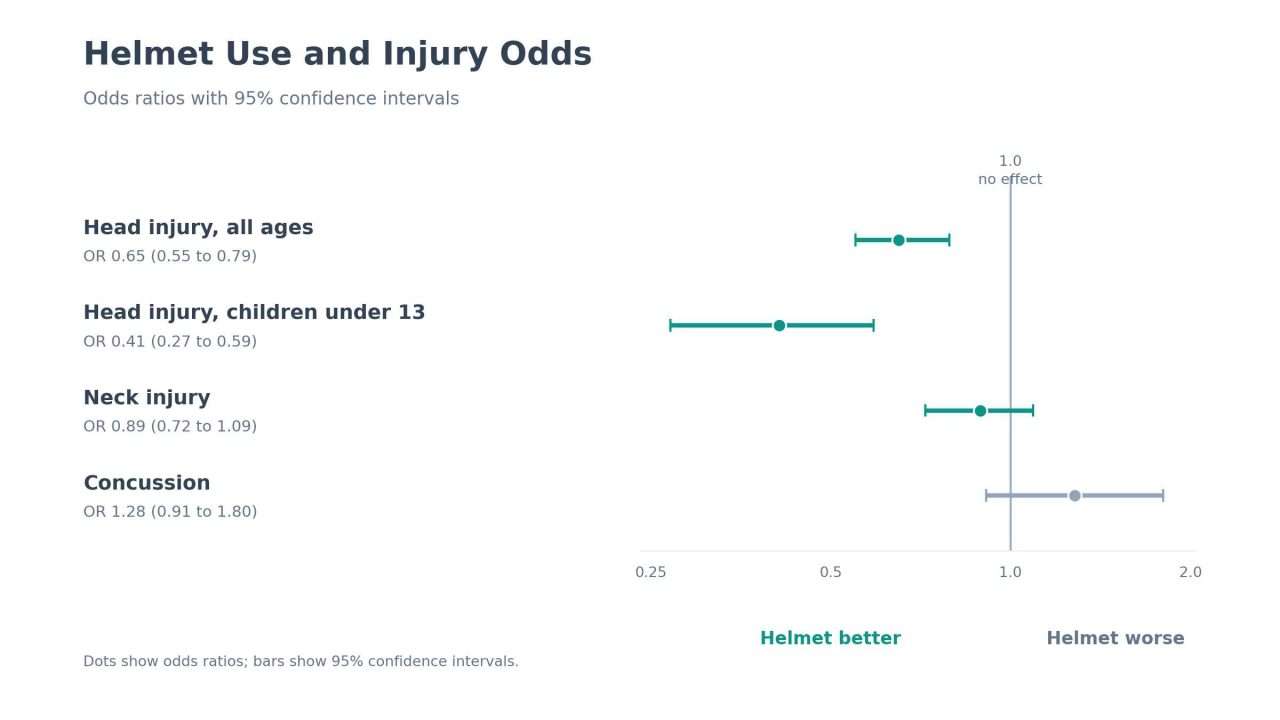
The team combined 12 studies and found that skiers and snowboarders wearing a helmet had significantly lower odds of head injury, with an odds ratio (OR) of 0.65 and a 95% confidence interval (CI) of 0.55 to 0.79. In plain English, that’s about 35% lower odds of a head injury, and the authors estimated that two to five of every ten head injuries among helmet users could be prevented.
An odds ratio, if you haven’t met one before, compares the odds of something happening in one group against another. An OR of 1.0 means no difference, anything below 1.0 means fewer injuries in the helmet group, and the confidence interval tells you how sure the researchers are of the number.
The effect held up whether the comparison group was uninjured skiers or skiers hurt somewhere other than the head. It showed up for skiers and snowboarders alike, and for people on groomed runs as well as in parks and off-piste.
Now for the honest caveat. None of the 12 studies described the design, quality, or fit of the helmets involved, and the overall study quality was rated as moderate. The authors also noted that a poorly fitted or worn-out helmet could mean the true protective effect is underestimated, which is a point worth remembering next time you pull on a helmet that slides around on your head.

What Did the Haider Evidence-Based Review Conclude?
Two years after the Russell paper, a team led by Dr. Adil Haider at Johns Hopkins published an evidence-based review in the Journal of Trauma and Acute Care Surgery. Working on behalf of the Eastern Association for the Surgery of Trauma, they reviewed 16 published studies in detail to settle three questions: do helmets reduce head injury, do they increase neck injury, and do they make people ski more recklessly?
Their background figures are sobering. The review notes that roughly 600,000 ski and snowboarding injuries happen in North America each year, with head injuries making up as much as 20% of them. Their conclusion was that helmets are strongly recommended for recreational skiing and snowboarding.
Haider also addressed the excuses head on. Skiers had long claimed that helmets block vision, muffle hearing, and encourage risky behavior, and his blunt response, as reported by Johns Hopkins, was that these are all just excuses. Sorry folks, but the data didn’t back any of them up.
Why Does Natasha Richardson Still Come Up in Helmet Debates?
In 2009, actress Natasha Richardson died after a fall at Mont Tremblant in Quebec. It’s the case most people think of when ski helmet safety comes up, and for good reason.
According to Haider, Richardson fell backward at a low speed on a beginner slope and hit her head, and a helmet would likely have prevented the fatal injury. There was no tree, no cliff, no high-speed collision. It was the kind of tumble most of us have taken a hundred times.
That’s exactly why the case matters, and why common sense should beat gut feel here. The scenario where a helmet does its best work, a low-speed fall onto a hard surface, is also the one that feels too ordinary to worry about. If you’ve ever thought helmets are only for experts and park riders, it’s worth reading about whether beginner skiers need a helmet.
Head injuries from apparently minor falls can also take time to show themselves. If you or someone you’re skiing with hits their head and later develops a worsening headache, confusion, or drowsiness, don’t wait it out. Go and see a doctor.
Do Ski Helmets Prevent Concussions?
This is where the marketing and the evidence part company. A 2023 critically appraised topic by Kaelin Agar and colleagues, published in the International Journal of Athletic Therapy and Training (IJATT), found that helmet use was not significantly linked to lower odds of concussion (OR 1.28, 95% CI 0.91 to 1.80). The confidence interval crosses 1.0, which means the data can’t tell a helmet from no helmet on this particular outcome.
That isn’t a new finding either. A 2009 systematic review in the British Journal of Sports Medicine concluded that helmets reduce head injury risk in skiing and snowboarding, but their effect on concussion is inconclusive.
Why the gap? A concussion is caused by the brain moving inside the skull, and much of that movement comes from rotation and sudden deceleration rather than a direct blow. The foam liner in a ski helmet is usually expanded polystyrene (EPS), the same white foam your takeout coffee cup and new TV come packed in, and it’s very good at crushing to soften a straight-on hit.
It’s far less good at stopping your brain from sloshing around. Cut a ski helmet in half (I watched a shop tech do it once, and it’s oddly satisfying) and you’ll find roughly an inch of foam doing all the work. That inch is great for a straight drop onto hardpack and nowhere near enough to stop a twisting jolt.
A helmet does not make you concussion-proof, and nobody who has read the research should claim it does.
What Do Ski Helmet Injury Statistics Say About Head Injuries?
Head injuries aren’t the most common ski injury (the lower leg and knee account for about a third), but they’re the most dangerous. Across many countries, head injuries account for 9% to 19% of all ski and snowboard injuries, and traumatic brain injury is the leading cause of death and serious injury among skiers and snowboarders.
Traumatic brain injury (TBI) is the medical umbrella term for any injury that disrupts normal brain function after a blow or jolt to the head, from a mild concussion through to a severe bleed. When ski helmet injury statistics talk about “serious head injury,” they usually mean something toward the top end of that scale.
The CPSC’s 1999 analysis of emergency room data found that head injuries made up about 14% of all skiing and snowboarding injuries, rising to about 22% among children under 15. The good news from that same report is that 94% of the head-injured patients in its special study were treated and released.
There’s also evidence the most worrying head injuries have become less common as helmets caught on. Research cited by the NSAA, led by Jasper Shealy, found that potentially serious head injuries fell from 4.2% to 3.0% of all ski injuries between 1995 and 2012. About three-quarters of those potentially serious injuries were mild concussions, and the study concluded helmets prevent skull fractures and have almost eliminated scalp lacerations.
How Do Skiers Actually Hit Their Heads?
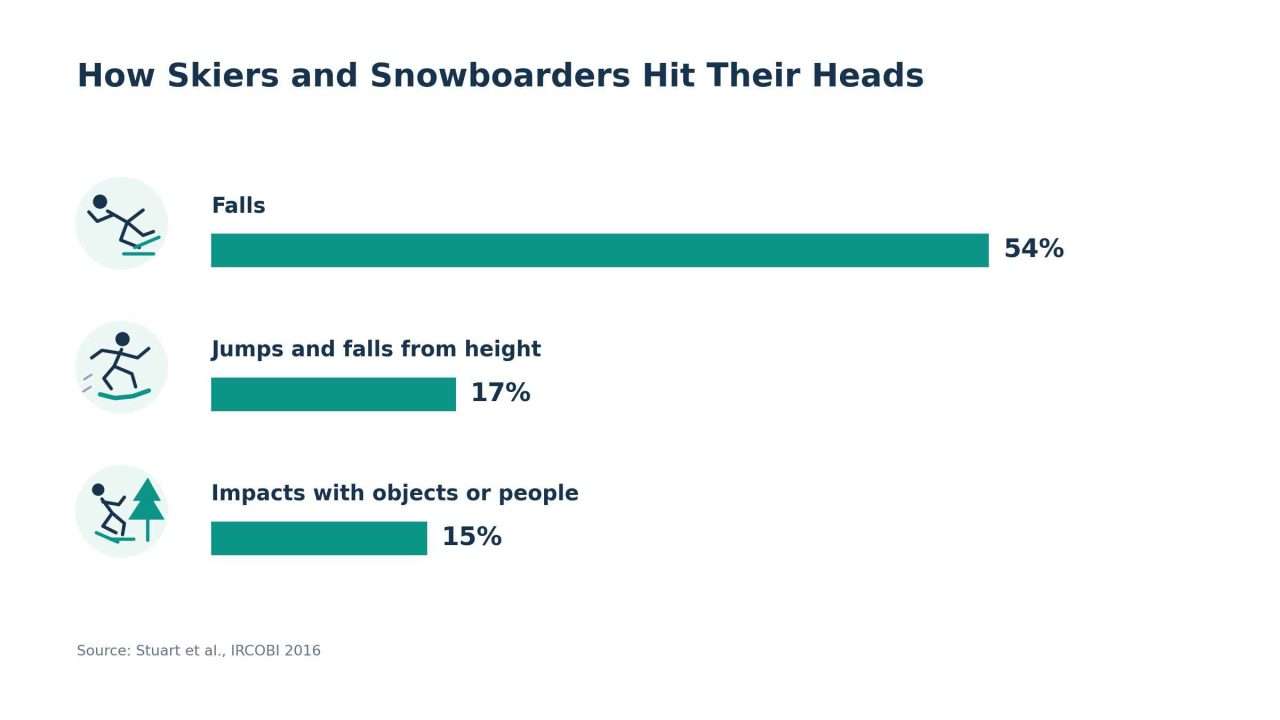
Mostly by falling over. A University of British Columbia (UBC) review of 763 snow sport head injury cases treated at two Vancouver-area hospitals found that falls caused 54% of incidents, jumps and falls from height 17%, and impacts with objects or other people 15%. The CPSC’s 1998 special study told a similar story, with falls behind 69% of head and neck injuries.
Now here’s the part that surprises people. Anyone who has caught an edge on a groomer at 8:30 on a cold morning, as I have more times than I’d care to admit, knows snow isn’t soft. A 2023 lab study dropped a headform onto real snow at about 6.1 meters per second (roughly 13.6 mph) and measured average peak accelerations, in multiples of gravity (G), of 51G on soft snow, 106G on hard snow, and 170G on very hard snow, with the helmet not significantly reducing linear acceleration in the conditions tested.
Before you toss your helmet in the trash, read the rest of that study. The helmeted headform penetrated less into the snow, and the authors’ takeaway was that future helmet testing should account for snow impacts, not that helmets are pointless. The point being, the surface you land on matters as much as the lid on your head.
Why Haven’t Ski Fatality Rates Dropped as Helmet Use Rose?
This is the question the helmet skeptics love, and it deserves a straight answer. Helmet use went from 25% to 91%, yet the U.S. fatality rate has hovered around the same level for years. Here’s the NSAA’s own 10-season record.
| Season | Fatalities | Skier visits (millions) | Rate per million visits |
|---|---|---|---|
| 2024/25 | 50 | 61.6 | 0.81 |
| 2023/24 | 36 | 60.5 | 0.60 |
| 2022/23 | 46 | 65.4 | 0.70 |
| 2021/22 | 57 | 60.7 | 0.94 |
| 2020/21 | 48 | 59.0 | 0.81 |
| 2019/20 | 42 | 51.1 | 0.82 |
| 2018/19 | 43 | 59.3 | 0.73 |
| 2017/18 | 37 | 53.3 | 0.69 |
| 2016/17 | 42 | 54.8 | 0.77 |
| 2015/16 | 39 | 52.8 | 0.74 |
| 10-season average | 44 | 57.9 | 0.76 |
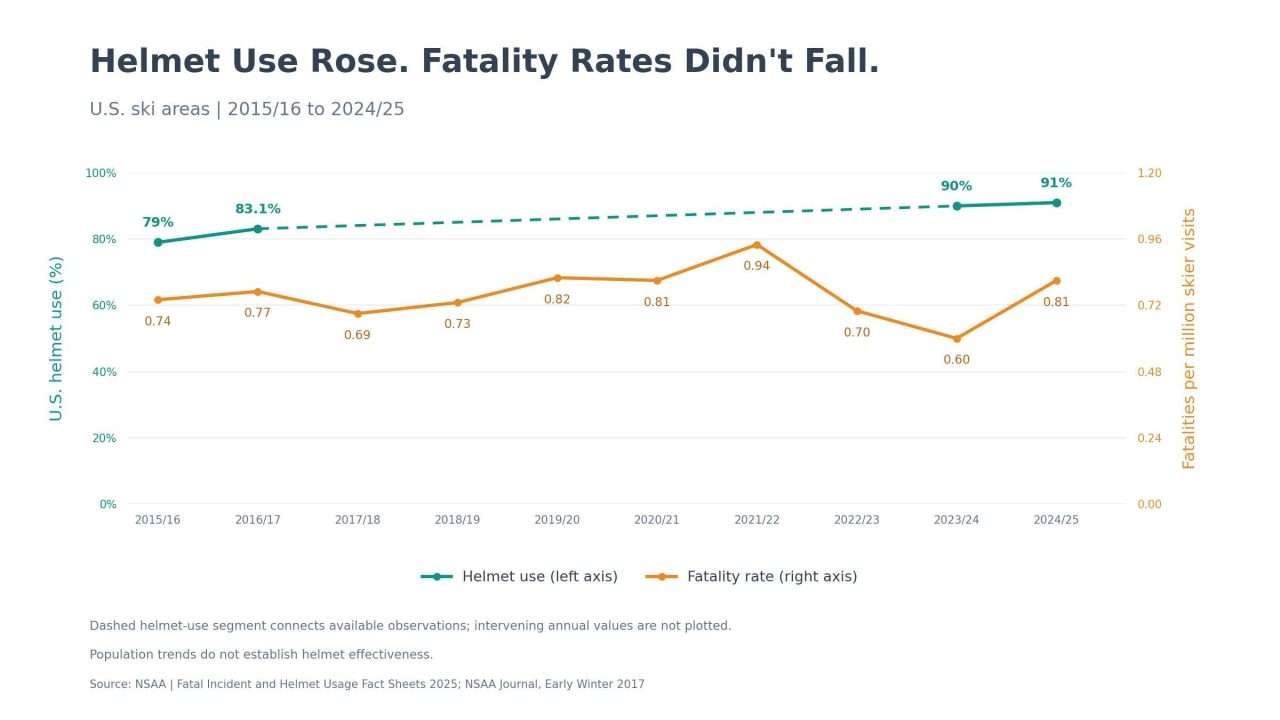
Jasper Shealy, the Rochester Institute of Technology researcher who spent decades studying ski injuries, flagged this pattern back in 2008. His paper with Robert Johnson and Carl Ettlinger found that helmets hadn’t been shown to reduce the overall fatality rate even with up to 40% of skiers wearing them, though they did change the primary cause of death. In other words, the fatal injury may shift away from the head, but the outcome often stays the same.
A cynic may say that proves helmets are a waste of money. That conclusion skips a step, though. Most ski deaths are high-energy collisions with immovable objects, and no recreational helmet is designed for that kind of hit, which we’ll come to shortly.
Who Is Most Likely to Die on the Slopes?
Statistically, it’s a man skiing an intermediate run. Of the 50 people killed at U.S. ski areas in 2024/25, 46 were male and 4 were female, 37 were skiers and 13 were snowboarders, and most incidents happened on intermediate terrain. The victims skewed toward age 30 and under, with about a quarter aged 20 to 30.
Men are overrepresented compared with their share of the people actually on the mountain, and that’s been true for as long as anyone has kept records. Speed, loss of control, and collisions with objects are the recurring factors NSAA lists. Let’s face it, none of those are things a helmet can talk you out of.
The same fact sheet reports that 16% of people in fatal incidents were not wearing a helmet. Be careful with that number, because it’s descriptive rather than causal. It tells you who was involved, not whether a helmet would have changed the outcome, and you can’t turn it into an effectiveness figure without knowing how hard each person hit.
Why Are Tree Collisions the Leading Cause of Ski Deaths?
Because a tree doesn’t give. The NSAA reports that collisions with trees caused nearly half of all reported deaths in 2024/25, with snow immersion incidents such as tree wells making up roughly ten percent. Collisions with trees and with the snow surface itself remain the two main causes of fatal incidents.
This pattern isn’t new. When CPSC staff reviewed death certificates from 1990 through 1997, they found collisions in 95 of the 108 deaths involving head injury, and 86 of those were collisions with a stationary object, usually a tree. Only nine involved hitting another person.
Think about what that means physically. A skier at 25 or 30 mph who stops dead against a trunk absorbs that energy through the whole body, not just the head. Even a perfect helmet can only manage the head’s share, which is why the chest, abdomen, and neck injuries take over as the cause of death.
The common sense lesson isn’t “don’t bother with a helmet.” It’s that speed control near the tree line will do more to keep you alive than any piece of gear you can buy.
How Fast Do Skiers Go Compared With Helmet Test Speeds?
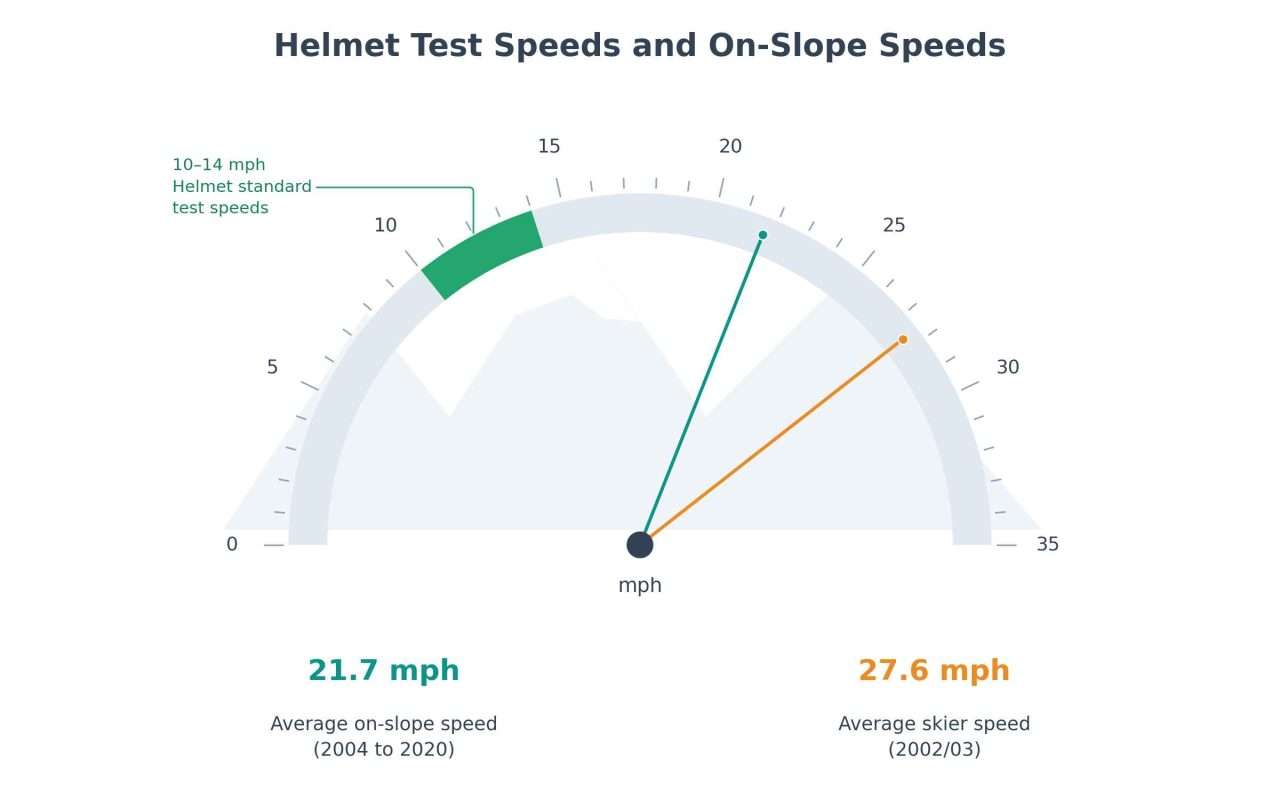
A lot faster than the helmet is tested for. Jasper Shealy, Carl Ettlinger, and Robert Johnson used a radar gun on about 650 skiers and snowboarders at three U.S. resorts and recorded an average speed of 26.7 mph, well above the 14.0 mph used in ASTM F2040 helmet testing. ASTM F2040 is the U.S. standard for recreational snow sport helmets, published by ASTM International (formerly the American Society for Testing and Materials).
Skiers also underestimate their own speed. In the same study, people actually traveling at 30 mph guessed they were doing about 23 mph. (Much like most of us on the interstate, come to think of it.)
I learned this the honest way when a ski-tracking app on my phone clocked me well over 30 mph on a run I’d have sworn was a gentle cruise. It’s a humbling number to look at in the lift line.
A larger 2023 dataset of 4,164 speed observations at eight U.S. ski areas found an average of 34.9 km/h, or about 21.7 mph, with ability level having the biggest influence on speed.
| Speed measure | Approx. mph | Source |
|---|---|---|
| Typical helmet standard impact test range | 10 to 14 | CPSC, 1999 |
| ASTM F2040 test speed | 14.0 | Shealy et al., ASTM |
| Average on-slope speed, 2004 to 2020 (8 U.S. areas) | 21.7 | Stepan et al., 2023 |
| Average snowboarder speed (2002/03) | 24.1 | Shealy et al., ASTM |
| Average skier speed (2002/03) | 27.6 | Shealy et al., ASTM |
| Average speed of helmet wearers (2002/03) | 28.4 | Shealy et al., ASTM |
Here’s the caveat that keeps this from being an argument against helmets. Ski speed isn’t impact speed. Most falls involve your head dropping a few feet onto the snow, and that vertical drop is much closer to what the standards simulate than your forward speed down the run.
What Do ASTM F2040, EN 1077 and Snell RS-98 Test For?
Turn your own helmet over and you’ll usually find a certification sticker tucked under the liner or on the back of the shell. Health Canada’s guidance on ski and snowboard helmets lists ASTM F2040-18, Snell RS-98, EN 1077:2007, and CSA Z263.1-14 as acceptable benchmarks. EN stands for European Norm and CSA for the Canadian Standards Association, and each code is really just a test recipe.
- ASTM F2040: the main U.S. standard for recreational snow sport helmets, tested at the 14.0 mph impact speed noted above.
- EN 1077: the European standard for alpine ski and snowboard helmets, split into Class A (more coverage) and Class B (lighter, with less coverage).
- Snell RS-98: the Snell Memorial Foundation’s recreational ski and snowboard standard, first issued in 1998, which the CPSC noted was among the first U.S. voluntary standards written for ski helmets.
- CSA Z263.1: the Canadian Standards Association’s alpine ski and snowboard helmet standard.
All of them follow the same basic idea. A helmet is strapped to a metal headform (the most patient test subject in the world) and dropped onto a steel anvil, and sensors measure how much of the impact reaches the “head,” measured in G. The CPSC concluded that a helmet meeting any one of these standards provides adequate protection to reduce the risk of head injury, even though the test parameters differ.
For a closer comparison of how snow and bicycle standards differ, see our breakdown of the safety data behind helmet standards for ski and bike helmets.
How Often Do Skier-to-Skier Collisions Cause Head Injuries?
Less often than you’d guess, given how much they dominate the conversation in the lodge. In the CPSC special study, colliding with another person caused about 6% of head and neck injuries, compared with 14% from striking an object. In the UBC dataset, objects and people combined made up 15%.
Rare doesn’t mean harmless, though. A skier-to-skier collision puts two moving bodies together, and the person hit from behind never sees it coming. The NSAA’s slope safety guidance says collisions are the leading cause of on-slope fatalities and catastrophic injuries, most often with stationary objects.
The best defense is the boring one. The NSAA’s Your Responsibility Code, last updated in 2022, covers the habits that prevent most collisions, including these:
- Always stay in control, so you can stop or avoid people and objects.
- People ahead of or downhill from you have the right of way.
- Stop only where you’re visible from above and not blocking traffic.
- Look uphill before starting down or merging onto a trail.
- Don’t use lifts or terrain while impaired by alcohol or drugs.
Are Snowboarders at Greater Risk of Head Injury Than Skiers?
The data leans that way for head injuries, though not for deaths. In the UBC hospital review, snowboarders made up about 61% of the head injury cases and skiers about 38%. A decade of data from western Canadian resorts likewise found fewer skiers than snowboarders experienced head injuries.
I’ve caught a heel edge on a snowboard exactly enough times to know why. With both feet locked to one board, there’s no stepping out of a fall, and a slammed heel edge tends to put you straight onto your back and the back of your head.
Fatalities run the other way. Skiers accounted for 37 of the 50 U.S. deaths in 2024/25, a split the NSAA says closely reflects the national participation mix. The Russell meta-analysis also found the protective effect of a helmet was similar for skiers and snowboarders, so the advice doesn’t change whichever you ride.
Are Terrain Parks More Dangerous for Your Head?
Terrain parks look like the most dangerous part of the mountain (especially to parents watching from the deck), and they do produce serious injuries, but the fatality numbers tell a calmer story. In 2024/25, the NSAA recorded nine catastrophic injuries in terrain parks, and no fatalities took place in terrain parks that season.
Where a helmet really earns its keep is in exactly that kind of terrain. In the Russell subgroup analysis, the single study examining park and off-piste riding found an odds ratio of 0.26 for head injury among helmet wearers, the strongest protective effect of any location studied. Jumps produce the vertical drops that helmets are built for.
The NSAA’s Park SMART program sums up the common sense side of it: start small, make a plan, always look, respect the features, and take it easy. A helmet is the backup plan, not the plan.
What Counts as a Catastrophic Ski Injury?
The NSAA defines a catastrophic injury as a life-altering injury such as a broken neck or back with full or partial paralysis, a serious head injury, or the loss of a limb. These are the injuries that change a life rather than end a season.
There were 63 of them at U.S. ski areas in 2024/25, a rate of 1.02 per million visits and the highest in the NSAA’s 10-season record. That’s about 43% above the 10-season average of 44 per season. Most involved male skiers on intermediate terrain, about 30% were aged 21 to 30, and one in five were 20 or younger.
Helmet use doesn’t explain the jump. Only 7 of the 63 people catastrophically injured weren’t wearing one. Near-record crowds, speed, and loss of control are the more likely culprits.
Do Ski Helmets Increase the Risk of Neck and Spine Injuries?
No, and this is one of the more persistent myths in skiing. The theory goes that a helmet adds weight and size to the head, so in a fall it acts like a lever on the neck, which sounds plausible enough to scare a lot of parents.
The evidence doesn’t support it. Pooling six studies, the Russell meta-analysis found no increased risk of neck injury with helmet use (OR 0.89, 95% CI 0.72 to 1.09). That held for children too, who are the group the theory worries about most because of their larger head-to-body ratio.
The authors also pointed to biomechanical work showing no increase in neck loads during simulated snowboarding falls with a helmet on. If you do suffer a neck or back injury on the hill, don’t try to “walk it off.” Stay still, get ski patrol, and get checked by a doctor.
Does Wearing a Helmet Make You Ski More Recklessly?
This idea is called risk compensation, meaning people take more risks when they feel better protected. It’s a real effect in some areas of life, so it’s a fair question to ask about ski helmets.
Most of the research says no. A 2007 study of 1,779 adults at 34 western U.S. and Canadian resorts found helmet wearers reported skiing slower and challenging themselves less than non-wearers. Austrian researchers led by Gerhard Ruedl found helmet use wasn’t associated with self-reported risk-taking, and a follow-up of more than 2,000 injured skiers found helmet use was nearly identical among risky and cautious skiers (81% vs. 83%).
There is a wrinkle. Shealy’s radar study found helmet wearers averaged 28.4 mph against 25.4 mph for non-wearers. That probably reflects who wears helmets, since better skiers go faster and adopted helmets earlier, but it’s a reminder that a helmet is no excuse to point them straight down the fall line.
The Russell team summed it up neatly: if helmet users do compensate, their injury risk still isn’t higher than non-users.
What Is the Injury Rate Per 1,000 Skier-Days?
Skiing is safer than it used to be. A 34-year Vermont study by Robert Johnson, Carl Ettlinger, and Jasper Shealy, covering about 6.8 million skier visits, found the overall injury rate fell 55% to 1.9 injuries per 1,000 skier visits. Twist-related lower leg injuries saw the biggest improvement, falling 87% over the study period.
Other countries report similar figures. Data from 29 resorts in western Canada between 2008 and 2018 showed an average of 2.24 injuries per 1,000 skier-days, while Norwegian resorts saw their rate drop from 1.47 to 1.27 injuries per 1,000 skier-days between 2000 and 2012.
Head and neck injuries are a small slice of those totals. Studies cited by Russell put them at 0.09 to 0.46 per 1,000 outings. So, on any given day, your odds of a head injury are low, but over a lifetime of ski trips they add up.
How Do Europe and Canada Compare on Ski Helmet Statistics?
Most ski helmet statistics come from North America, but Europe has some of the best long-running data.
Norway produced one of the landmark studies. Steinar Sulheim’s case-control study at eight Norwegian resorts in 2002 found helmet use was associated with a 60% reduction in head injury risk (57% for severe head injuries). Interestingly, his team’s follow-up found that protective effect had weakened by 2010 and was no longer significant in 2011, which they put down to changing skiing trends.
Switzerland got to near-universal helmet use without a law. Data from the Swiss Council for Accident Prevention (known at home as the BFU) shows helmet use rose from 16% in 2002/03 to 76% in 2009/10, and a BFU spokesperson told Swiss public broadcaster SRF (Schweizer Radio und Fernsehen) in 2025 that about 95% of Swiss skiers now wear one.
Britain was slower off the mark. Back in 2009, the Ski Club of Great Britain estimated that around 44% of British skiers and boarders wore helmets, even with free helmet rental on offer. Canada, meanwhile, became the setting for the world’s first all-ages helmet law, which brings us to the legal side.
Are Ski Helmets Mandatory in Other Countries?
In most places, no. Italy made headlines when helmets became compulsory for everyone on its pistes from November 1, 2025, with fines of up to €200 or a lift pass suspension of up to three days. It’s the first European country to do it for all ages, and the helmet must carry the CE mark (Conformité Européenne), the European safety compliance label.
Nova Scotia actually beat Italy by more than a decade. The province introduced legislation in December 2011 making helmets mandatory for all ages on its ski hills, with fines of up to $250, and described it as the first law of its kind in the world.
| Country / region | Helmet requirement |
|---|---|
| Italy | All ages, since November 1, 2025 (CE-certified helmet) |
| Canada (Nova Scotia) | All ages on ski hills, legislated 2011 |
| Austria | Children under 15 in most states, including Salzburg and Styria; none in Tyrol or Vorarlberg |
| Croatia and Slovenia | Children up to 14 |
| Poland | Children under 16 |
| Switzerland | No legal requirement |
| France | No legal requirement |
| Germany | No legal requirement |
| Norway | No legal requirement |
| United States | No federal law; not compulsory for adults |
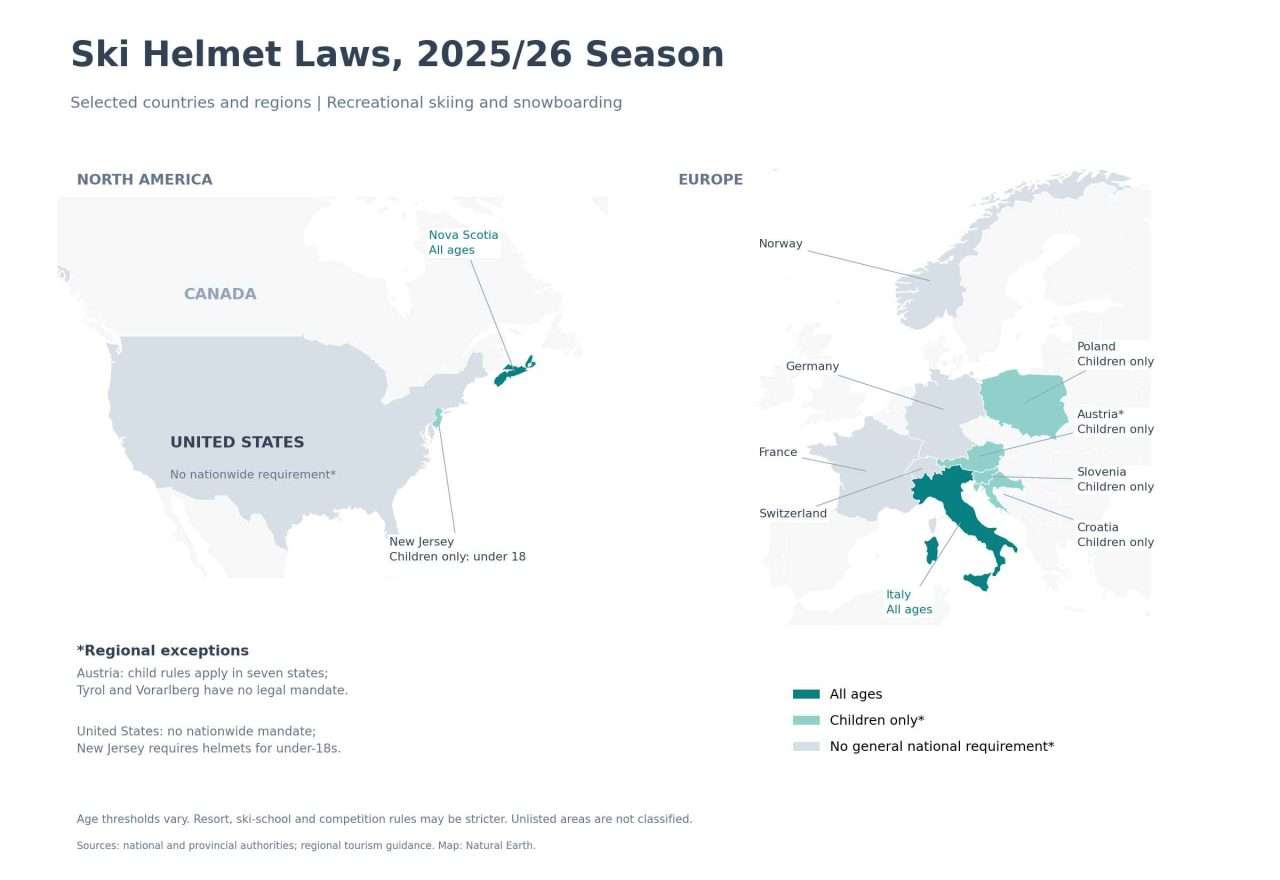
I would call myself an advocate of common sense rather than an advocate of ski helmet laws. Switzerland and the U.S. both reached 90%-plus helmet use without one, which suggests education does the heavy lifting. For a country-by-country rundown, see our guide to ski helmet laws around the world.
What Do Snowmobile Helmet Statistics Show?
Snowmobiles are a different animal entirely, since you’re steering a machine that can weigh over 600 pounds and top 90 mph. A widely cited 2003 review estimated that snowmobile accidents cause about 200 deaths and 14,000 injuries in North America each year, with head injury the leading cause of death. That baseline is now more than 20 years old, so treat it as a rough guide rather than a current count.
More recent hospital data paints the same picture. A study of 528 snowmobile trauma patients at two Wisconsin trauma centers found 45% suffered head injuries and 28% sustained vertebral fractures. Of the patients tested for alcohol, 60% were over the legal limit.
Because sleds reach highway speeds, the protection needed is closer to a motorcycle helmet than a ski helmet.
What Should You Take Away From Ski Helmet Safety Statistics?
Put all these ski helmet safety statistics together and a clear, if slightly uncomfortable, picture emerges. A helmet cuts your odds of a head injury by roughly a third, protects your skull and scalp extremely well, and does particularly good work for kids and park riders. It won’t reliably prevent a concussion, and it won’t save you from a tree at 30 mph.
The common sense approach is to stack the odds in your favor. Here’s what the data says actually moves the needle:
- Wear a certified helmet (ASTM F2040, EN 1077, Snell RS-98, or CSA Z263.1) that actually fits.
- Control your speed, especially on intermediate runs, where most fatal incidents happen, and anywhere near trees.
- Replace your helmet after a hard impact, or once age and UV exposure have taken their toll.
- Know the Responsibility Code and stay well clear of other people on the slope.
- Take head knocks seriously and go and see a doctor if symptoms appear.
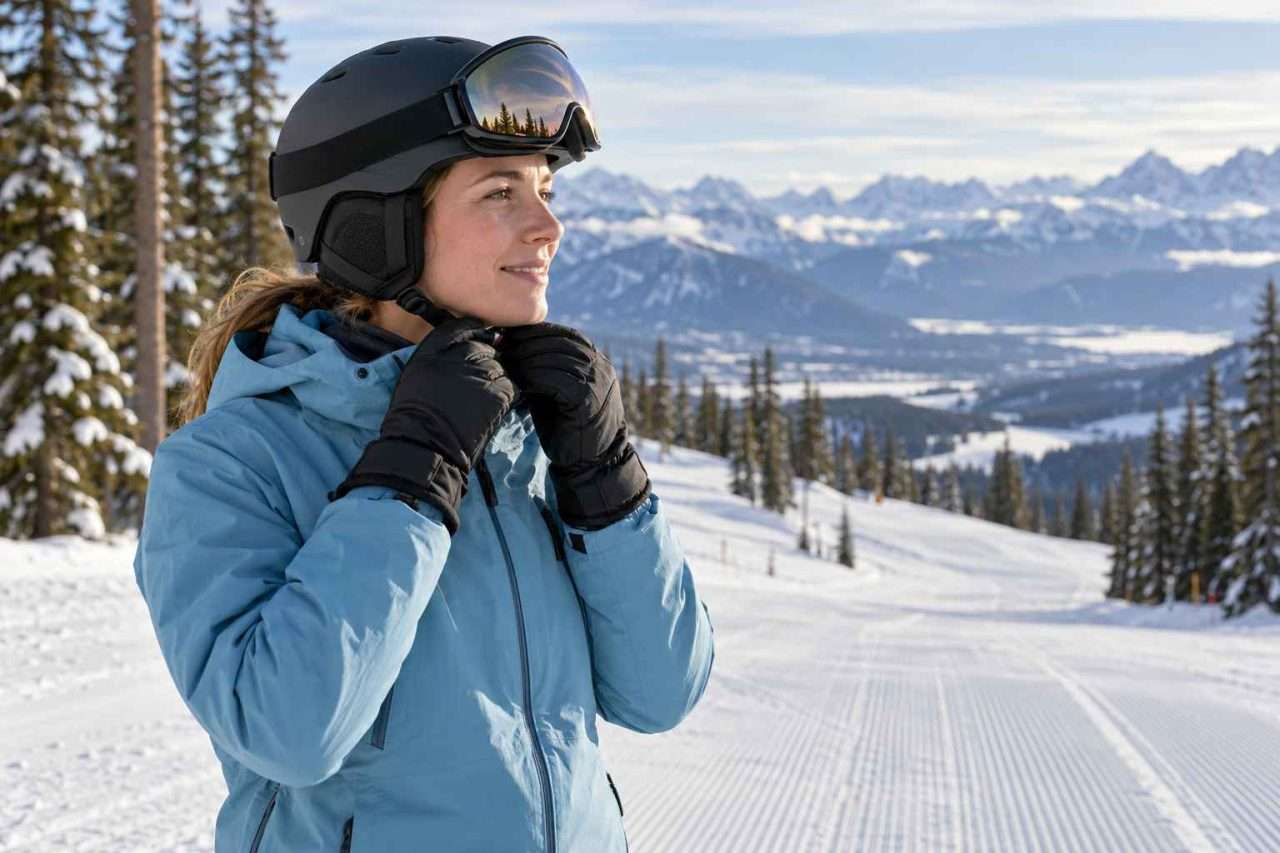
If you’re shopping, our guide to choosing a safer ski helmet covers certifications, rotational systems, and fit.
So, wear the helmet and ski like you aren’t wearing one. Your brain will thank you for both.
Frequently Asked Questions
Do ski helmets with MIPS reduce brain injury compared with standard EPS ski helmets?
Peel back the comfort padding on a MIPS helmet and you’ll see a thin plastic liner that lets your head slide a little on impact instead of twisting with the shell. What we don’t have yet is solid real-world data proving fewer brain injuries on the slopes. So, treat MIPS as a sensible upgrade, not a force field.
Does buying a more expensive ski helmet provide better head protection?
Pick up a $300 helmet next to a $60 one and most of the extra money is in the fit dial, the vents, the goggle clip and a lighter shell (things your head will appreciate, even if your brain doesn’t notice). So, check the certification sticker and the independent ratings first, then spend whatever’s left on comfort.
Can you wear a ski helmet for other sports such as ice skating or sledding?
Ice skating is where it gets a bit clunky, because a padded ski helmet with ear covers is overkill at an indoor rink (and you’ll cook). The point being, any certified helmet beats no helmet, but ice hockey is a different story and needs a proper hockey helmet.
Do kids need a different type of ski helmet than adults?
The real difference is fit, and I’ve lost count of the parents buying a size up ‘so they’ll grow into it.’ A loose helmet won’t protect them, so get a snug fit with a rear dial and skip the thick beanie underneath.
What age should a child start wearing a ski helmet?
Common sense says if they’re old enough to slide down a mountain on two planks, they’re old enough to wear a helmet. Start them young and it just becomes part of getting dressed, like boots and mittens (and far less of a fight than the mittens).
Are ski helmets required by law in any U.S. state?
No state requires adults to wear one, and similar bills elsewhere haven’t made it (California’s was vetoed and New York’s has yet to pass). So, across most of the country it comes down to your own common sense, which is exactly where it should be.
Do I need a CE-certified ski helmet to ski in Italy as a visitor from the United States?
Flip your helmet over and check the sticker inside for EN 1077. Plenty of US helmets carry both ASTM F2040 and EN 1077, but if yours is ASTM only, rent one over there rather than argue the point with the ski patrol.
RELATED READS