CPSC vs EN 1078 vs ASTM F1447: 3 Differences That Matter
The Short Version: CPSC, EN 1078, and ASTM F1447 differ in three key ways: jurisdiction and legal enforceability, impact test severity, and the head coverage area required. CPSC is mandatory for U.S. bicycle helmet sales, EN 1078 governs Europe, and ASTM F1447 is a voluntary U.S. standard.
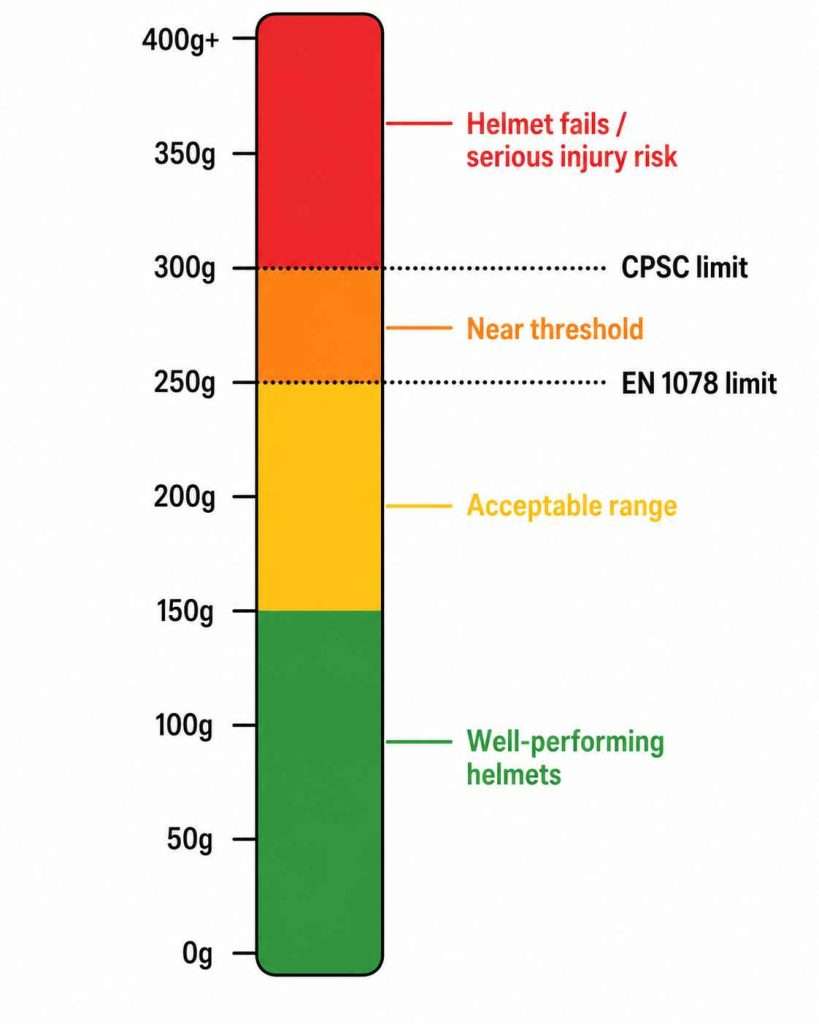
CPSC requires a flat-anvil drop from 2.0 meters with a peak acceleration limit of 300 g. ASTM F1447 uses essentially the same 2.0-meter flat-anvil drop, but a stricter acceleration limit of 275 g rather than 300 g. EN 1078 sets a stricter 250g threshold but uses lower drop heights and fewer anvil types. CPSC and ASTM F1447 require more extensive rear-head coverage than EN 1078, which allows a higher rear coverage line.
My neighbor picked up a new road helmet last summer when he was visiting family in Germany. Nice-looking lid, EN 1078 certified, good brand. Then someone at his local bike club told him it wasn’t legal to ride with it in the US. He came over to ask me if that was actually true, and honestly, I wasn’t sure.
So I decided to dig into it properly. What I found out about how CPSC, EN 1078, and ASTM F1447 actually differ – and why the differences matter more than most people realize – is worth knowing if you ride with any regularity.
What Are Bicycle Helmet Standards, and Why Do They Exist?
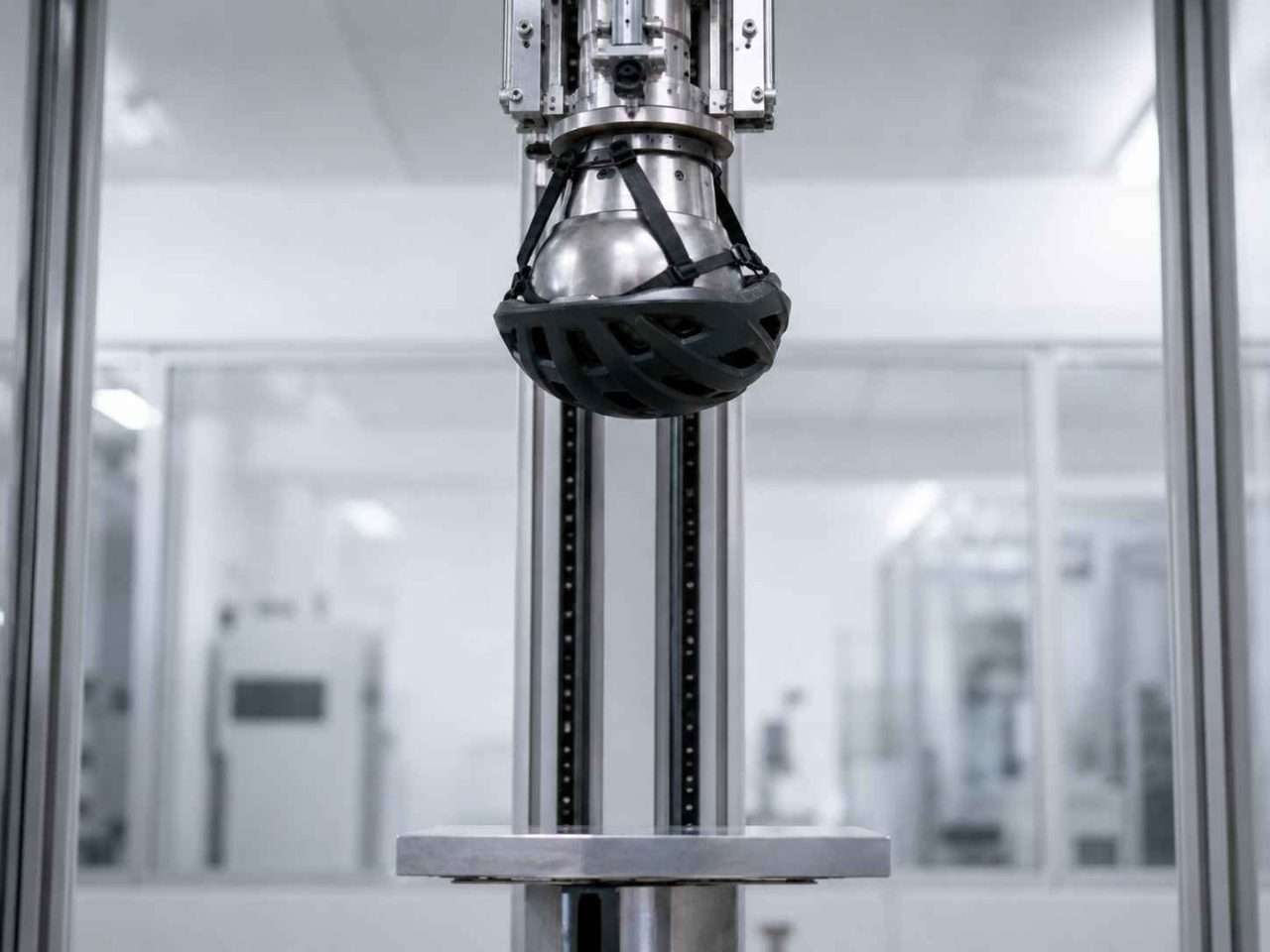
The short answer is that without them, manufacturers could sell helmets that look perfectly fine on a shelf but fail completely in a crash. Bicycle helmet standards set minimum requirements for how much force a helmet can transmit to your head during an impact, how well the retention system holds the helmet in place, and how much peripheral vision the design allows.
Every standard does essentially the same job. A test headform – a rigid head-shaped form fitted with an accelerometer – gets dropped inside a conditioned helmet onto fixed anvils. The accelerometer measures peak g-force transmitted through the helmet. Pass the threshold, pass the test. Simple in concept, but the details of drop height, anvil type, pre-conditioning, and threshold values are where the three major standards diverge in meaningful ways.
What Does CPSC 1203 Require?
CPSC 16 CFR Part 1203 is the mandatory federal standard for all bicycle helmets sold in the United States. It’s been law since March 10, 1999, when it replaced the old voluntary ANSI Z90.4 standard. Every helmet on a US store shelf, regardless of brand or country of manufacture, must comply with it before it can legally be sold.
The standard requires helmets to pass four tests. The one that gets the most attention is impact attenuation — meaning how much force the helmet absorbs before transmitting it to your head. Peak g-force cannot exceed 300g. The drop heights are 2.0 meters onto a flat anvil, and 1.2 meters onto both a hemispherical anvil (like a rounded rock) and a curbstone anvil (a 90-degree edge simulating a curb).
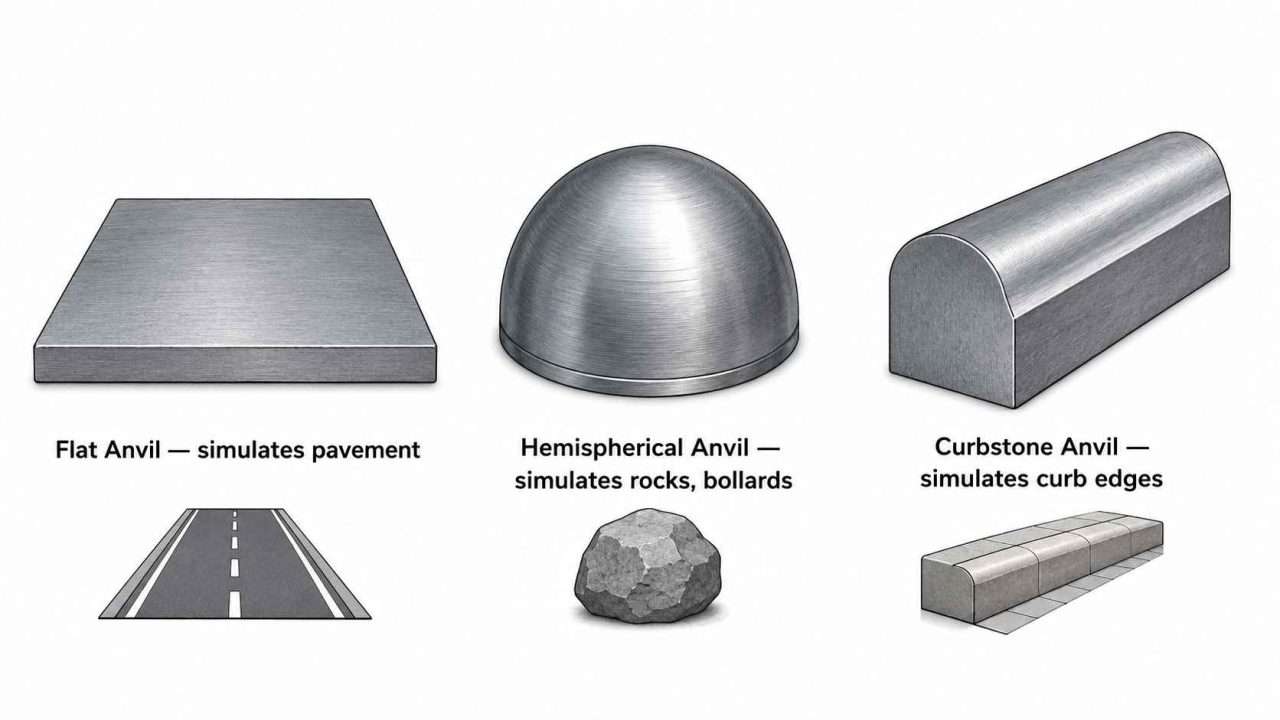
For a deeper look at drop tests, anvils, and what accelerometers actually measure, see our guide to see how helmets are actually tested during certification.
The other three tests cover peripheral vision (minimum 105 degrees unobstructed to each side), retention system strength (the strap must not stretch more than 1 inch under dynamic loading), and positional stability, sometimes called a roll-off test, which checks whether the helmet stays in position during an impact rather than rotating off the head.
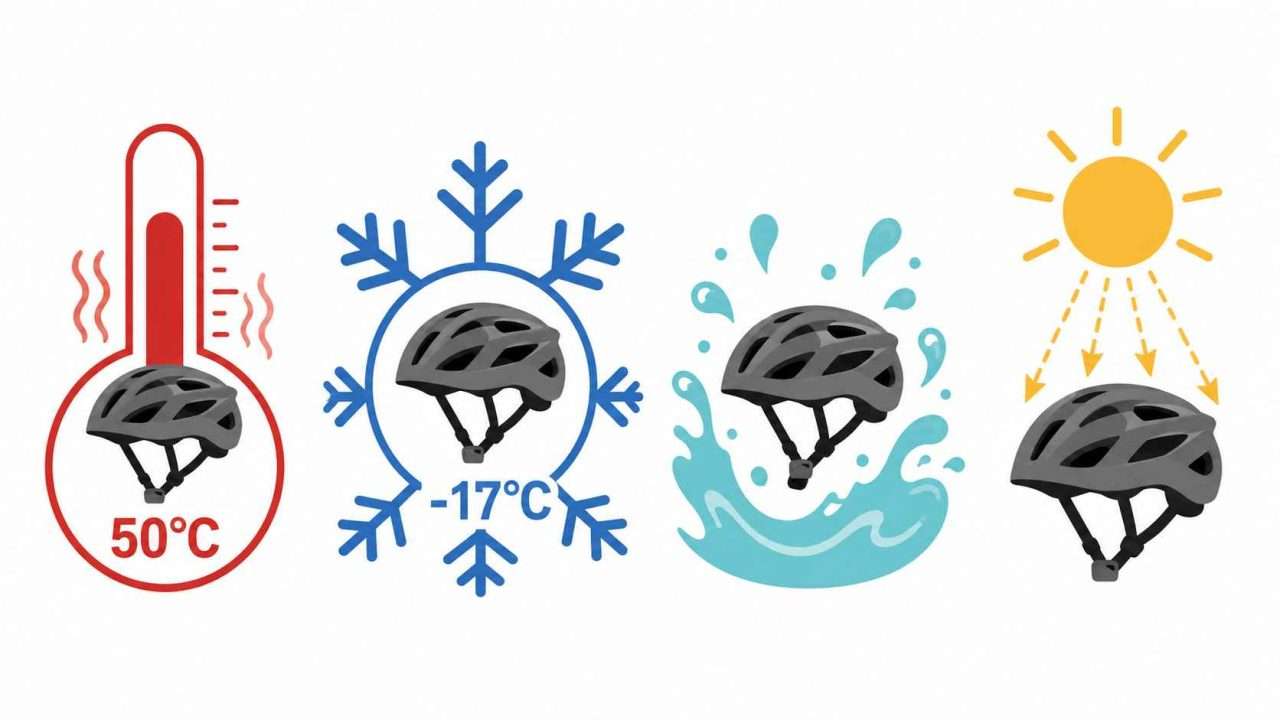
Before any of those tests happen, helmets undergo pre-conditioning to simulate real-world aging:
- High temperature: 47°C to 53°C for 4 to 24 hours
- Low temperature: -17°C to -13°C for 4 to 24 hours
- Water immersion for 4 to 24 hours
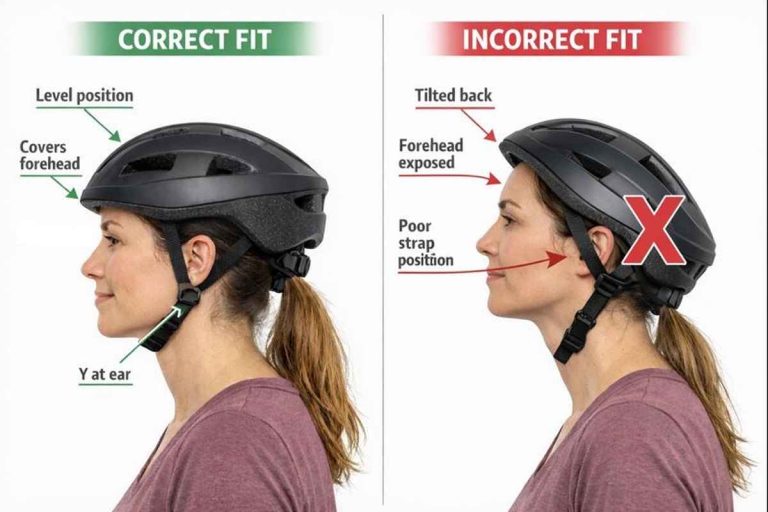

One thing worth knowing: CPSC is self-certification. The manufacturer tests their own helmets and declares compliance. There’s no mandatory third-party verification. The Consumer Product Safety Commission does conduct market surveillance and can pull non-compliant helmets, but the initial certification burden is on the manufacturer.
Special rule for children under 5: Helmets for children under five years old must meet extended head coverage requirements, protecting more surface area around the back and sides of the head. Young children have proportionally larger heads, weaker neck muscles, and thinner skull bones – the standard accounts for that.
In fact, Europe has a bike helmet standard totally dedicated to helmets for young children – EN 1080.
What Does EN 1078 Require?
EN 1078 is the mandatory European standard for bicycle, skateboard, and roller skate helmets. CEN (the European Committee for Standardization) published it in 1997, with a formal update and amendment in 2012. Any helmet sold within the EU or UK must carry CE marking based on EN 1078 compliance.
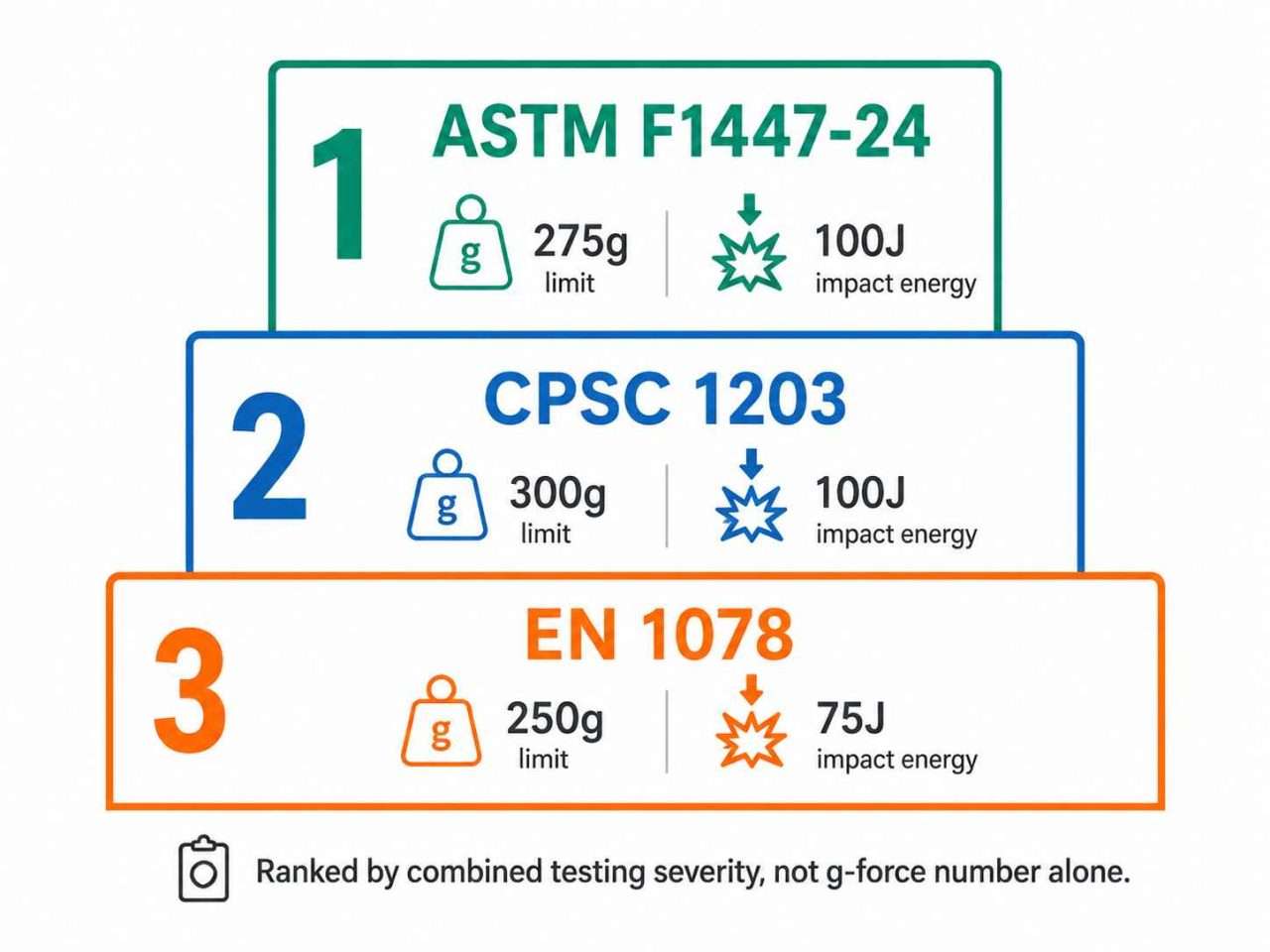
The testing structure is similar to CPSC but the specifications differ at several key points. Drop heights are 1.5 meters onto a flat anvil and 1.06 meters onto a kerbstone anvil. There is no hemispherical anvil test. Peak g-force threshold is 250g – stricter than CPSC’s 300g limit. Four impacts are required per helmet, on different areas (crown, side, rear, front).
Pre-conditioning covers:
- High temperature: 50°C for 4 to 6 hours
- Low temperature: -20°C for 4 to 6 hours
- UV aging under high-intensity xenon lamps simulating extended sun exposure
The retention system requirements test both strength (will the strap break?) and effectiveness (will the helmet stay on?). It must withstand dynamic loading without significant stretch or slip.
One structural difference worth noting: EN 1078 testing uses Safety Equipment Institute (SEI) or similar accredited third-party laboratories for certification. It’s not fully self-certified the way CPSC is. That adds a layer of independent verification, though it doesn’t change the testing specifications themselves.
The scope of EN 1078 is also broader than CPSC 1203 – it covers bicycles, skateboards, and roller skates under one standard. In Europe, you can legally ride a skateboard in a helmet certified to EN 1078, whereas the US uses separate certification tracks for different activities.
What Does ASTM F1447 Require?
ASTM F1447 is a voluntary standard published by ASTM International, the same organization responsible for testing standards across hundreds of industries. The current version is ASTM F1447-24. It’s optional – no US state or federal law requires it – but some manufacturers pursue it to demonstrate that their helmets exceed the mandatory CPSC minimums.
The headline difference is the g-force threshold: ASTM F1447 sets a maximum of 275g, compared to CPSC’s 300g. The Bicycle Helmet Safety Institute notes this 25g margin represents meaningful additional protection for a helmet that otherwise passes identical drop heights and anvil types to CPSC.
So the test conditions are essentially the same as CPSC – 2.0 meters flat, 1.2 meters hemispherical and curbstone – but the pass/fail line is stricter. A helmet could pass CPSC at 298g and fail ASTM at the same impact.
The practical reality is that you don’t see ASTM F1447 certification often. Most mainstream helmets carry CPSC only. Premium manufacturers sometimes certify to both. If you see both certifications on a helmet’s internal label, you can reasonably infer it performed comfortably within CPSC limits.
How Do CPSC, EN 1078, and ASTM F1447 Compare Side by Side?
| Feature | CPSC 1203 | EN 1078 | ASTM F1447-24 |
|---|---|---|---|
| Status | Mandatory (US) | Mandatory (EU/UK) | Voluntary (US) |
| Max G-Force | 300g | 250g | 275g |
| Flat Anvil Drop | 2.0 meters | 1.5 meters | 2.0 meters |
| Hemispherical Anvil | 1.2 meters | Not tested | 1.2 meters |
| Curbstone/Kerbstone | 1.2 meters | 1.06 meters | 1.2 meters |
| Pre-Conditioning | Heat / Cold / Water | Heat / Cold / UV | Heat / Cold / Water |
| Certification Model | Self-certification | Third-party (accredited lab) | Self-certification |
| Device Scope | Bicycles only | Bikes, skates, boards | Bicycles & Roller Skating |
| Peripheral Vision Test | Yes (105° min) | Yes | Yes |
| Roll-Off / Positional Stability | Yes | Yes | Yes |
The most important thing that table shows is the relationship between drop height and g-force threshold. CPSC drops helmets from greater heights, producing higher impact energy, but allows up to 300g. EN 1078 drops from lower heights but requires the result to stay under 250g. They’re testing different things at different intensities, and comparing just the g-force numbers without accounting for that is where most people go wrong.
Which Standard Is Toughest – and Why That Question Is More Complicated Than It Sounds
Most people assume the strictest standard is whichever one has the lowest g-force threshold. By that logic, EN 1078 wins at 250g. But that reasoning misses something important.
A helmet can only pass at 250g if the testing produces no more than 250g. If you reduce the drop height and eliminate one of the anvil types, you’re running a less energetic test. The lower threshold is achievable precisely because the impact conditions are gentler. It’s not that European helmets are inherently better at absorbing force – it’s that the test asks them to absorb less force to begin with.
Think of it like comparing test scores. Getting 90 out of 100 on an open-book quiz is a different achievement from getting 85 on a closed-book exam. The higher number doesn’t automatically reflect better knowledge.
CPSC’s 2.0-meter flat anvil drop produces approximately 25 joules more impact energy per test than EN 1078’s 1.5-meter drop. A helmet surviving that at 299g has absorbed a more severe real-world impact than one surviving an EN 1078 test at 249g. Neither number tells you the whole story without knowing the conditions that produced it.
The honest answer is that no single standard is comprehensively tougher than the others across every dimension. CPSC is more demanding in terms of raw impact energy and anvil variety. EN 1078 uses UV pre-conditioning that CPSC doesn’t, which better simulates a helmet that’s been worn in the sun for a season. ASTM F1447 sets the tightest g-force ceiling but otherwise mirrors CPSC conditions.
What About the Misconception That 250g Is Safer Than 300g?
This is the one that comes up constantly, so it’s worth spending a moment on it properly. The 250g vs 300g comparison is frequently cited as proof that European helmets offer better protection. The reasoning sounds logical: lower g-force means less force transmitted to your brain, so lower threshold equals better protection.
The problem is that you can’t compare the thresholds across standards without comparing the test conditions that produced them. The Bicycle Helmet Safety Institute’s standards summary notes that peak g limits across current bicycle helmet standards range between 250 and 300g depending on the standard — both thresholds reflect the same biomechanical danger zone, just approached from different testing philosophies. Both standards set their limits within that range, which is the meaningful shared purpose.
What the g-force number alone doesn’t tell you is whether a helmet certified to 250g under EN 1078 conditions would also pass 300g under CPSC’s more severe conditions. A well-made premium helmet sold in Europe will often carry both certifications – and that dual certification is worth looking for if you want the strongest evidence of overall performance.
Can I Use a European Helmet in the United States?
Back to my neighbor’s question. The answer is: it depends on what’s printed on the inside of the helmet.
A helmet certified only to EN 1078 is not CPSC compliant and cannot legally be sold as a bicycle helmet in the U.S. Whether it is legal to wear depends on state or local helmet laws, but for U.S. riding the practical advice is simple: look for the CPSC certification label. More importantly, EN 1078-only helmets are designed to pass a less energetic test – they may use thinner, lighter foam than CPSC-certified helmets, which means they might not perform as well in the kind of high-energy impacts that CPSC testing simulates.
However, many quality helmets sold in Europe carry both EN 1078 and CPSC certification. If your helmet’s internal label shows both CE marking and CPSC 1203 compliance, you’re fine. It’s been tested to both standards and meets both.
The practical guidance:
- Riding in the US: check for CPSC certification on the internal label
- Riding in Europe: check for CE marking based on EN 1078
- Riding both: look for dual-certified helmets, which are widely available from major brands
What Do CPSC, EN 1078, and ASTM F1447 Not Cover?
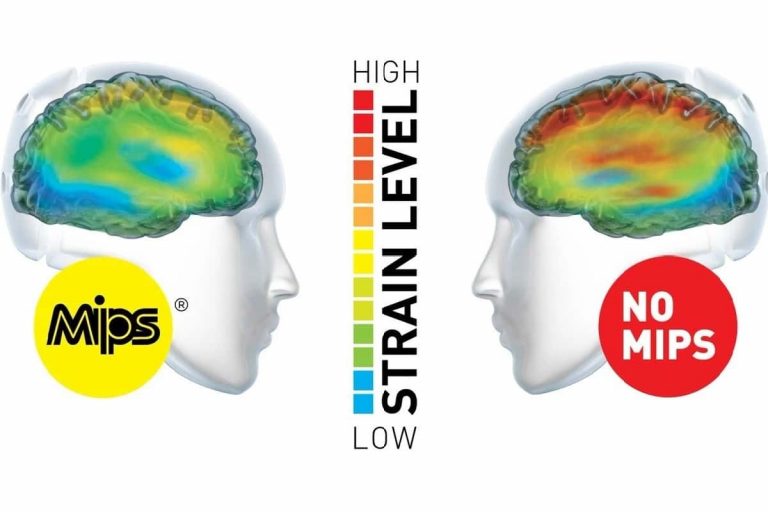
This is an important gap to understand. Every one of these standards tests only linear impacts – straight-on, direct hits. None of them test rotational forces.
In real crashes, your head rarely hits something in a perfectly straight line. More often there’s a glancing, oblique impact that sets your head rotating – and rotational acceleration is closely associated with concussions and diffuse axonal injuries, the kinds of brain trauma that don’t always show up on a scan but do show up in symptoms weeks later.
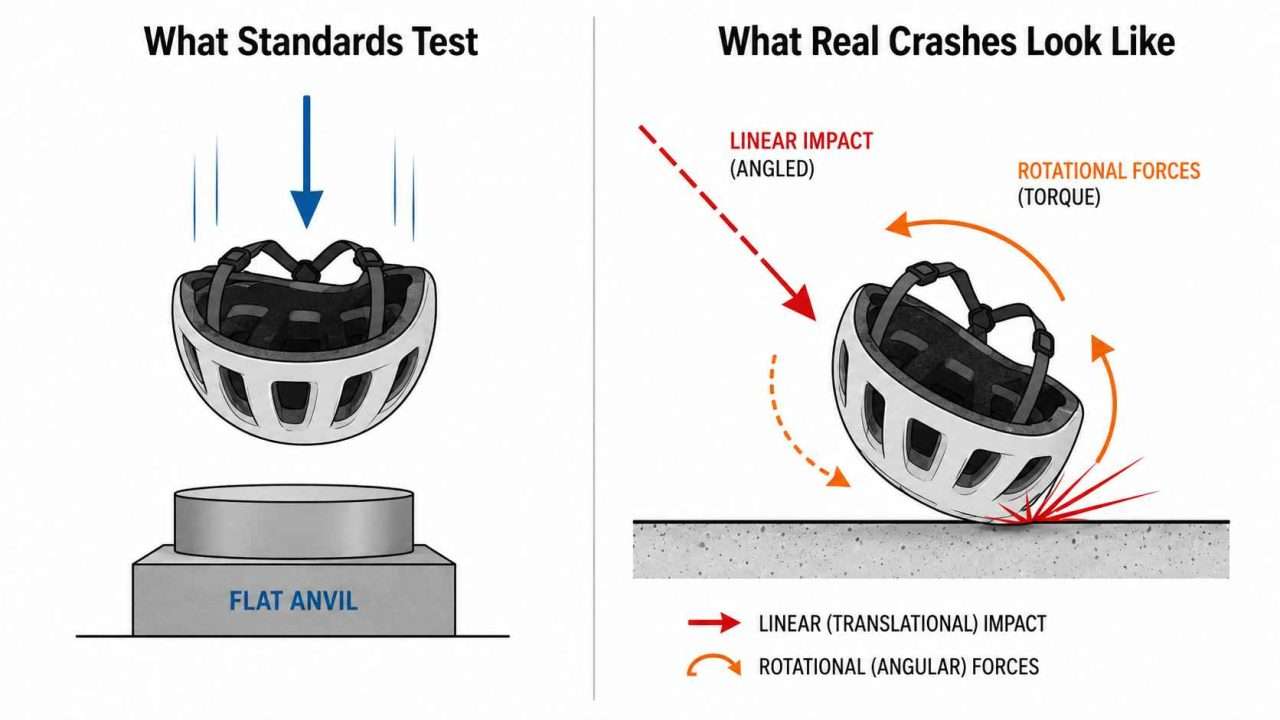
EN 1078 is expected to add rotational force testing in a future update, possibly as early as 2026. CPSC has no announced timeline for similar changes. Until mandatory standards catch up, voluntary testing programs like Virginia Tech’s STAR ratings – which do include rotational force measurements – are the most reliable way to compare helmets beyond what certification alone tells you.
The point being: certification tells you a helmet passed a laboratory test. It doesn’t tell you everything about how that helmet will perform in your specific crash.
What Does the Certification Label Inside Your Helmet Actually Show?
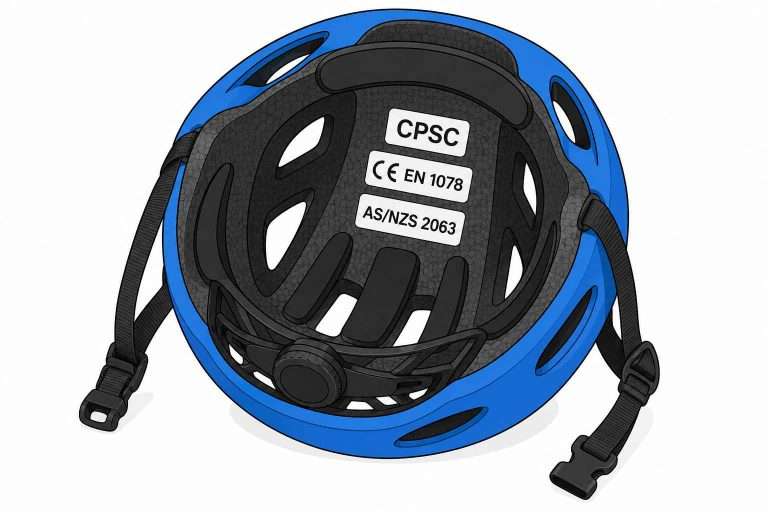
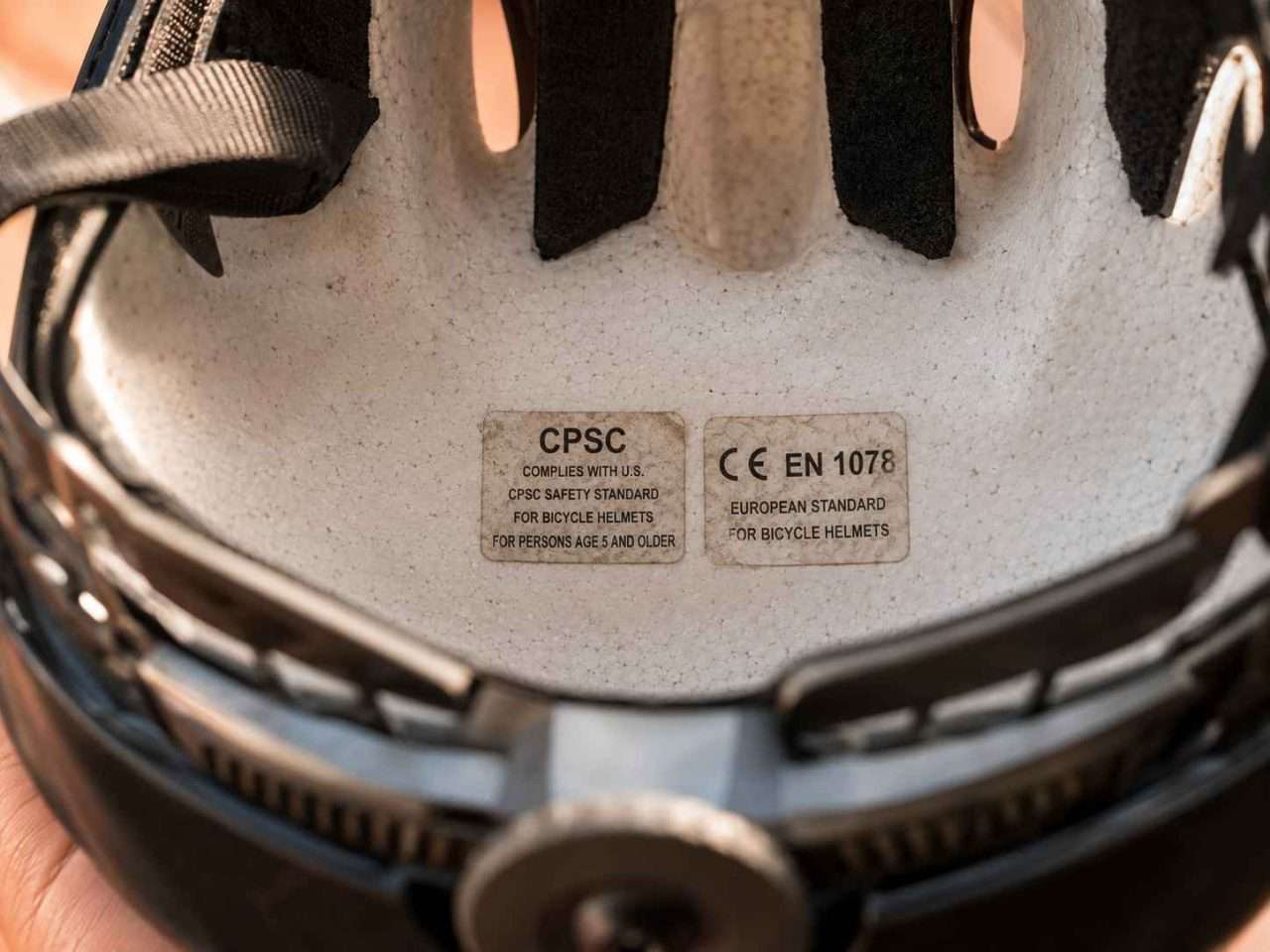
The internal label is where you find the real information. Most helmets have a sticker or molded label on the inside of the foam liner. Here’s what to look for:
For CPSC compliance, you’ll see language referencing “CPSC 16 CFR Part 1203” or simply “CPSC 1203.” Some helmets also include the words “Complies with U.S. CPSC Safety Standard for Bicycle Helmets.”
For EN 1078 compliance, look for the CE mark (the interlocking C and E) followed by “EN 1078.”
For ASTM F1447 compliance, the label will reference “ASTM F1447” followed by the year of the standard version (e.g., ASTM F1447-24).
A helmet with all three certifications listed is about as well-documented as a bicycle helmet gets at the mandatory and voluntary levels. It’s been tested to the strictest g-force threshold (275g from ASTM), the highest impact energy (CPSC’s drop heights), and independently verified through accredited lab testing (EN 1078’s third-party process).
So, Which Standard Should You Care About?
If you’re in the US, CPSC certification is the floor. It’s the law, and it represents a genuinely rigorous set of tests. A helmet that passes CPSC has survived impacts that a lot of real crashes won’t exceed.
If you want more than the floor, ASTM F1447 dual certification is a reasonable signal that a helmet comfortably passed CPSC conditions. The 275g threshold means it had more room to spare.
If you’re riding in Europe or buying a European brand, EN 1078 is the baseline requirement. For international use, look for helmets with both CE (EN 1078) and CPSC markings.
And if you want the most complete picture of how a helmet actually performs – not just whether it passed a lab test, but how it ranked against other certified helmets – look at independent ratings. Virginia Tech’s STAR system tests 24 impacts including rotational forces, which takes you well beyond what any mandatory standard requires.
So, all certified helmets provide real protection. The differences between standards matter most at the margins – for riders doing high-speed descents, racing, or anyone who wants to know they have more than the legal minimum. Common sense says: start with the right certification for where you ride, and go from there.
Bicycle Helmet Safety Standards – Frequently Asked Questions
What does CPSC stand for?
How often are ASTM standards reviewed?
What is CPSC compliant?
How are bicycle helmets tested?
An accelerometer inside the headform measures the g-forces transmitted through the helmet on impact. The helmet must keep that peak below 300g. It also has to pass the peripheral vision test, stay put during the positional stability test, and its retention straps must not stretch more than 30mm during the dynamic strength test. Fail any one of those, and it can’t be certified.
How often are ASTM standards updated?
Are EN 1078 bike helmets legal in Australia?
However, there is one important caveat – whether you can legally ride while wearing that helmet depends on the road rules of each state and territory, which are separate.