What Bicycle Helmet Testing Measures and What It Misses
The Short Version: Bicycle helmet testing measures linear impact absorption, retention system strength, coverage area, and positional stability. Current standards use a linear accelerometer at the center of gravity of a metal headform and constrain drop tests to linear motion. They do not measure rotational forces on the head, which are a key mechanism of diffuse brain injuries such as concussion.
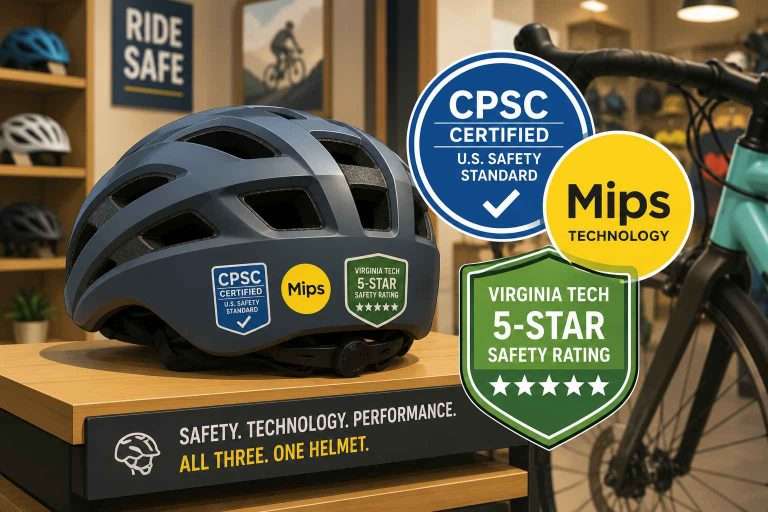
Real-world cyclist head impacts are nearly always oblique — arriving at an angle — rather than the straight vertical drops that standards specify. Voluntary ratings programs such as Virginia Tech’s STAR system test helmets under oblique conditions and publish concussion-risk rankings that go beyond what certification requires.
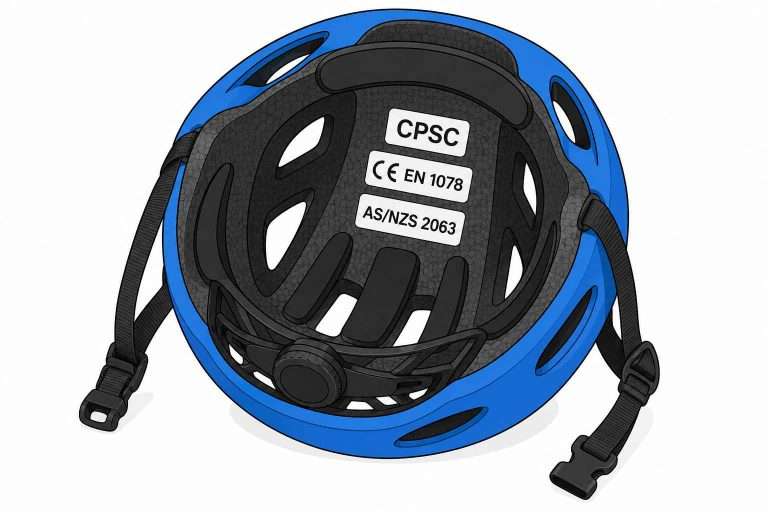
Every certified bicycle helmet on a store shelf has been dropped, struck, baked, frozen, soaked, and yanked before it got there. That CPSC (Consumer Product Safety Commission) sticker inside your helmet isn’t decorative. It means the helmet passed a battery of lab tests, and the testing is more involved than most people realize.
What’s interesting is that not all standards test the same way. The differences between CPSC, EN 1078, and Snell show up not just in what numbers a helmet has to hit, but in how hard the lab is allowed to push it to get there. Same goal, different methods, and the details matter.
Let’s take a look at what actually happens inside the test lab.
Why Does Bicycle Helmet Testing Even Matter?
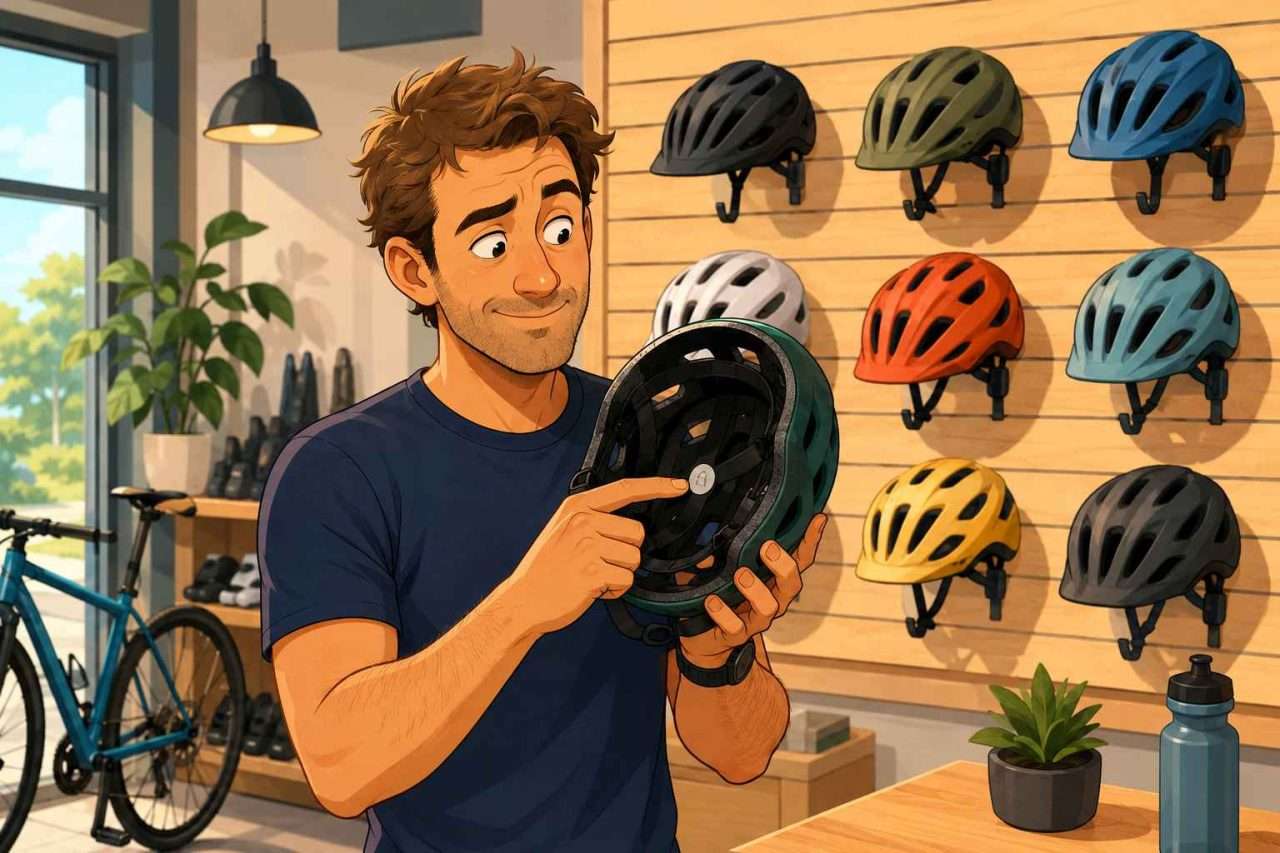
You might think that any helmet is better than no helmet, so why do the specifics of testing matter? It’s a fair question. The answer is that without standardized testing, manufacturers could build a helmet that looks protective, feels sturdy in your hands, and still fails catastrophically in an actual crash. The foam could crumple too fast. The straps could snap. The shell could shatter on an edge instead of spreading the force.
Certified bicycle helmet testing answers one question above all others: will this helmet still be doing its job when you really need it? The tests are designed to simulate the kinds of impacts real riders actually experience – hitting pavement at speed, striking a curb edge, or clipping a rock. Pass every test, and the helmet earns its certification. Fail any single one, and it goes back to the drawing board.
It’s an all-or-nothing system. You don’t meet a standard “except for one test.” A failure on any element is a complete failure, full stop.
What Happens Before a Helmet Is Even Dropped?
Before any drop test happens, the lab has to do two things: get the right samples, and mark each one precisely. Full compliance testing for CPSC 1203 requires 8 samples of the same helmet model. That’s not one helmet getting tested 8 times – it’s 8 separate units, because different samples go through different conditioning treatments.
The lab also needs a number from the manufacturer called the Helmet Positioning Index, or HPI. This tells the technician exactly how far forward to place the helmet on the test headform, measured from a reference point on the headform’s face. Without the HPI, the helmet could be sitting too far back or tipped forward, which would throw off every subsequent test. It’s a simple concept – standardize the fit before you test the helmet – but it’s a critical one.
Once the helmet is seated correctly using the HPI, a 5-kilogram (about 11-pound) bag of lead shot is placed on top of it. This compresses any fit padding inside, replicating how the foam settles when an actual head is wearing the helmet. Then a marker traces the “test line” all the way around the helmet’s circumference. Every subsequent impact during drop testing must land on or above that line – the area below it is simply not required to be tested.
What Are the Variable Mass Headforms Used in Testing?
The headforms used in drop testing aren’t generic props – they’re precisely specified forms made from low-resonance magnesium alloy, chosen in sizes that correspond to different helmet sizes. Under CPSC 1203, headform sizes are drawn from an international ISO specification (DRAFT ISO/DIS 6220-1983) and come in sizes labeled A, E, J, M, and O.
The rule is that each helmet gets tested on the smallest headform it fits. “Fits” means all the helmet’s sizing pads are at least partially compressed when the thickest pads are installed and the helmet is correctly positioned. This matters because testing on a headform that’s too small would give the foam more room to deform than it would on a real head – artificially inflating performance numbers.
Under Australian and European standards, drop assembly weights vary by headform size – for example, the AS/NZS 2063 twin-wire drop rig uses assemblies of 3.5, 4.0, 5.0, and 6.0 kg for its four headform sizes. CPSC specifies a fixed drop assembly weight of 5 kg (plus or minus 0.1 kg) regardless of headform size. These are the variable mass headforms described in testing literature – different sizes, different weights, same purpose: simulate a human head of the appropriate proportions.
How Does the Monorail and Twin-Wire Test Rig Work?
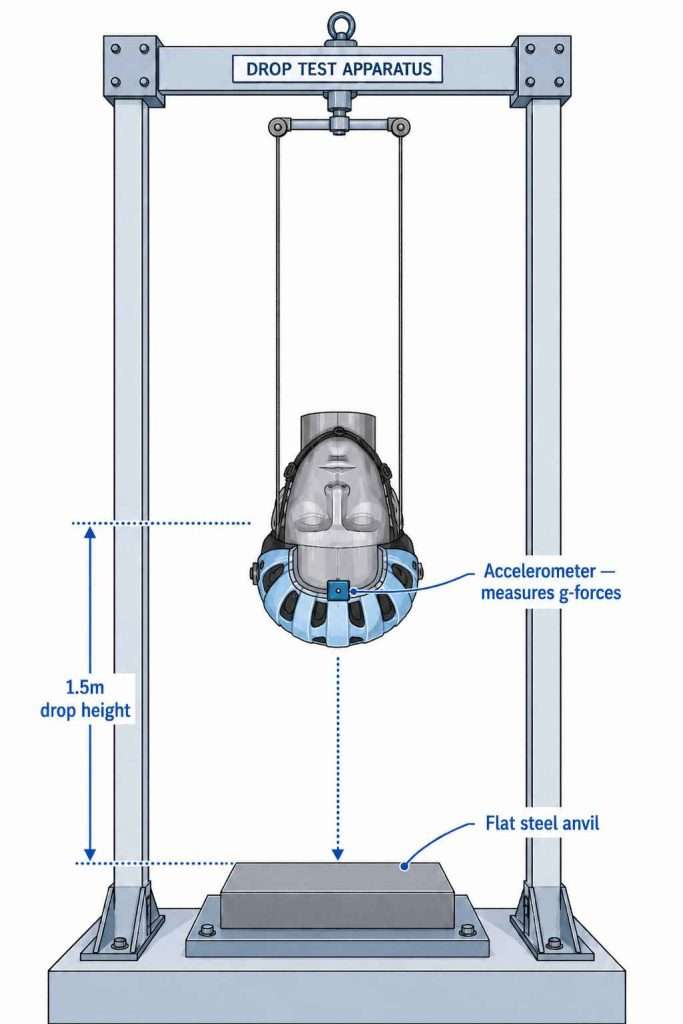
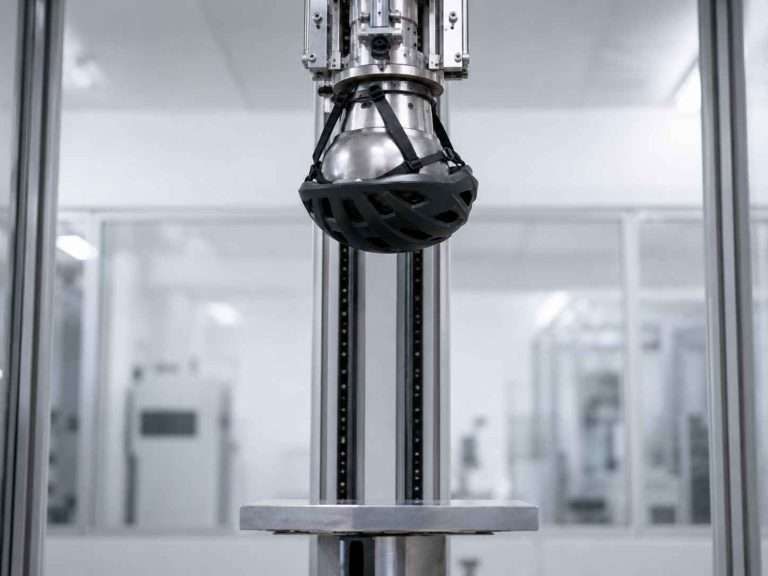
Here’s where it gets satisfyingly mechanical. The helmet is strapped upside down onto the headform, which is then mounted on a guided drop apparatus. There are two main types: a monorail rig, where the headform slides down a single rail, and a twin-wire rig, where two parallel wires guide the fall. Both achieve the same result – a controlled, straight-down free fall with no sideways drift that would compromise the impact point.
The Bicycle Helmet Safety Institute describes it this way: the technician raises the helmet and headform to a specified height, then a trigger releases it into free fall. Just before impact, the drop velocity is checked to confirm it’s within the required range for that test. Inside the headform is an accelerometer – the instrument that measures everything that actually matters.
CPSC specifies a uniaxial accelerometer capable of measuring up to at least 1,000 g, with its sensitive axis aligned within 5 degrees of vertical. The center of gravity of the entire drop assembly (headform plus support hardware, minus the helmet) must fall within a tightly defined rectangular area around the impact point. All of this precision exists for one reason: to make sure every lab, everywhere, is running the same test.
What Are the Three Anvil Types and What Does Each One Simulate?
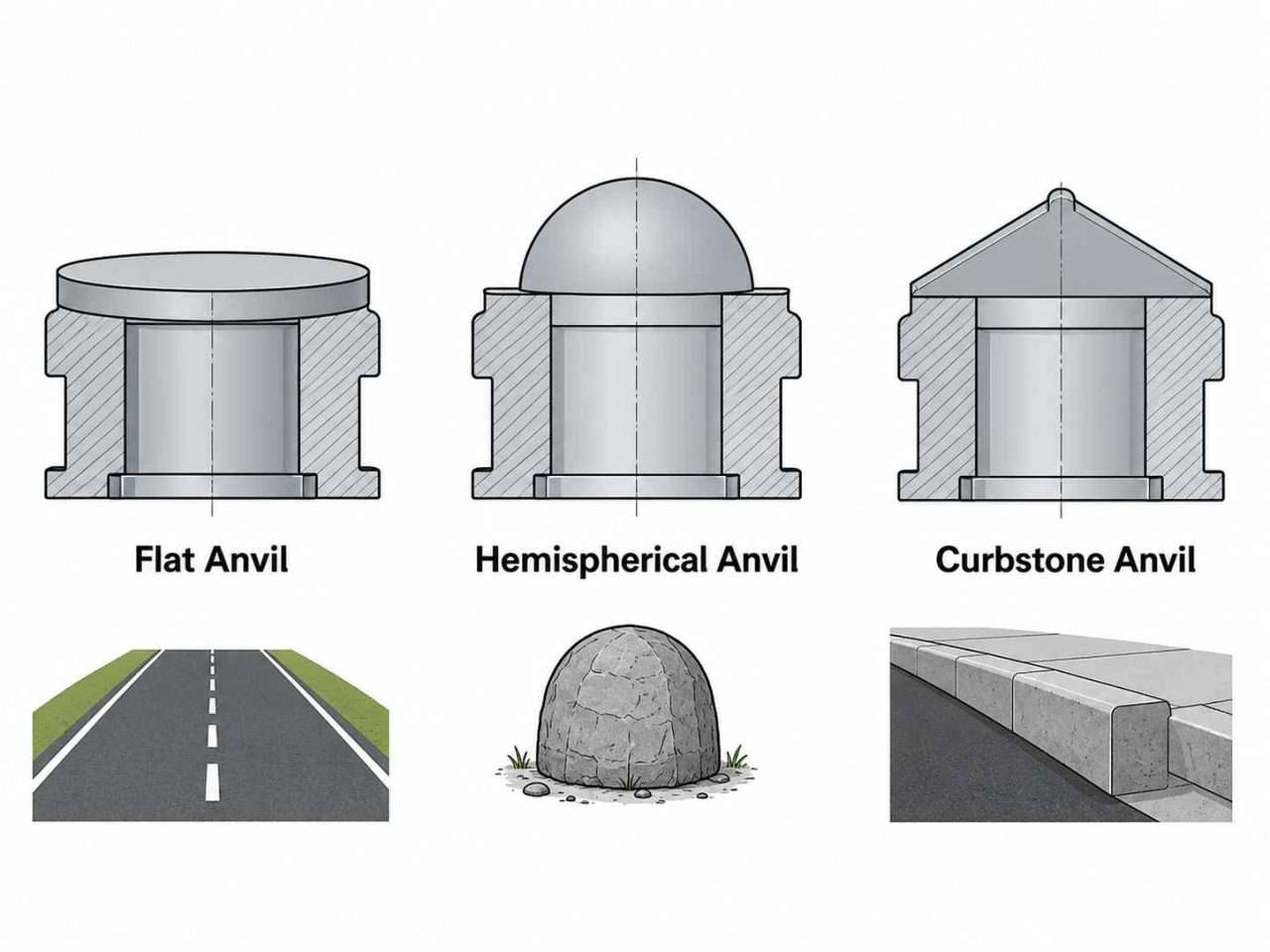
This is probably the most practically interesting part of the whole process. The anvil the helmet lands on isn’t just a flat plate – different anvil shapes simulate different real-world hazards, and not every standard uses all three types.
Think of it this way. The surface your head might hit in a crash isn’t always smooth pavement. Sometimes it’s the edge of a curb. Sometimes it’s a rock. The anvil shapes are designed to replicate those scenarios.
The flat anvil simulates hitting a smooth, hard surface – pavement, a road surface, a floor. Under CPSC 1203, the helmet and headform are dropped from 2.0 meters onto the flat anvil, reaching an impact speed of approximately 14 mph. EN 1078 uses a flat anvil drop of approximately 1.5 meters (impact velocity 5.42 to 5.52 m/s). AS/NZS 2063 also uses a 1.5-meter flat anvil drop – and it’s the only anvil type the Australian standard uses.
The hemispherical anvil is roughly the shape of a grapefruit cut in half – a rounded dome. Under CPSC testing, it’s used with a 1.2-meter drop (about 11 mph impact speed). EN 1078 does not include a hemispherical anvil test. The rounded shape concentrates the impact force into a smaller area, which is why it’s considered a particularly demanding test – the helmet can’t spread the force as effectively across a curved point as it can across a flat surface.
The curbstone (or kerbstone) anvil is rounded like the edge of a concrete curb – a specific curved profile that replicates striking the lip of a raised surface. CPSC uses a 1.2-meter curbstone drop. EN 1078 uses a kerbstone anvil with a 1.06-meter drop. The kerbstone and hemispherical tests are what separate CPSC from EN 1078 in terms of severity – CPSC subjects helmets to both, while EN 1078 uses only the kerbstone alongside the flat anvil.
The upshot is that a CPSC-certified helmet has been struck on three different surface types at varying heights, while an EN 1078-only helmet has been struck on two. Neither approach is wrong, but they’re testing for different scenarios – and that difference matters when you’re considering which certification to look for.

What Does Pre-Treatment Conditioning Actually Do?
Here’s something most people never think about: the helmets that go into drop testing aren’t fresh out of the box. Before a single drop happens, samples are put through environmental conditioning designed to simulate what real-world wear does to a helmet’s materials over time. Temperature, moisture, UV exposure – all of these degrade EPS foam and shell materials, and testing on a brand-new helmet only tells you how it performs on day one.
Under CPSC 1203, the 8 samples are divided into four groups of two. One group is tested at ambient room temperature. A second group is heated to 47–53°C (117–127°F) for 4 to 24 hours, replicating a helmet left in a hot car or worn in summer heat. A third group is chilled to -13 to -17°C (roughly 9 to 1°F) for 4 to 24 hours, simulating cold-weather use. The fourth group is soaked in potable water at 17–27°C for 4 to 24 hours, replicating rain exposure or a sweaty, wet-helmet ride.
EN 1078 conditioning follows a similar logic but uses a UV aging step instead of a water soak – helmets are exposed to high-intensity xenon lamps that simulate weeks of sun exposure. High temperature conditioning under EN 1078 is 50°C for 4 to 6 hours; cold conditioning is -20°C for 4 to 6 hours. The point being that a helmet that performs beautifully when cold but collapses when warm (or vice versa) is not a helmet you can trust year-round.
This pre-treatment requirement is one of the most important – and most overlooked – aspects of helmet certification. It’s also a key reason why replacing a helmet after significant age or heat exposure makes sense from a materials science standpoint, not just a marketing one.
How Does the Accelerometer Measure Head Injury Risk?
Inside the test headform is an accelerometer – a small sensor that records the peak deceleration experienced during impact, expressed in units of g (gravitational force). When the helmet and headform strike the anvil, the foam liner compresses and slows the deceleration over a slightly longer time period. That’s the whole point of the foam: stretching out the deceleration so your brain isn’t whipped to a stop all at once.
The accelerometer captures the peak g-force at the moment of maximum deceleration. Research and standards bodies have established that peak linear accelerations around 250–300 g are associated with a sharply increased risk of severe head or brain injury, which is why standards set their maximum thresholds in that range. CPSC 1203 sets the limit at 300g. EN 1078 sets it at 250g. ASTM F1447 (the voluntary US standard) sets it at 275g, which is stricter than the mandatory CPSC requirement.
In practice, the better-performing helmets don’t just scrape under the limit – they come in well below it. The Bicycle Helmet Safety Institute notes that helmets working well typically register below 200g, and in the better ones below 150g. So the 300g threshold is the floor, not the target. A helmet recording 295g on every drop is technically passing, but a helmet recording 150g is doing a lot more work for your brain.
It’s also worth knowing what the accelerometer doesn’t measure: rotational forces. More on that shortly.
What Are the Retention System Tests?
A helmet that absorbs impact beautifully but flies off your head during a crash is not a helmet. The retention system tests – strap strength and the rolloff test – make sure the chin strap and buckle assembly actually do their job under dynamic loading.
The CPSC dynamic retention test works like this: the helmet is placed on a headform fitted with an artificial chin. A cable runs from the back of the helmet, over the top, and attaches to a weighted drop apparatus. A 4-kg (8.8-lb) weight drops 0.6 meters (2 feet) onto a stop anvil, yanking the strap with a sharp jolt. The strap must not break, and the retention system must not stretch more than 1 inch (about 25mm) under this loading. The test is run both face-down and face-up to simulate different crash orientations.
The rolloff test is slightly different – it checks whether the helmet will rotate off the headform when force is applied. The helmet must not come off the headform when the weight drops. It sounds simple, but it’s the test that catches helmets with poorly designed shell geometry or straps positioned too far back. A helmet that’s technically strapped on but rolls off your forehead in a crash offers almost no protection at all.
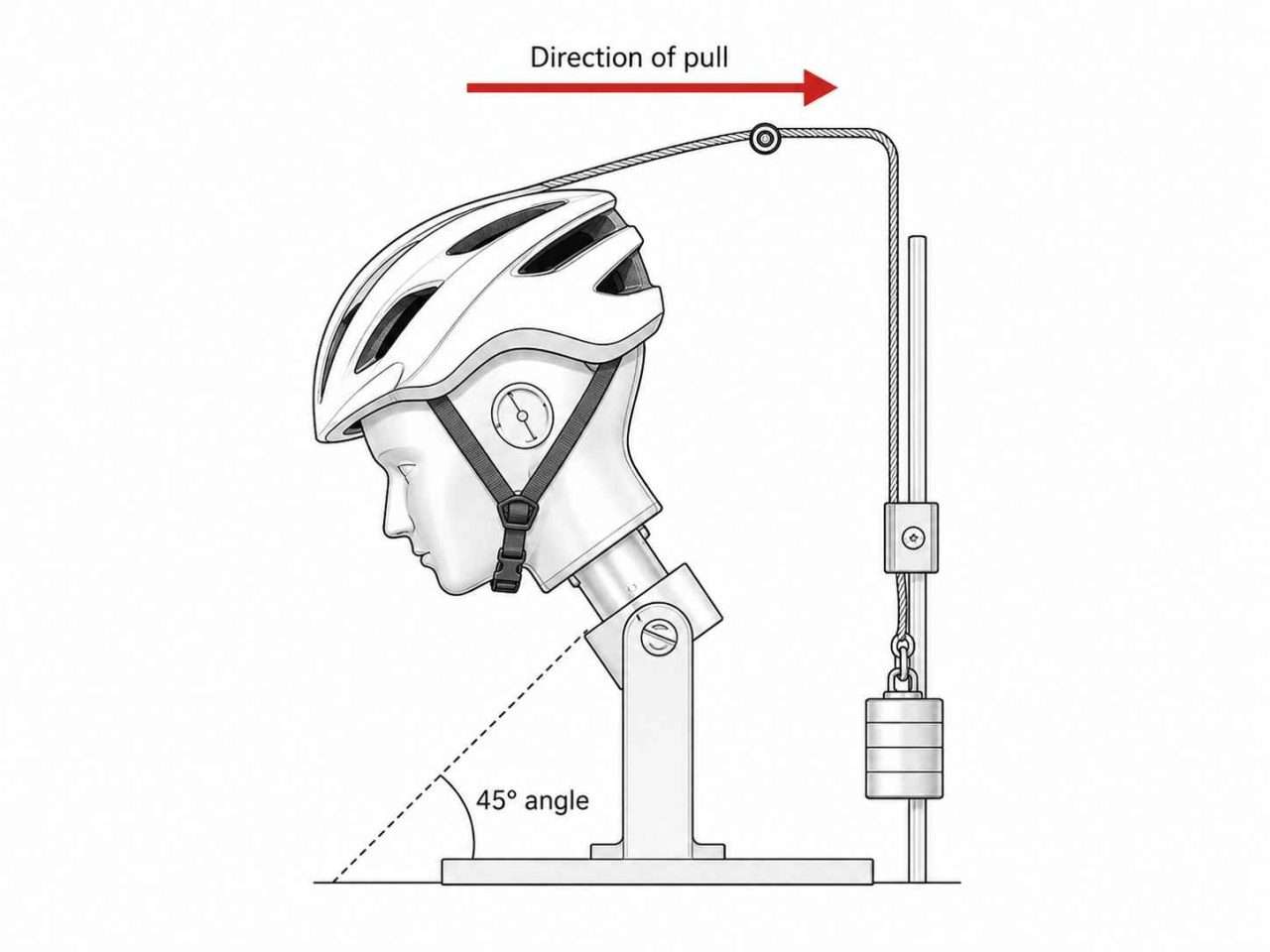
EN 1078 also tests retention system effectiveness by applying a shock load to the rear or front of the helmet, attempting to pull it off the headform – simulating the risk of the helmet catching on something and being yanked away during a fall.
How Does the CPSC Standard Compare to EN 1078 in Testing Severity?
This is the question that trips up a lot of riders – especially anyone who’s noticed that EN 1078 has a lower g-force limit and assumed that must mean it’s tougher. Let’s walk through what the numbers actually tell us.
The EN 1078 limit of 250g is indeed stricter in absolute terms. But the testing that produces that number is gentler – lower drop heights, less impact energy per drop, and no hemispherical anvil test at all. A helmet can pass at 249g on a 1.5-meter flat drop and still potentially transmit more force to your head in a severe real-world crash than a CPSC helmet that recorded 290g on a 2.0-meter flat drop followed by two 1.2-meter anvil drops.
The analogy that works here: it’s like comparing exam grades from two different tests. An A on an easy quiz and a B on a much harder one don’t tell you the same thing about what the student actually knows. The score only means something in the context of what generated it.
So, CPSC testing hits helmets harder and in more ways. EN 1078 demands a lower peak reading but gets there with less force. Both produce helmets that offer real protection – but understanding the difference helps you evaluate what you’re actually buying.
How Does Snell B-95 Testing Differ From CPSC?
The Snell Memorial Foundation’s B-95 standard – the voluntary certification you’ll occasionally see on premium bicycle helmets – uses a flat anvil drop of 2.2 meters, versus CPSC’s 2.0 meters. That’s a modest difference in height but a meaningful difference in impact energy, since energy increases with the square of velocity. The g-force limit is the same 300g as CPSC, but the helmet has to hit that limit from greater height and higher impact speed. Snell also includes a curbstone anvil test.
Not many bicycle helmet manufacturers pursue Snell B-95. The reason is fairly practical: absorbing more impact energy without exceeding the g-force limit requires more foam, which means a heavier, thicker, less-ventilated helmet. Consumers vote with their wallets, and a noticeably heavier helmet is a hard sell even if the safety case is strong. That’s not a knock on Snell – it’s just the commercial reality of the cycling market, as opposed to, say, motorcycle helmets where Snell certification is far more common.
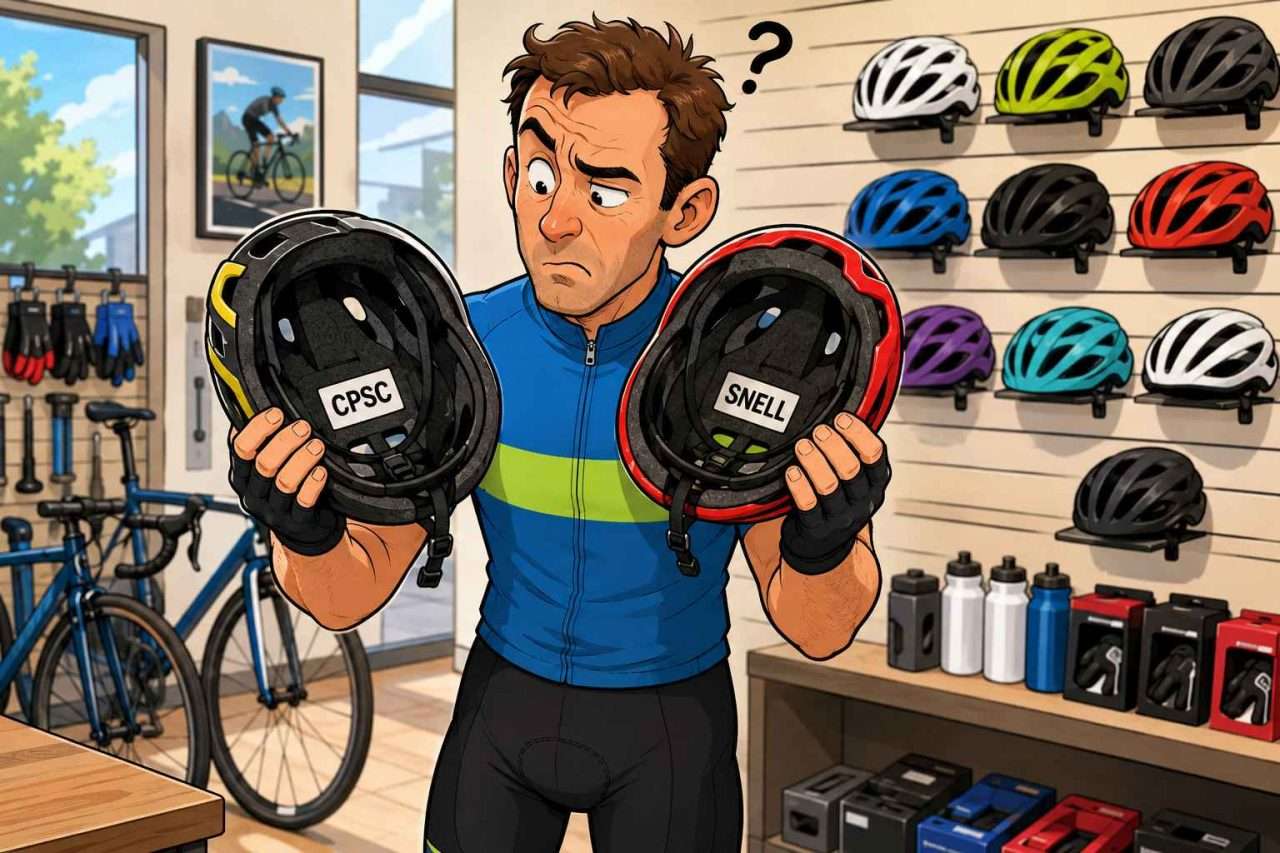
For a deeper look at how Snell B-95 stacks up against CPSC across every testing parameter, that comparison is covered in full in the Snell vs CPSC spoke of this series.
What Does Current Testing Not Cover?
This is arguably the most important section in this whole article, because it’s where the gap between certification and real-world protection is widest.
Every major bicycle helmet standard – CPSC, EN 1078, AS/NZS 2063, ASTM F1447 – tests exclusively for linear impacts. The headform drops straight down, the accelerometer measures straight-line deceleration, the pass/fail decision is made. What none of these tests measure is rotational force.
In a real crash, your head rarely takes a purely linear hit. More often, it glances off a surface at an angle, which twists the head and brain relative to each other. This rotational motion is associated with concussions, certain types of hematomas, and diffuse axonal injuries (DAIs) – the kind of injury where axons in the brain are stretched or torn. These injuries can produce long-lasting impairments in memory, sleep, and motor function, and can occur even when the helmet passes all its linear tests without incident.
Technologies like MIPS (Multi-directional Impact Protection System) are specifically designed to address this gap, allowing the liner to rotate slightly relative to the shell on oblique impact. But MIPS and similar technologies are not required by any mandatory standard yet. You have to actively look for them.
It’s worth noting that EN 1078 is expected to be updated – possibly in 2026 – to include rotational force testing for the first time. That would be a significant step forward for the standard, and the rest of the certification world will be watching closely. For now, though, if rotational protection matters to you (and it should), certification alone doesn’t guarantee it’s there.
What About the Peripheral Vision Test?
Drop testing gets most of the attention, but there’s a fourth test under CPSC 1203 that has nothing to do with impact at all: peripheral vision. A certified bicycle helmet must leave a minimum of 105 degrees of unobstructed vision to both the left and right. That means you can see approaching traffic without turning your head completely sideways, which is exactly what you need when checking for cars in an urban environment.
The test is run by mounting the helmet on a headform with a full chin, positioned face-down at 45 degrees. A cable runs from the back of the helmet to the retention test apparatus. Then the peripheral vision is checked against the 105-degree threshold. It’s a pass/fail test: the helmet either obstructs vision inside that field, or it doesn’t.
This requirement is why you’ll never see a CPSC-certified bicycle helmet with a visor or brim that cuts off your side vision. The design has to let you see, not just protect your head when you can’t avoid what’s coming.
What Does This Mean for the Helmet You Actually Buy?
Let’s bring this back to the practical. You’re standing in a store (or scrolling a product page) and you see two certified helmets – one CPSC-only, one with CPSC and ASTM F1447 dual certification. What do you do with that information?

First, any CPSC-certified helmet has already gone through the full battery of tests described on this page – 8 samples, four conditioning groups, three anvil types, strap and rolloff tests, and peripheral vision. That is a meaningful floor of protection, and you shouldn’t underestimate it. The mandatory standard is genuinely rigorous.
Second, a helmet with voluntary ASTM F1447-24 certification has passed an additional g-force threshold of 275g – 25g stricter than the 300g CPSC ceiling. That’s extra safety margin, not the difference between a safe helmet and a dangerous one. Think of it as the difference between a car that meets minimum crash test requirements and one that scores five stars.
Third – and this is the part the certification sticker alone won’t tell you – look for rotational protection features like MIPS if you want protection that goes beyond what any current mandatory standard actually tests. Common sense says that if the testing has a known gap, filling that gap yourself is the sensible move.
So, what makes a bicycle helmet certified? A lot of work in a lab that most of us never see, pushing 8 samples through heat, cold, water, three different anvils, strap tests, and a vision check. Pass all of that, and it earns the sticker. Understanding what went into getting it is how you make a genuinely informed choice about which helmet belongs on your head.
Bicycle Helmet Safety: Your Questions Answered
Are bicycle helmets supposed to break on impact?
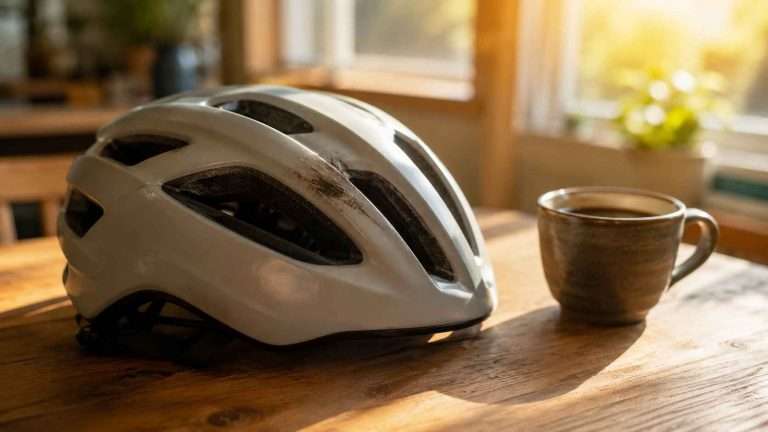
The catch is that EPS doesn’t spring back. It cannot and will not return to its original shape after a significant impact. So even if your helmet looks fine on the outside, the foam inside may already be compromised. If you’ve been in a crash, replace the helmet. Even if your helmet looks fine, it probably isn’t.
Are cheap helmets safe?
What you do get with a more expensive helmet is better fit, more ventilation, lighter weight, and other features or options. Those things matter for comfort, and a helmet that’s comfortable is one you’ll actually wear. But the basic protection? A $25 helmet from a big-box store that carries a CPSC sticker is doing the same job as a $250 one in that department.
The one thing to watch out for is uncertified helmets, particularly from overseas online marketplaces. Consumer Reports found potentially unsafe bicycle helmets being sold online without the required CPSC label. Cheap is fine. Uncertified is not. Always check for that CPSC sticker inside.
How to check helmet quality?
Next, look at the straps. Check for fraying, fading, or any signs the stitching is beginning to fail. The buckle should snap together cleanly, with no missing or broken pieces. A buckle that holds together with one broken tab might feel secure in your hand – it won’t be in a crash.
Then put it on your head. A good helmet sits level, covers your forehead, and doesn’t rock forward, backward, or side to side. The retention system (usually a dial at the back) should hold it snugly against your head. The Bicycle Helmet Safety Institute has a full inspection checklist worth bookmarking. If anything doesn’t pass, the answer is simple: replace it.
Are bike helmets certified?
Beyond the mandatory CPSC standard, there are also voluntary certifications worth knowing about. The ASTM F1447 standard is similar to CPSC and widely used. The Snell Memorial Foundation’s B-95 standard is tougher still, using a higher 2.2-meter drop height, though relatively few bicycle helmets carry it because the thicker foam required tends to make for a heavier, less ventilated helmet.
The Virginia Tech Helmet Lab runs an independent rating system that goes beyond the legal minimums, specifically testing for concussion-level impacts that the CPSC standard doesn’t fully address. Their ratings are publicly available and worth checking before you buy. A 4- or 5-star rating from Virginia Tech is a solid indicator that a helmet is doing more than just clearing the legal bar.
Are bicycle helmets Snell approved?
The point being, a helmet without a Snell sticker isn’t necessarily inferior – it just means the manufacturer chose not to pursue a voluntary certification on top of the legally required CPSC standard. If you specifically want a Snell-certified bicycle helmet, the Snell Foundation maintains a current list of certified models on their website.
How to know if a bicycle helmet is good?
Beyond the ratings, fit matters enormously. A helmet that moves around on your head during a crash – even a fraction – isn’t doing its full job. The helmet should sit level on your forehead, not tilted back. Shake your head. It shouldn’t wobble. And it should feel secure with the chin strap fastened and the retention dial snugged up.
So, a good helmet is one that’s CPSC certified, carries a strong Virginia Tech rating if you can find one, fits your head properly, and that you’ll actually wear every single time you ride. That last part matters more than any of the other criteria.
How often should bike helmets be replaced?
The question of time-based replacement is more complicated. The Snell Foundation recommends replacing bicycle helmets every five years, and that’s a reasonable rule of thumb. A study published in 2016 by MEA Forensic Engineers & others reviewed testing of 675 used bicycle helmets, some as old as 26 years, and found no evidence that EPS foam loses its protective performance simply through aging alone. That said, straps, buckles, padding, glue, and the outer shell all degrade over time – particularly with UV exposure, sweat, and heat. A helmet that’s been rattling around in a car for five summers is a different proposition from one that’s been carefully stored.
Common sense needs to prevail here. Inspect your helmet regularly. If the straps are fraying, the buckle is cracked, or the shell is visibly degraded, it’s time for a new one regardless of its age. If everything checks out and it hasn’t been in a crash, a well-maintained helmet over the five-year mark may still be doing its job. Don’t risk it, replace it.