EN 1080 Explained: Child Helmet Standard Built After Deaths
The Short Version: EN 1080 is the European safety standard for impact protection helmets worn by young children, built around a mandatory self-release chinstrap system. It was developed after fatal strangulation incidents in which children wearing standard EN 1078 helmets became trapped on playground equipment, with their body weight loading the chinstrap.
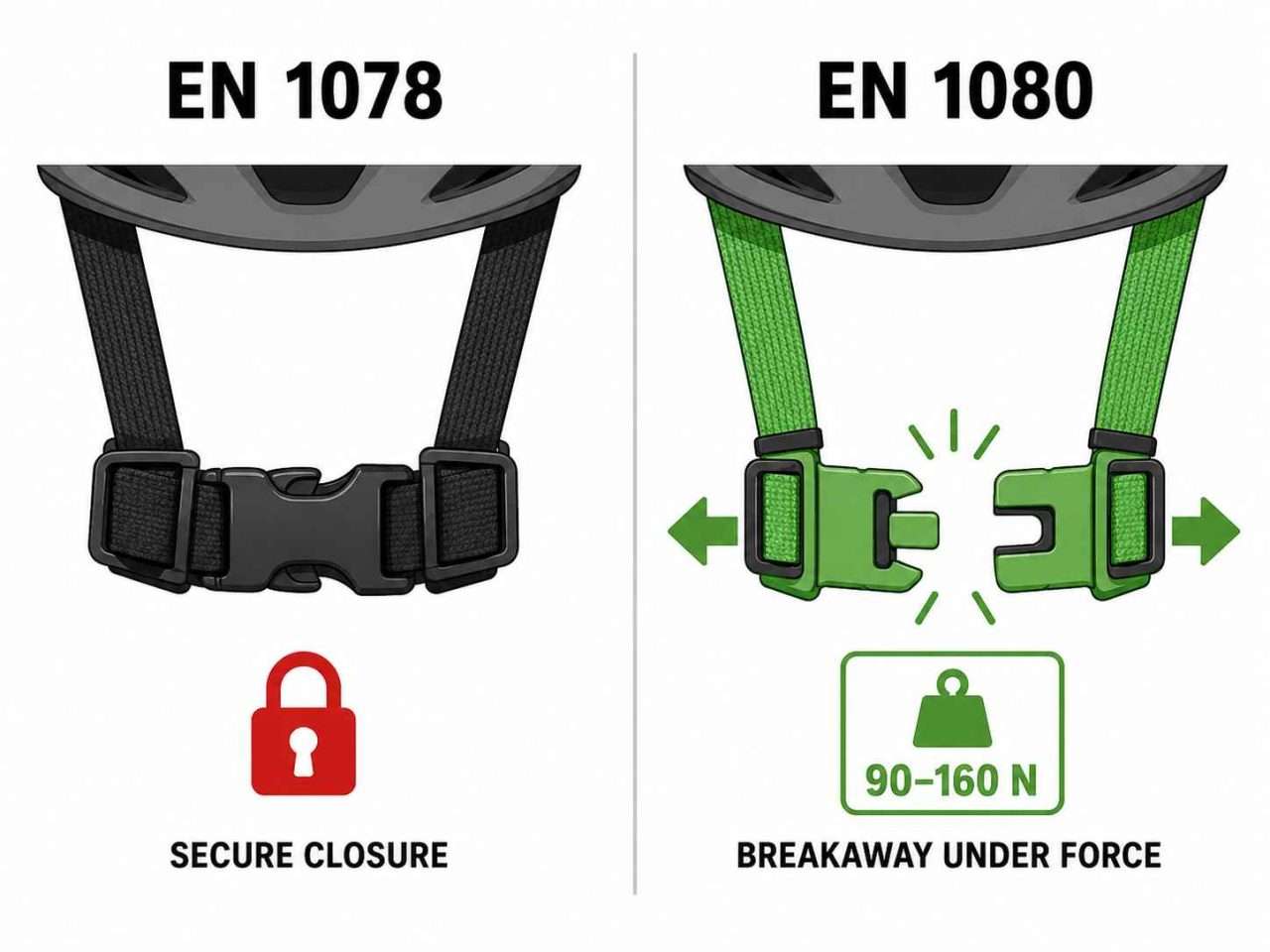
The standard’s defining requirement is a chinstrap that releases under a force of 90–160 Newtons — strong enough to stay on in a fall, calibrated to give way before strangulation can occur. The current edition is EN 1080:2013. Compliant chinstraps must be colored green to allow quick visual identification.
If you’ve ever looked at a small child’s bike helmet and noticed a green buckle, you probably didn’t think much of it. Most people don’t. But that buckle is there for a specific and pretty sobering reason, and it comes down to a European safety standard called EN 1080.
EN 1080 is a children’s helmet standard designed around a risk that most adults never consider: what happens if a small child’s helmet gets caught on something while they’re riding, climbing, or playing. The standard addresses that with a breakaway buckle system, and the thinking behind it is worth understanding if you’re buying a helmet for a young child.
Let’s take a look at what EN 1080 actually requires and why that green buckle matters.
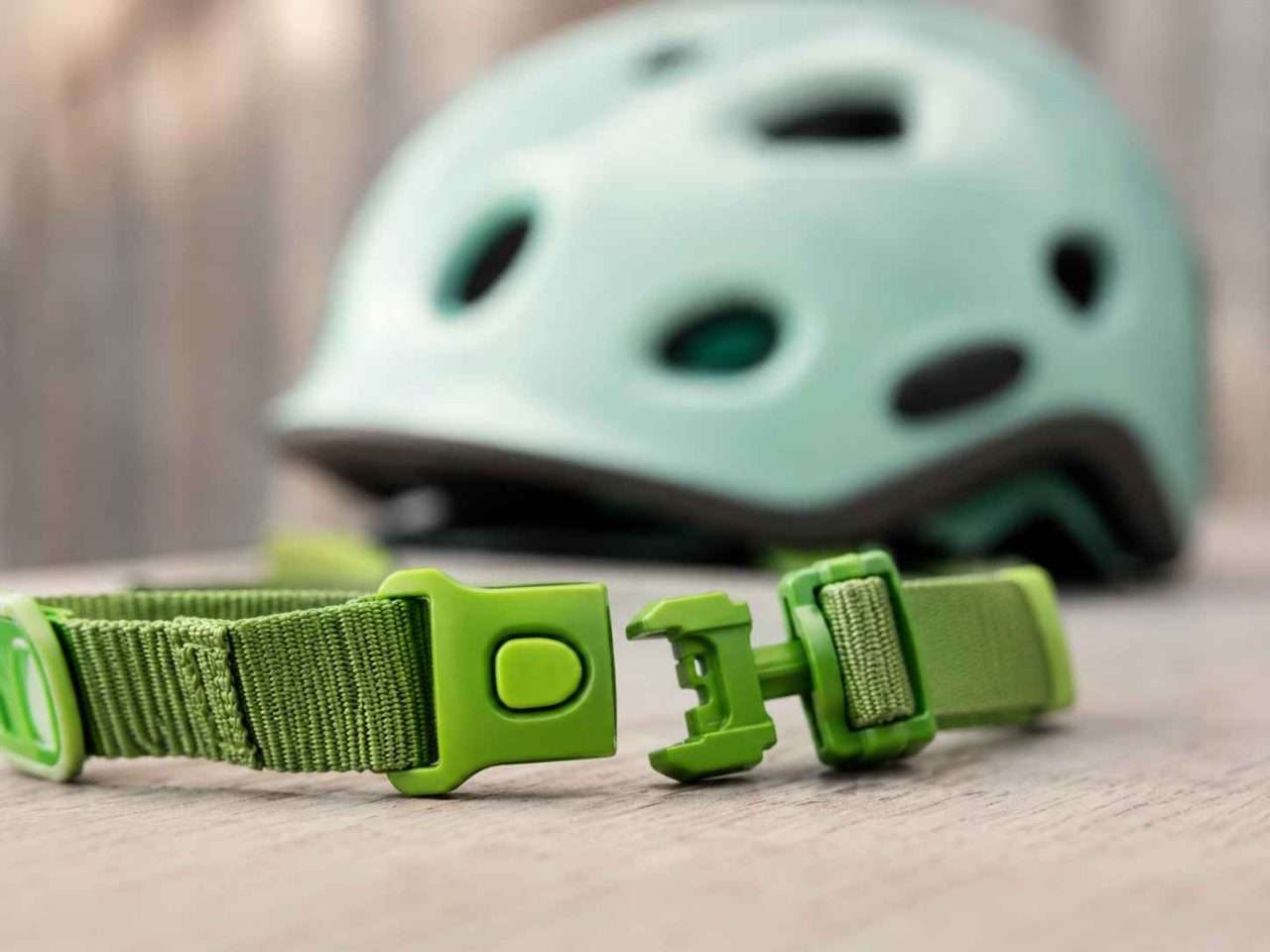
EN 1080 is a European standard specifically for impact protection helmets for young children. It’s derived from EN 1078, the standard that covers bicycle helmets for older children and adults, but it adds one critical requirement that EN 1078 doesn’t have: a deliberately weak retention system designed to release under load. That green buckle, it turns out, is there because children died.
Why Did EN 1080 Come Into Existence?
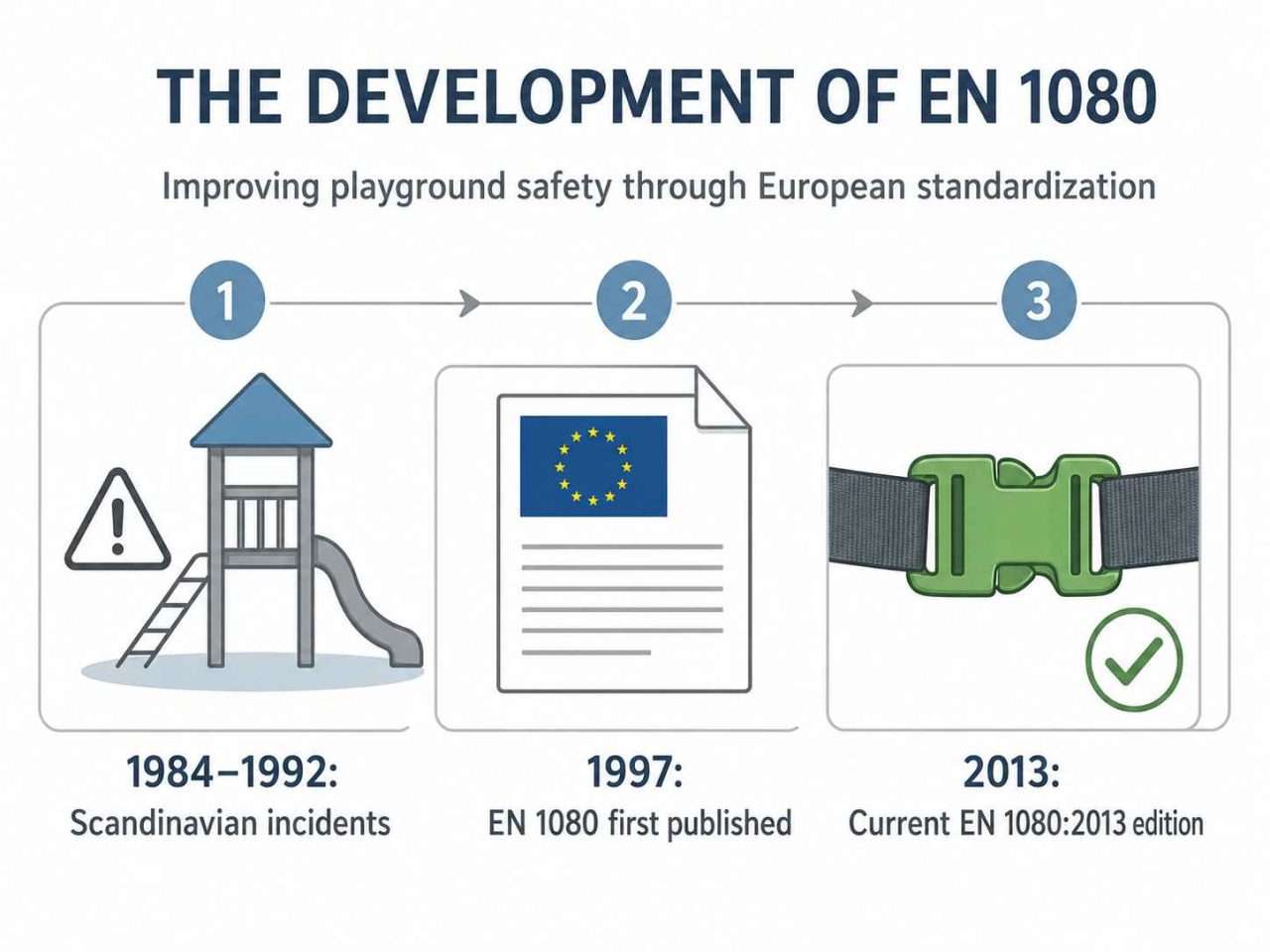
In the mid-1980s, reports began coming in from Scandinavia of a horrifying pattern. Young children wearing bicycle helmets were getting the helmets caught on playground equipment – the kind of gap between bars that a bare head would pass through, but a helmeted head wouldn’t. With the helmet snagged, the child’s weight hung from the chin strap. The results were fatal.
Documentation compiled by the Bicycle Helmet Safety Institute records six fatal strangulation cases from Sweden and Norway between 1984 and 1992, all boys under the age of six, along with an estimated thirty or forty near-miss incidents that didn’t result in death. Every one of them involved a child whose helmet had caught on playground equipment while the child was playing – not riding.
The problem was that the chin strap on a standard bicycle helmet, which needs to be strong enough to keep the helmet in place during a crash, was also strong enough to hold a child’s full body weight if the helmet snagged. European safety reviews confirm that EN 1080 was drafted specifically in response to these incidents, writing the breakaway buckle requirement into the standard so that the retention system would give way before the load became lethal.
What Is the EN 1080 Standard, Exactly?
EN 1080:2013 is a European standard published by CEN (the European Committee for Standardization), under technical committee CEN/TC 158, which handles protective headgear. It superseded the original 1997 version of the standard. Like EN 1078, it covers construction, shock-absorbing properties, retention system performance, field of vision requirements, and marking. The key difference is the self-release system requirement.
In the EU and UK, helmets certified to EN 1080:2013 carry CE marking under PPE Regulation EU 2016/425, which classifies bicycle helmets as Category II personal protective equipment. In the UK, post-Brexit, the equivalent mark is UKCA. The standard references EN 960 for headforms used in testing and the EN 13087 series for test methods including retention system strength and field of vision.
How Does the Self-Release System Work?
This is the heart of EN 1080. The retention system – the chin strap and buckle – must be capable of self-release when a load is applied gradually, simulating a child’s weight hanging from a snagged helmet.
The test is straightforward. The helmet is mounted on a test rig that applies increasing force to the retention system over time. The retention system must release – that is, it must fail and open – at somewhere between 90 and 160 Newtons of force. To put that in terms most people can picture: 90 Newtons is roughly the force applied by a mass of about 9 kilograms (around 20 lbs). 160 Newtons is about 16 kilograms (around 35 lbs). For context, that upper limit is roughly the body weight of a four-year-old.
So, the standard is essentially saying: the strap has to stay put during normal riding, but it must give way before the load reaches a level that could strangle the child. It’s a deliberately calibrated weak point, not a design flaw.

What Are the Other Technical Requirements?
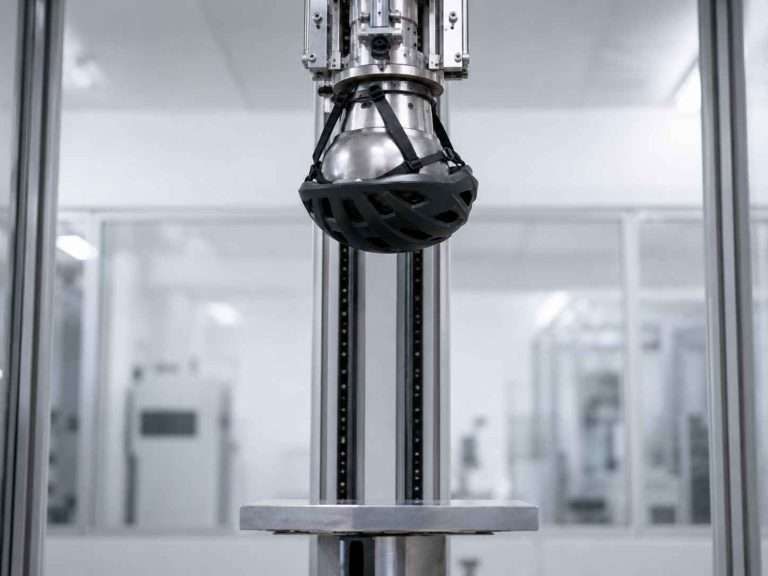
Beyond the self-release requirement, EN 1080 helmets must also meet shock absorption performance. Testing uses the same falling headform method as EN 1078: the helmet is fitted to a standardized headform (per EN 960), fitted with accelerometers (instruments that measure the deceleration forces transmitted through the helmet to the head), then dropped from a specified height onto a test anvil. The maximum peak acceleration recorded cannot exceed 250g. That’s the same threshold as EN 1078.
There are specific requirements around the chin strap itself. The strap must be at least 15mm wide. Chin cups – the padded cups some older helmets used – are not permitted. The buckle must be adjustable so it can sit below the jaw, not at the throat. And the field of vision requirement means no part of the helmet can obstruct the child’s view.
The standard also specifies material safety, since these helmets sit directly against a child’s skin. Materials must be chemically safe, resistant to sweat and toiletries, and compliant with nickel emission limits for any metal parts.
What Does the Green Color Coding Mean?
Here’s where that green buckle comes in. EN 1080 requires that some or all of the visible parts of the retention system be permanently colored green. The purpose is identification – so that parents, caregivers, retailers, and medical personnel can instantly distinguish an EN 1080 self-release helmet from a standard EN 1078 helmet.
This matters for two reasons. First, it helps parents make an informed choice when buying. A green strap signals that this helmet is designed with the strangulation risk in mind. Second, and just as important, it signals that this helmet should NOT be used for activities where the retention system is required to stay securely fastened – like tree climbing, playground equipment, or anything that isn’t low-speed cycling. More on that in a moment.
EN 1080 vs EN 1078: What’s the Actual Difference?
Think of EN 1080 as EN 1078 with one extra layer of protection added – and one layer of protection removed. The extra layer is the self-release retention system. The removed layer is the retention strength that a full EN 1078 helmet requires.
Because the chin strap in an EN 1080 helmet must release at between 90 and 160 Newtons, it cannot simultaneously provide the full retention strength of an EN 1078 helmet (which needs to stay firmly on the head under crash forces). These two requirements pull in opposite directions. EN 1080 makes a deliberate design trade-off: slightly less crash retention in exchange for greatly reduced strangulation risk.
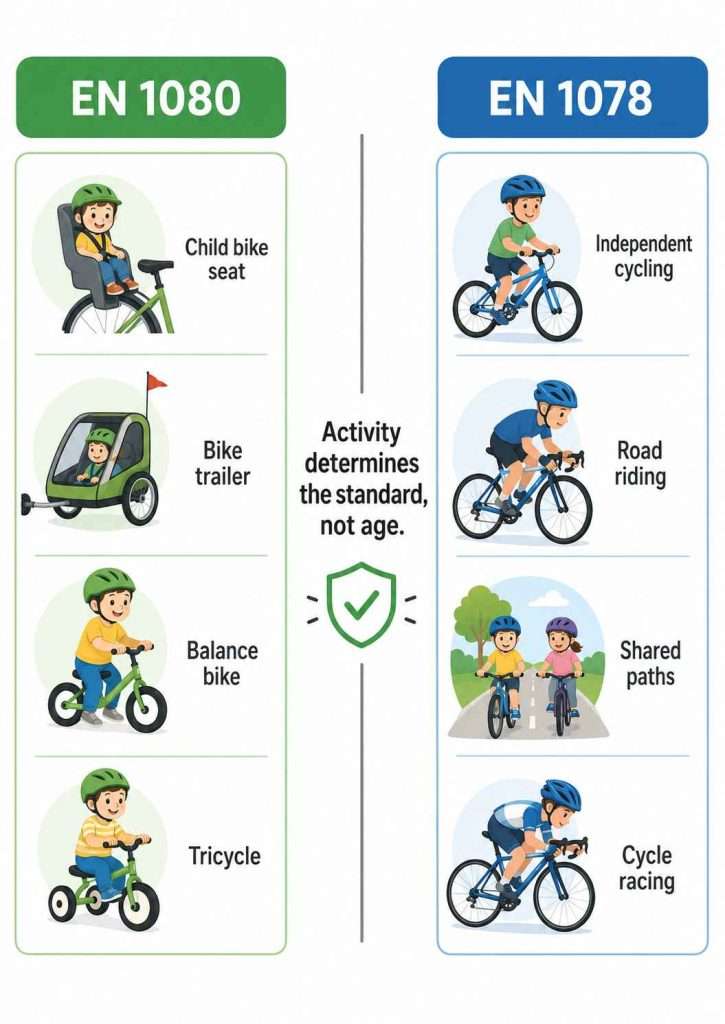
For low-speed cycling activities – a toddler in a child seat, a small child on a balance bike at walking pace – that trade-off is the right call. The strangulation risk is real; the high-speed crash risk is minimal. For older children cycling faster, or doing any sport that involves falling hard, EN 1078 is the right standard.
| Feature | EN 1080:2013 | EN 1078:2012 |
|---|---|---|
| Who it’s for | Young children in low-speed cycling activities | Cyclists, skateboarders, roller skaters of all ages |
| Self-release buckle | Required (90–160 Newtons) | Not required |
| Max peak acceleration | 250g | 250g |
| Chin strap width | Minimum 15mm | Minimum 15mm |
| Chin cups | Not permitted | Not specified |
| Color coding | Green retention parts (required) | No color requirement |
| CE marking | Yes (PPE Regulation EU 2016/425) | Yes (PPE Regulation EU 2016/425) |
| Playground use | Not appropriate | Not appropriate (no helmet) |
| Referenced test methods | EN 960, EN 13087 series | EN 960, EN 13087 series |
Mobile users: swipe left/right to see all columns
How Does EN 1080 Compare to the US Approach for Young Children?
The US and Europe took genuinely different approaches to the same problem – protecting very young children on bikes – and it’s worth understanding both, because neither is obviously wrong.
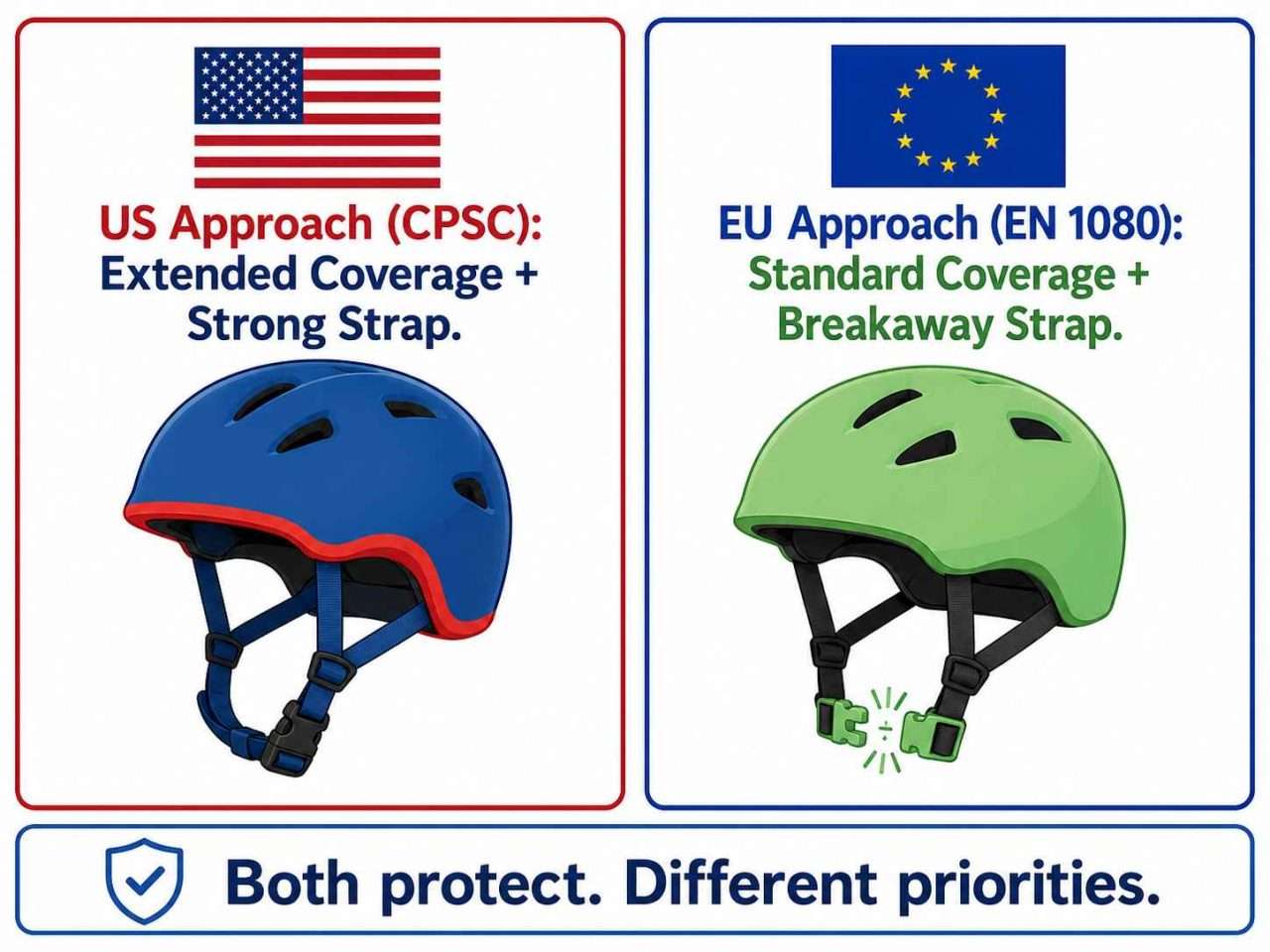
In the United States, CPSC 16 CFR Part 1203 requires that helmets for children under five years old provide extended head coverage compared to adult and older-child helmets. The idea is that toddlers have proportionally larger heads, weaker neck muscles, and less-developed skull bones, so the helmet needs to cover more surface area and offer more protection overall. The retention system remains strong – same as any other CPSC-compliant helmet.
The European approach with EN 1080 doesn’t mandate expanded coverage in the same way. Instead, it focuses on the strangulation scenario specifically, weakening the retention system so it releases under load. The philosophy is: for the activities very young children do on bikes, crash severity is lower, but the entrapment risk is real and underappreciated.
So the US says: protect the head better. Europe says: reduce the entrapment risk. Both responses address genuine hazards, just different ones. The most cautious approach, if you’re in the US and buying a toddler helmet, is to look for a helmet that meets CPSC requirements with the extended coverage for under-fives AND carries an EN 1080 self-release buckle – some manufacturers produce helmets certified to both.
When Should a Child Use EN 1080 vs EN 1078?
This is the practical question most parents need answered, and the answer is mostly about age, speed, and activity type. The question isn’t whether one standard is “better” – it’s which one addresses the dominant risk for a specific child in a specific situation.
A good working guide looks like this:
| Scenario | Appropriate Standard | Reason |
|---|---|---|
| Infant/toddler in a child seat or trailer | EN 1080 (EU/UK) or CPSC extended coverage (US) | Low speed, strangulation risk if helmet catches |
| Toddler on balance bike at walking pace | EN 1080 (EU/UK) or CPSC extended coverage (US) | Low impact energy, strangulation risk relevant |
| Child aged 4–5 cycling independently at low speed | EN 1078 or EN 1080 – parent’s call | Transition age; speed and activity type determine the dominant risk |
| Child aged 5+ cycling at normal pace | EN 1078 (EU/UK) or CPSC (US) | Higher crash energy; full retention strength needed |
| Child on playground equipment | No helmet | Entrapment/strangulation risk from any helmet |
| Child climbing trees, playing outdoors (not cycling) | No helmet | Same reason – no helmet is safer than a snaggable helmet |
Mobile users: swipe left/right to see all columns
The point being: once a child gets off the bike, the helmet comes off too. That guidance applies regardless of which standard the helmet meets. The strangulation risk on playground equipment is not solved by EN 1080’s self-release buckle alone – the standard itself specifically states it is not intended for playground equipment use.
What Does the Playground Warning Actually Mean?
It’s worth spending a moment on this because it’s counterintuitive. You’d think that if an EN 1080 helmet has a strap designed to release under load, it would be safer on a playground than a standard helmet. Not quite.
The self-release system is calibrated to the scenario of a child’s head becoming snagged while the child is already in motion – falling from a bike, for instance. It releases at somewhere between 90 and 160 Newtons. But playground equipment presents different scenarios: a child sitting, dangling, hanging, or partially suspended in ways that don’t load the strap in a predictable linear direction. The 90–160 Newton release window may or may not help in those situations.
The real guidance from safety authorities is simpler than a technical fix: helmets don’t belong on children playing on playground equipment at all. The safest approach, as documented by the Bicycle Helmet Safety Institute, is to remove the helmet when the child gets off the bike. Every time. EN 1080 reduces the risk if entrapment happens, but it doesn’t eliminate it.
How to Identify an EN 1080 Helmet
If you’re buying a helmet for a very young child and you’re in Europe or the UK, here’s what to look for:
- Green retention parts. The strap, buckle, or both should be permanently colored green – not just a green helmet, but specifically the retention system components.
- EN 1080:2013 on the label. Check the label inside the helmet. It should state EN 1080:2013.
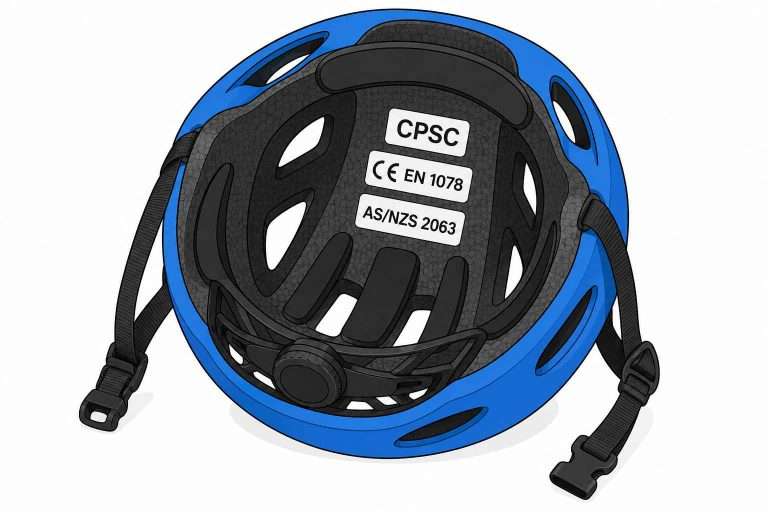
- CE mark. Look for CE/UKCA marking and manufacturer documentation identifying the applicable standard and conformity assessment.
- No chin cups. EN 1080 doesn’t permit chin cups. If the helmet has padded chin cups built into the strap, it’s not EN 1080 compliant.
If you’re in the US and buying for a child under five, look for CPSC certification plus a label stating the helmet is intended for children aged one and older, which signals the extended coverage requirement has been met. There’s no US equivalent of the EN 1080 self-release requirement built into federal standards, so if you want that specific protection, look for a helmet that carries both CPSC and EN 1080 certification.
Is EN 1080 Common in the US Market?
Less so than in Europe, and there’s a reason for that. The ASTM F8.53 subcommittee, which handles headgear standards in the US, discussed the strangulation risk as early as 1999. Their concern was that weakening buckles to prevent a small number of strangulation incidents would put a far larger number of infant and child riders at risk of losing their helmet during a crash. The position, as documented by the Bicycle Helmet Safety Institute, was that the warning label approach – advising parents to remove helmets before playground use – was safer overall than mandating a weaker buckle.
That’s a reasonable argument, and it explains why CPSC went a different direction. The tradeoff genuinely exists: a strap that releases at 90–160 Newtons is strong enough to keep the helmet on during a low-speed balance bike fall, but it is not the same retention strength as a strap that must survive the full roll-off and retention tests demanded by CPSC. For a parent in the US, the practical answer is: follow the CPSC-required extended coverage standard for under-fives, and take the helmet off when the child isn’t on the bike.
The Bottom Line on EN 1080
EN 1080 exists because children died wearing perfectly compliant bicycle helmets. The standard doesn’t mean the helmets are weaker in any dismissive sense – it means they’ve been specifically engineered for the risk profile of a very young child on a low-speed bike or in a child seat, where a standard retention system poses an entrapment hazard that outweighs its benefit.
The green buckle on my neighbor’s daughter’s helmet wasn’t just a color choice. It was a considered response to documented tragedy, calibrated to a specific force range, and marked green so any adult who handles the helmet can recognize what it’s for. For an overview of how EN 1080 fits into the broader picture of bicycle helmet safety standards, including how it relates to EN 1078, CPSC, and the other major certifications, that’s a good place to start.
So: if you have a toddler who rides, look for the green. If the child is on the playground, take the helmet off. Common sense and a bit of research go a long way.
EN 1080: Frequently Asked Questions
What is the difference between EN 1078 and EN 1080?
EN 1078 is the main European safety standard for bicycle helmets – it covers cyclists of all ages as well as skateboarders and roller skaters. EN 1080 is a derived version of EN 1078 that was created specifically for helmets worn by young children, and it was updated to its current form in 2013.
The key difference comes down to one thing: the retention system. EN 1078 helmets use a standard chin strap that holds firm during a crash so the helmet stays in place. EN 1080 helmets use a self-release system – the buckle is deliberately designed to let go under a set force to prevent strangulation if a child’s helmet gets caught on something. So, same basic impact protection, but a very different approach to how the helmet stays on.
What age group is EN 1080 recommended for?
EN 1080 is designed for young children. The standard does not give a specific age, stating “helmets for young children (young children indirectly defined only by head size)”. The idea is that very young kids are more likely to be involved in lower-speed activities – think balance bikes, child seats, and trailers – where the risk of a helmet catching and causing strangulation is a real concern.
It’s worth noting that because the buckle on an EN 1080 helmet is designed to release under pressure, these helmets aren’t suitable for climbing or playground use where you’d want the helmet to stay firmly in place. The standard itself is clear that EN 1080 helmets are not intended for playground equipment use.
How is the buckle on an EN 1080 helmet different?
The buckle on an EN 1080 helmet uses what’s called a self-release system. Under EN 1080 testing requirements, the retention system must release under a force of between 90 and 160 Newtons – roughly the equivalent of a 16kg weight pulling on the strap. That’s enough to hold the helmet securely during normal riding, but it will give way if the strap gets caught and starts to pull dangerously on a child’s neck.
There are a couple of other specifications worth knowing. The chin strap must be at least 15mm wide, chin cups are not permitted, and – so you can spot one at a glance – some or all of the visible parts of the self-release retention system must be colored green. That green color is your quick visual indicator that you’re looking at an EN 1080 helmet.