Ski Helmet Safety Standards: 9 Explained, Sport by Sport
The Short Version: Ski helmet safety standards are certification benchmarks that set minimum impact-absorption, retention-strap, and coverage requirements for snow sports helmets. The major standards are ASTM F2040 (U.S.), EN 1077 (Europe), and Snell RS-98.
EN 1077 drops helmets onto a flat anvil at 5.42 m/s and caps peak headform acceleration at 250 g. ASTM F2040 uses a faster 6.2 m/s flat-anvil drop with a 300 g limit. Australia adopted EN 1077 as AS 5578 in May 2026.
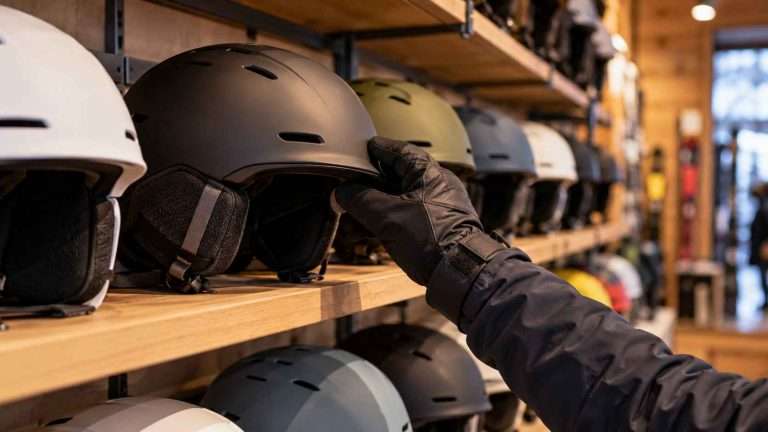
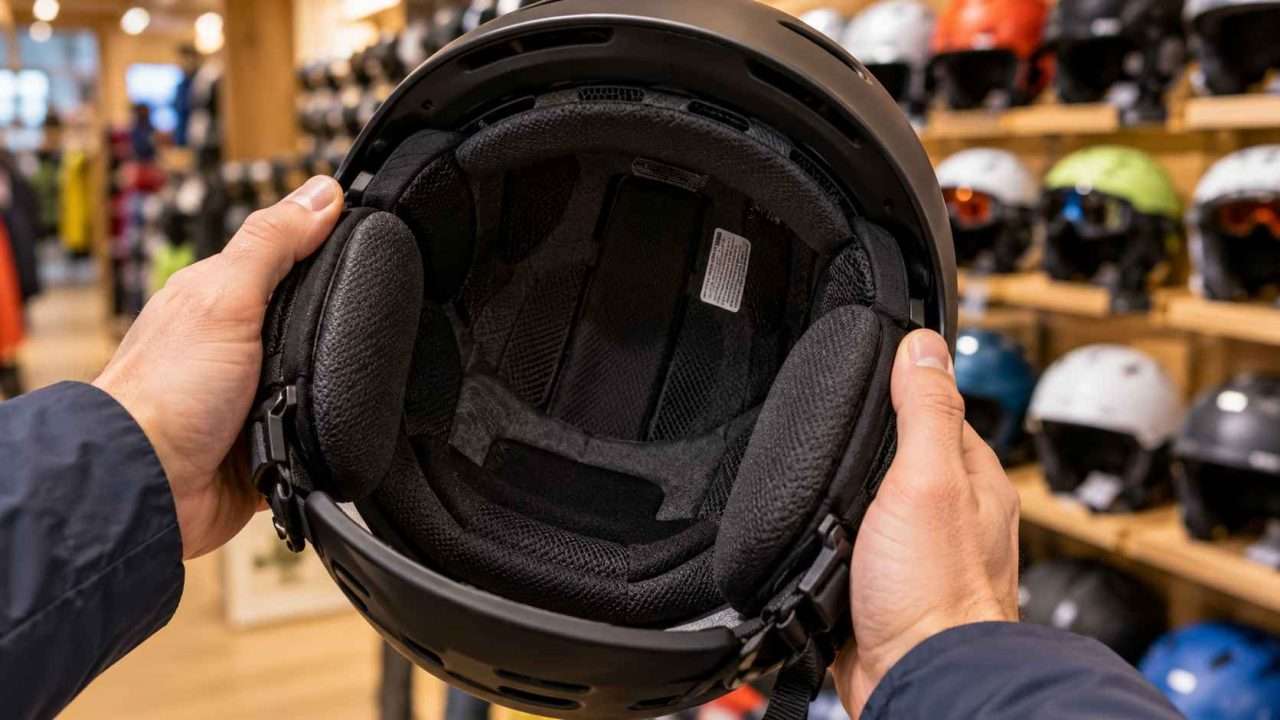
Pick up any ski helmet in the shop, flip it over, and peel the liner back a little. Somewhere in there you’ll find a sticker reading something like “CE EN 1077:2007 Class B”, or “ASTM F2040” in type small enough to need your reading glasses. (In the race helmet aisle, there’ll be an FIS sticker stuck on the back as well.)
That’s alphabet soup for the CE mark (Conformité Européenne), the EN (European Norm) for ski helmets, the U.S. standard from ASTM International (originally the American Society for Testing and Materials), and the racing rules of the FIS (International Ski and Snowboard Federation). Don’t worry, we’ll decode every one of them.
Those codes are the ski helmet safety standards the helmet was tested against, and they’re the most useful thing printed anywhere on it. They’re also about as readable as a tax form. So let’s translate them into plain English, sport by sport.
I’ve bought, worn, dropped, and retired more snow helmets than I care to count, for myself and for the kids, and I’ve read the actual standards documents behind those stickers (riveting stuff, if you enjoy footnotes about headform mass). This guide pulls it all together: what each standard covers, how helmets are tested, what the numbers mean, and (just as important) what a certification can’t promise you.
And, I’ll say up front that I’m an advocate of common sense rather than an advocate of helmet laws. But common sense starts with knowing what that sticker actually promises.
What Are Ski Helmet Safety Standards, Anyway?
A helmet safety standard is a rulebook for a lab test. It spells out how hard a helmet gets hit, what it gets hit against, how cold or wet it is at the time, and how much force is allowed to reach the head inside. Pass every test and the maker can put the standard’s number on the certification label.
Think of it as a driving test for helmets. Passing doesn’t make a helmet perfect in every crash, but it proves it can handle the basics.
Almost every snow sport standard checks the same handful of things, just with different numbers:
- Shock absorption (also called impact attenuation): how much of a hit the liner soaks up before the force reaches your head.
- Retention system strength: whether the chin strap and buckle hold when they’re yanked hard.
- Helmet stability: whether the helmet stays put instead of rolling off forward or backward (the “roll-off” test).
- Coverage and penetration resistance: how much of your head is protected, and whether something sharp can punch through the shell.
Most of that shock absorption is done by EPS (expanded polystyrene), the same white foam that cradles a new TV in its box. It crushes on impact, turning the energy of the hit into squashed foam rather than a squashed brain.
Which Ski Helmet Safety Standards Cover Which Snow Sport?
Here’s the first thing that trips people up. There isn’t one snow helmet standard, there are several, and the right one depends on what you’re doing on the snow and where the helmet was sold.
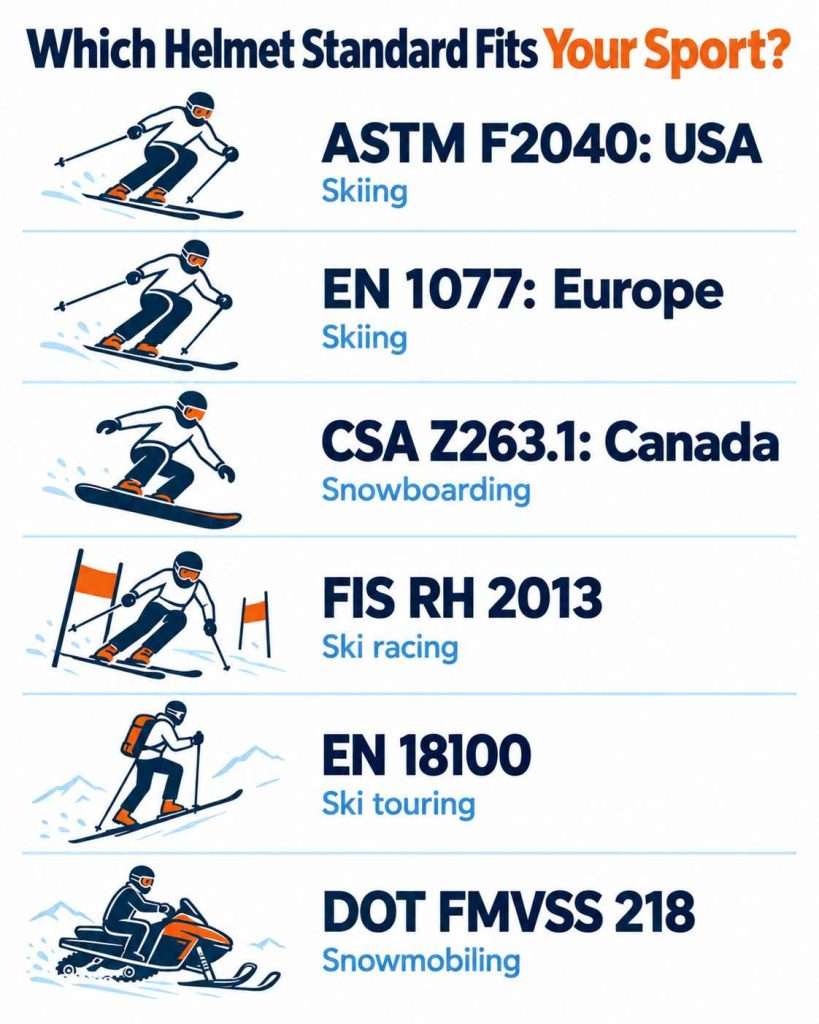
- Skiing and snowboarding in the U.S.: ASTM F2040
- Skiing and snowboarding in Europe: EN 1077, Class A or Class B
- Skiing and snowboarding in Canada: CSA Z263.1 (from CSA Group, formerly the Canadian Standards Association), ASTM F2040, EN 1077, or Snell RS-98
- Alpine racing (downhill, super-G, giant slalom): FIS RH 2013 (RH for racing helmet)
- Ski touring and ski mountaineering: EN 18100
- Snowmobiling: DOT (U.S. Department of Transportation) FMVSS 218 (Federal Motor Vehicle Safety Standard No. 218), with ECE 22.06 (from the United Nations Economic Commission for Europe) and Snell M2020 as alternatives or extras
Notice that snowmobiling is the odd one out. A snowmobile has an engine, so its helmets are tested to motorcycle helmet standards rather than ski standards (more on that below).
How Do the Main Snow Helmet Standards Compare?
Here’s how all nine standards stack up side by side, from who writes them to the numbers a helmet has to beat.
| Standard | Written By | Covers | Required? | Key Pass/Fail Numbers |
|---|---|---|---|---|
| ASTM F2040-18 | ASTM International (U.S.) | Skiing, snowboarding, other nonmotorized snow sports | Voluntary in the U.S. | 6.2 m/s flat anvil; 300g max |
| EN 1077:2007 (Class A/B) | CEN (European Committee for Standardization) | Alpine skiing, snowboarding | Route to the CE mark needed for sale in Europe | 5.42 m/s; 250g max |
| CSA Z263.1-14 | CSA Group (Canada) | Alpine skiing, snowboarding | Voluntary mark; one of the standards Health Canada accepts | Third-party certification; multiple-impact testing |
| Snell RS-98 | Snell Memorial Foundation | Recreational skiing, snowboarding | Voluntary | 100 J flat anvil; 300g max; random retail sampling |
| FIS RH 2013 | FIS (International Ski and Snowboard Federation) | Downhill, super-G, giant slalom racing | Required in FIS speed and GS races | ASTM F2040 + EN 1077 Class A + 6.8 m/s test |
| EN 18100:2025 | CEN (Europe) | Ski mountaineering, touring, splitboarding | Harmonized under EU protective equipment rules | Published late 2025 |
| FMVSS 218 (DOT) | U.S. Department of Transportation | Motorcyclists and other motor vehicle users, including snowmobilers | Mandatory for motorcycle helmets sold in the U.S. | 400g max; 5.8 to 6.2 m/s flat anvil |
| ECE 22.06 | United Nations Economic Commission for Europe | Motorcycle helmets (snowmobile helmets abroad) | Required where UN Regulation No. 22 applies | Adds an oblique (angled) impact test |
| Snell M2020 | Snell Memorial Foundation | Motorcycles and other motorized vehicles | Voluntary | D (DOT-compatible) and R (ECE-compatible) options |
ASTM F2040-18
- Written By
- ASTM International (U.S.)
- Covers
- Skiing, snowboarding, other nonmotorized snow sports
- Required?
- Voluntary in the U.S.
- Key Pass/Fail Numbers
- 6.2 m/s flat anvil; 300g max
EN 1077:2007 (Class A/B)
- Written By
- CEN (European Committee for Standardization)
- Covers
- Alpine skiing, snowboarding
- Required?
- Route to the CE mark needed for sale in Europe
- Key Pass/Fail Numbers
- 5.42 m/s; 250g max
CSA Z263.1-14
- Written By
- CSA Group (Canada)
- Covers
- Alpine skiing, snowboarding
- Required?
- Voluntary mark; one of the standards Health Canada accepts
- Key Pass/Fail Numbers
- Third-party certification; multiple-impact testing
Snell RS-98
- Written By
- Snell Memorial Foundation
- Covers
- Recreational skiing, snowboarding
- Required?
- Voluntary
- Key Pass/Fail Numbers
- 100 J flat anvil; 300g max; random retail sampling
FIS RH 2013
- Written By
- FIS (International Ski and Snowboard Federation)
- Covers
- Downhill, super-G, giant slalom racing
- Required?
- Required in FIS speed and GS races
- Key Pass/Fail Numbers
- ASTM F2040 + EN 1077 Class A + 6.8 m/s test
EN 18100:2025
- Written By
- CEN (Europe)
- Covers
- Ski mountaineering, touring, splitboarding
- Required?
- Harmonized under EU protective equipment rules
- Key Pass/Fail Numbers
- Published late 2025
FMVSS 218 (DOT)
- Written By
- U.S. Department of Transportation
- Covers
- Motorcyclists and other motor vehicle users, including snowmobilers
- Required?
- Mandatory for motorcycle helmets sold in the U.S.
- Key Pass/Fail Numbers
- 400g max; 5.8 to 6.2 m/s flat anvil
ECE 22.06
- Written By
- United Nations Economic Commission for Europe
- Covers
- Motorcycle helmets (snowmobile helmets abroad)
- Required?
- Required where UN Regulation No. 22 applies
- Key Pass/Fail Numbers
- Adds an oblique (angled) impact test
Snell M2020
- Written By
- Snell Memorial Foundation
- Covers
- Motorcycles and other motorized vehicles
- Required?
- Voluntary
- Key Pass/Fail Numbers
- D (DOT-compatible) and R (ECE-compatible) options
What Is ASTM F2040?
ASTM F2040 is the U.S. standard for helmets used in nonmotorized recreational snow sports, written by ASTM International. The current edition is F2040-18, published in 2018. It’s a voluntary standard, which means no federal law forces a ski helmet sold in the U.S. to meet it.
Under F2040, a helmet is dropped onto a flat anvil at 6.2 m/s, and at lower speeds onto hemispherical and edge-shaped anvils. Peak acceleration inside the headform can’t exceed 300g on any impact. Samples are conditioned hot, cold, wet, and at room temperature, then put through retention strength and roll-off tests.
The scope language in the standard is refreshingly honest. ASTM says a helmet meeting F2040 will help reduce the risk of some head injuries at slower speeds, but that the protection is limited, and it calls for compliance with “the common sense rules of the sport’s safety.” I couldn’t have put it better myself.
The standard also bans cherry-picking. A maker can’t claim a helmet meets “part” of F2040; it either passes everything or it fails the lot.
Is ASTM F2040 Being Updated in 2026?
Yes, it’s on the table. ASTM opened work item WK97858 on January 22, 2026 to revise F2040-18, under its helmet subcommittee F08.53.
The rationale points to a 275g peak acceleration limit. That figure came out of balloting on ASTM’s bicycle helmet standard (F1447), where members reached consensus that 275g balanced cost against benefit while still lowering the forces reaching the head.
A cynic might say a standards revision is just an excuse to force everyone to upgrade their helmet. Regardless of that, a lower limit means the foam has to do more of the work and your skull does less of it. And the helmet you already own doesn’t stop working the day a new edition is published.
Keep in mind that a work item is a proposal, not a finished standard. Nothing changes on the shop shelf until a revision is actually approved and published.
What Is EN 1077, and What Does the CE Mark Mean?
EN 1077 is the European standard for helmets used by alpine skiers and snowboarders. It’s written by CEN through its head protection committee, CEN/TC 158, and the current edition is EN 1077:2007, which replaced the 1996 version.
Unlike ASTM in the U.S., EN 1077 has teeth. In Europe a ski helmet counts as PPE (personal protective equipment), and it needs CE marking before it can be sold, with EN 1077 as the usual route to getting it.
In the shock absorption test, the helmet is dropped at 5.42 m/s onto a solid metal anvil with a 4 kg metal headform inside, and peak acceleration can’t exceed 250g. Each design is tested at room temperature, at -25°C (-13°F), and after artificial aging, which mimics years of sun and wear.
The standard also checks field of vision, extent of coverage, retention strength, and penetration resistance. That last one matters more than you’d think when you count the ski poles, ski tips, and tree branches flying around a busy slope on a Saturday.
What’s the Difference Between EN 1077 Class A and Class B?
EN 1077 comes in two flavors. The standard’s own introduction explains that Class A protects a larger area of the head and offers more protection from penetration than Class B.
In practice, Class A helmets cover the ears (small openings for hearing and ventilation are allowed), while Class B helmets cover a smaller area. Class B also gets a gentler penetration test: a 3 kg striker hits the shell at 2.71 m/s, versus 3.84 m/s for Class A, which works out to roughly a 375 mm drop versus a 750 mm drop.
The trade-off is comfort, and you’ll feel it the moment you try both on. A hard-eared Class A helmet muffles the world a little, while a soft-eared Class B lets you hear the lift operator (and the snowboarder coming up behind you). That’s why you’ll see the letter B on so many lightweight, soft-ear helmets.
So, which should you pick? Both classes face the same 5.42 m/s shock absorption test, so for everyday resort skiing, fit and comfort matter more than the letter. If you ski fast, ski the trees, or race, the extra coverage of Class A is cheap insurance.
Do Ski Helmet Safety Ratings Tell You Which Helmet Is Safest?
Short answer: No. Certification is pass or fail, so a helmet that scraped through at 299g carries exactly the same ASTM F2040 sticker as one that recorded 150g. The Snell Memorial Foundation even states plainly that it won’t rank the helmets it certifies.
That’s why “ski helmet safety ratings” is a slightly misleading phrase. What you’re really looking at is a certification, a minimum bar that every certified helmet has cleared.
Which raises the question every skeptic in the rental line asks: if a $60 helmet and a $300 helmet carry the same sticker, why pay more? Because certification is the floor, not the ceiling. The extra money usually buys you fit, weight, ventilation, and extras like rotational protection, not a higher pass mark.
It’s tempting to rank the standards instead. ASTM F2040 hits harder (6.2 m/s versus 5.42 m/s on the flat anvil) but lets more force through (300g versus 250g), while EN 1077 tests colder. Neither is simply “tougher,” and that’s exactly why so many helmets carry both.
Health Canada has taken the same common-sense view. In a response to a British Columbia municipal resolution, the department said it had no evidence that any one helmet standard is superior to the others.
How Are Ski Helmets Tested in the Lab?
Every snow helmet standard follows roughly the same recipe. The Snell RS-98 standard, which is published in full, is a good example of how detailed it gets. Here’s what happens to a helmet before it earns its sticker:
- Conditioning. Samples are chilled, heated, soaked, or left at room temperature (and under EN 1077, artificially aged) so the foam is tested in the worst conditions it’ll face.
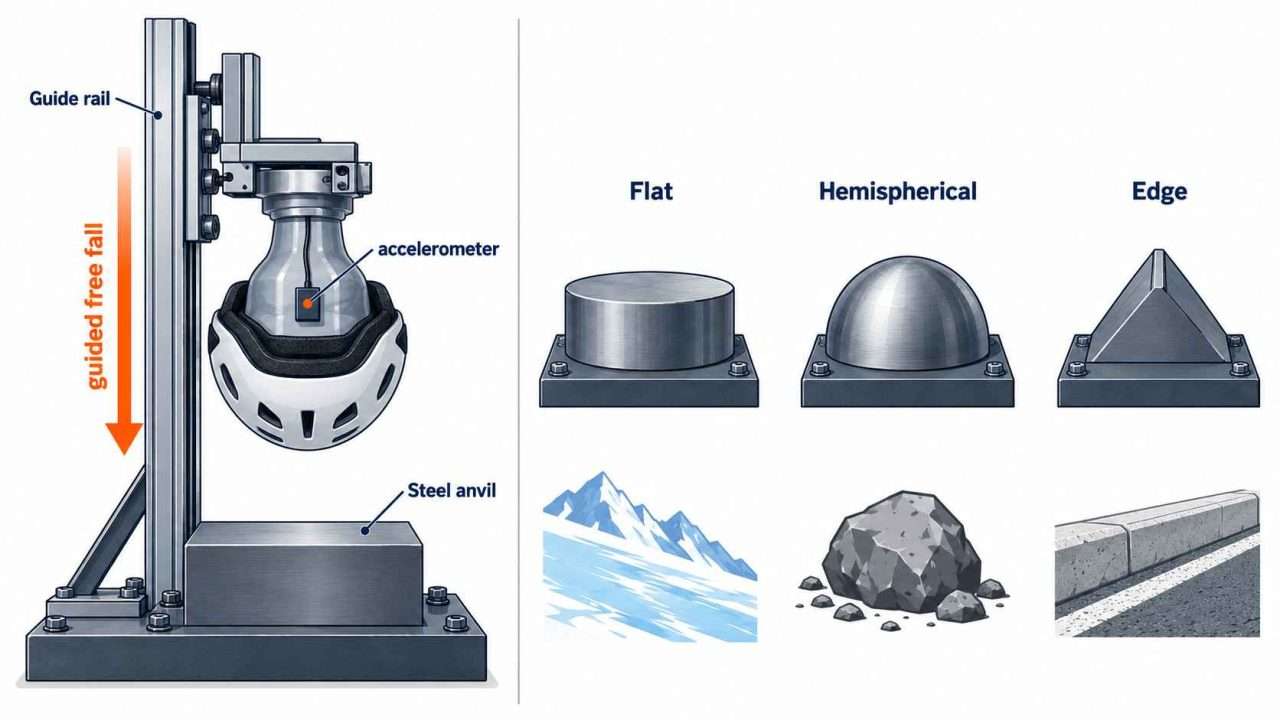
- Impact testing. The helmet goes on a metal headform fitted with an accelerometer, then drops in a guided free fall onto a steel anvil.
- Measuring the hit. The accelerometer records peak acceleration in g. Go over the limit on any single impact and the helmet fails.
- Retention testing. The chin strap is loaded hard to make sure it neither snaps nor stretches too far.
- Roll-off testing. A dropped weight jerks the helmet forward and backward to see if it stays on the headform.
- Penetration testing. In standards that include it, such as EN 1077 and Snell RS-98, a pointed steel striker is dropped onto the shell and must not touch the headform underneath.
The three anvil types stand in for things you might actually hit. The flat anvil is the icy groomer, the hemispherical anvil is a rock or a frozen lump of mogul, and the edge anvil is a curb, a rail, or the edge of someone else’s ski.
That mix matters, because falls and collisions both happen. In a University of British Columbia (UBC) review of snow sport head injuries, simple falls caused 54% of incidents, jumps and falls from height 17%, and collisions with objects or other people 15%.
What Do Impact Test Speeds and G Limits Actually Mean?
Test speeds are quoted in meters per second, which isn’t how most of us think about falling over. So I converted them (the drop heights are what you’d get in a frictionless free fall).
| Standard | Test | Speed (m/s) | Speed (mph) | Equivalent Drop |
|---|---|---|---|---|
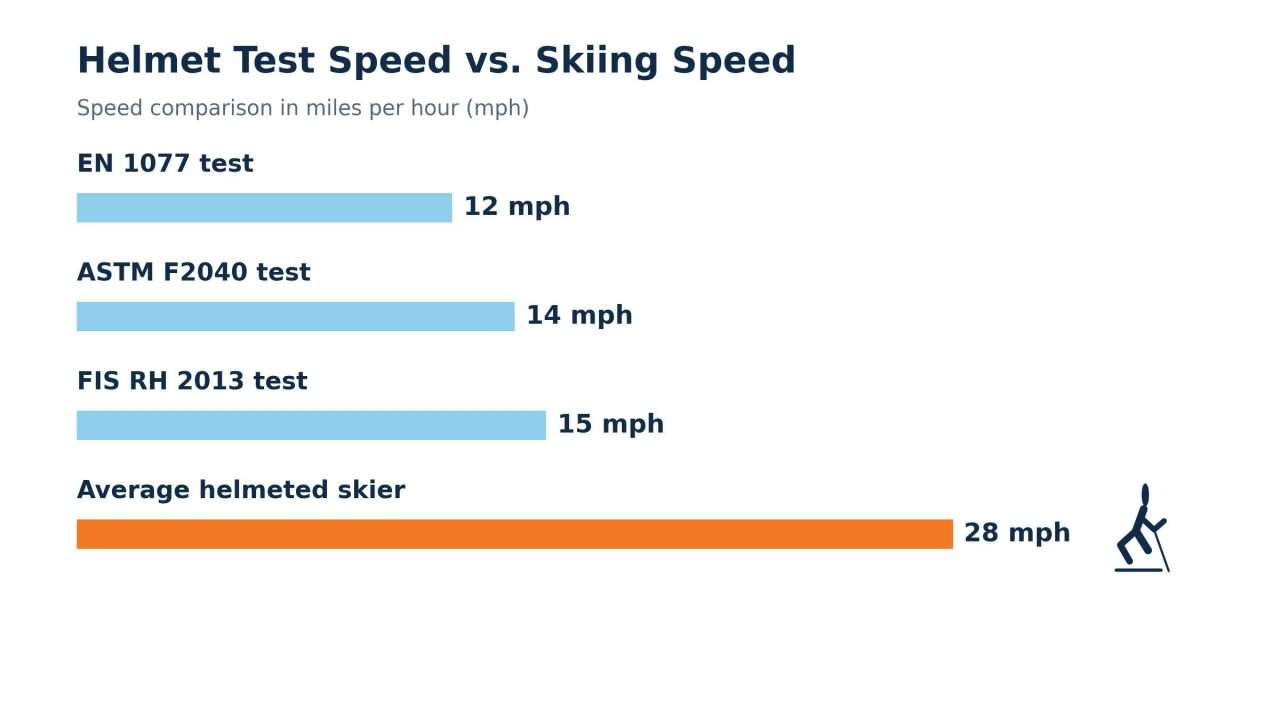
| EN 1077 | Shock absorption | 5.42 | 12.1 | 1.5 m (4.9 ft) |
| ASTM F2040 | Flat anvil impact | 6.2 | 13.9 | 2.0 m (6.4 ft) |
| DOT FMVSS 218 | Flat anvil impact | 5.8 to 6.2 | 13.0 to 13.9 | 1.7 to 2.0 m (5.6 to 6.4 ft) |
| FIS RH 2013 | Extra racing impact test | 6.8 | 15.2 | 2.4 m (7.7 ft) |
Now compare that with how fast people actually move on the hill. The same UBC paper cites earlier research putting the average speed of helmeted skiers at 45.8 km/h (about 28 mph), roughly double the ASTM test speed.
That isn’t as damning as it sounds, because most falls don’t drive your head straight down into the snow at full speed. But it’s a reminder that a helmet tested at 14 mph can’t work miracles at 40.
As for g, it’s simply a multiple of the pull of gravity. A peak acceleration limit of 300g means the headform can’t decelerate at more than 300 times that pull, for an instant measured in milliseconds.
Where Does Snell RS-98 Fit In?
Snell RS-98 is a ski and snowboard standard from the Snell Memorial Foundation, a nonprofit better known for motorcycle and auto racing helmets. It was published in August 1998, which makes it older than the first edition of ASTM F2040 in 2000.
What makes Snell different is that certification isn’t a one-off. Manufacturers sign a contract with the Foundation, and Snell buys certified helmets from retail stock for random sample testing to make sure production helmets still pass.
The impact tests are hefty, too: 100 joules on the flat anvil (equal to a 2-meter drop of a 5 kg headform) and 80 joules on the hemispherical and edge anvils, with the same 300g limit as ASTM. Samples are also tested cold at -20°C (-4°F) and after being sprayed with water for at least four hours.
The Foundation recommends replacing a ski helmet after five years, or sooner if the maker says so. (Confession: my first ski helmet hung around the garage a good while longer than that.) We cover the reasons in how long ski helmets last.
What Is CSA Z263.1, and Does Canada Require It?
CSA Z263.1 is Canada’s own standard for recreational alpine skiing and snowboarding helmets, written by CSA Group. The first edition appeared in 2008, and the current edition, CSA Z263.1-14, replaced it in 2014.
It covers the same ground as the others (shock absorption, helmet stability, and retention system strength) plus marking and labeling. CSA Group says the standard requires third-party testing and certification and includes multiple-impact testing in random locations, so the maker can’t simply mark its own homework.
Here’s the twist. The CSA mark is voluntary, but Health Canada enforces the CCPSA (Canada Consumer Product Safety Act), and it has issued a notice that ski and snowboard helmets failing the impact, stability, and retention requirements of CSA Z263.1-14, ASTM F2040-18, or EN 1077:2007 (or an equivalent) pose a danger to human health or safety.
Health Canada’s consumer helmet advice also lists Snell RS-98 among the accepted standards. In other words, a Canadian buyer can pick any of the four and be on solid ground.
What Do FIS RH 2013 Racing Helmets Have to Pass?
Racing is where the bar goes up. The FIS introduced its RH 2013 helmet specification for the 2013/14 season, covering the alpine racing disciplines where crashes are fastest: downhill, super-G, and giant slalom.
An RH 2013 helmet has to pass both ASTM F2040 and EN 1077 Class A, plus an extra impact test at 6.8 m/s. It must also carry a permanent label on the back that, according to the FIS helmet rule, reads “Conform To FIS Specifications RH 2013” (RH being ‘Racing Helmet’). No sticker, no start.
Under the FIS helmet rules, race helmets must cover the head and ears, and spoilers or edges that stick out aren’t allowed. Soft ear protection is permitted only for slalom, where many race helmets, like Sweet Protection’s Volata, accept a removable chin guard to fend off gates.
U.S. Ski & Snowboard applies the same requirement to its masters racers, so this isn’t just a World Cup thing.
Is There a Standard for Ski Touring and Ski Mountaineering Helmets?
There is now. EN 18100:2025, from the same CEN/TC 158 committee, was published in late 2025 and covers helmets for ski mountaineering and similar activities such as ski touring, skimo (ski mountaineering racing), and splitboarding.
It specifically excludes helmets for alpine skiers and snowboarders, so it doesn’t replace EN 1077. It fills the gap for people who climb uphill on skins and then ski down, a crowd that used to make do with climbing helmets or resort helmets that weren’t built for either job.
The UIAA (the International Climbing and Mountaineering Federation) followed with UIAA 111, which is based on EN 18100:2025 and adds requirements of its own. If you’re wondering how ski and climbing helmets compare, here’s whether ski helmets meet climbing standards.
What Does a DOT Certified Snowmobile Helmet Have to Pass?
There’s no federal standard written specifically for snowmobile helmets. Instead, snowmobile helmets are certified to FMVSS 218, the motorcycle helmet standard, which applies to helmets designed for motorcyclists and other motor vehicle users.
It’s a different beast from any ski standard. The helmet takes two impacts at each of four sites, on a flat anvil at 5.8 to 6.2 m/s and a hemispherical anvil at 5.0 to 5.4 m/s, after being conditioned anywhere from 5°F to 131°F or soaked in water.
Peak acceleration can’t exceed 400g, and the regulation also limits how long the force lingers (no more than 2 milliseconds above 200g, or 4 milliseconds above 150g). A 3 kg pointed striker is dropped from 3 meters to test penetration, and the chin strap must hold an extra 250 lb on top of a 50 lb preload.
Look for a label on the back of the shell reading DOT, FMVSS No. 218, and CERTIFIED. That label is the manufacturer’s own certification that the helmet complies, which is exactly why a voluntary second opinion like Snell appeals to some riders (we cover DOT certification in more depth elsewhere).
Can You Wear a Ski Helmet on a Snowmobile?
No. A ski helmet is not a snowmobile helmet, however warm and comfortable it feels.
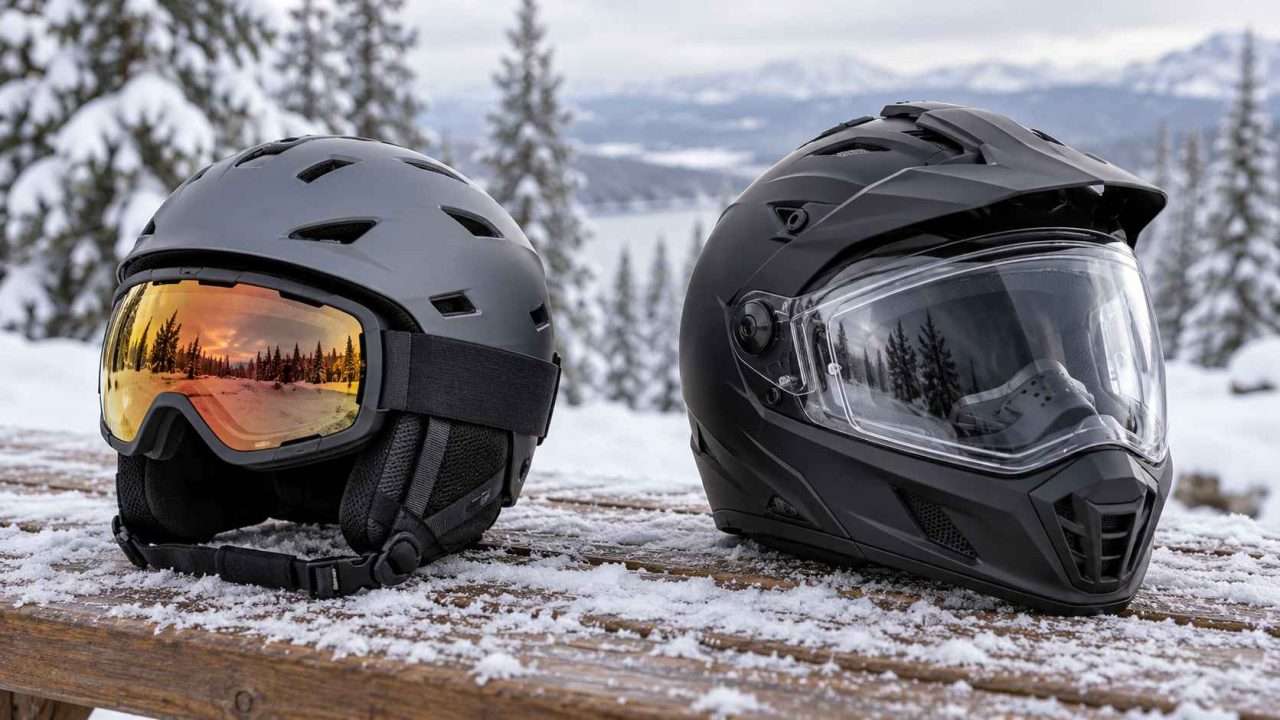
Pick up a full-face snowmobile helmet straight after a ski helmet and you’ll know it before you’ve read a single label. It’s heavier, the shell is thicker, and the shield and breath deflector make it feel like a different species altogether.
ASTM F2040’s own scope talks about nonmotorized sports and slower speeds. A DOT helmet is designed for motor vehicle users, takes two hits at the same spot, survives a 3-meter penetration drop, and has to give you at least 105 degrees of peripheral vision to each side.
The law agrees, at least in places. Minnesota’s snowmobile regulations require riders under 18 to wear a helmet that meets DOT specifications, and Ontario requires snowmobile drivers and passengers to wear a helmet meeting the province’s motorcycle helmet standards.
Where Do ECE 22.06 and Snell M2020 Fit for Snowmobilers?
If you ride in Europe, or anywhere else that follows UN vehicle rules, you’ll see ECE 22.06 instead of (or alongside) DOT. It’s the 06 series of UN Regulation No. 22, adopted for a June 2020 vote by the UN’s World Forum for Harmonization of Vehicle Regulations (known as WP.29).
Its headline change was rotational protection. The working group that drafted it named rotational acceleration requirements as its main goal, which led to an oblique test where the helmet strikes an angled anvil (we explain the rest under ECE certification).
Snell M2020 is the Foundation’s voluntary standard for helmets used with motorcycles and other motorized vehicles, in effect since October 1, 2019. It offers two impact test options, M2020D for markets built around DOT and M2020R for markets built around ECE.
What Does It Mean When a Helmet Is Dual Certified?
A dual certified helmet has passed two (or more) standards. On ski helmets, a common pairing is ASTM F2040 plus EN 1077, which lets one helmet be sold on both sides of the Atlantic, and race helmets stack FIS RH 2013 on top.
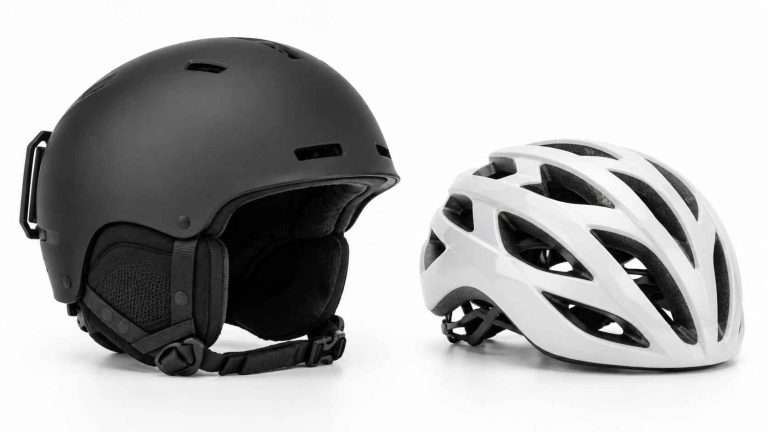
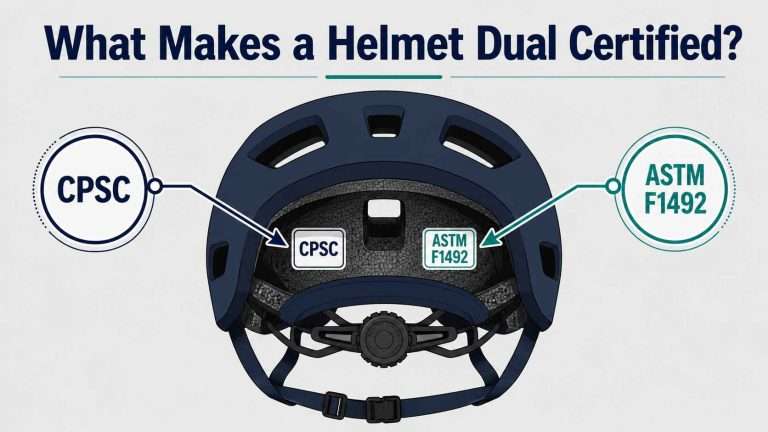
You’ll also find helmets certified for both skiing and cycling. In the U.S., a bike helmet has to meet the CPSC (Consumer Product Safety Commission) standard, 16 CFR Part 1203, so a ski-and-bike helmet carries that on top of its snow certification.
What you can’t do is assume. A bike helmet with no snow certification hasn’t been tested to a snow sport standard at all, so here’s whether a bike helmet meets ski standards and why ski and bike helmet certifications differ.

How Much Do Certified Helmets Actually Reduce Head Injuries?
Quite a lot, and the research is consistent. A 2006 Norwegian study published in JAMA (the Journal of the American Medical Association) found that wearing a helmet was associated with roughly a 60% reduction in the risk of head injury among skiers and snowboarders.
A 2010 meta-analysis of 12 studies in the CMAJ (Canadian Medical Association Journal) put the reduction at 35%, and found no evidence that helmets raise the risk of neck injury. So the “helmets break your neck” theory you’ll occasionally hear in the lift line doesn’t hold up.
Not only that, but helmet use has gone mainstream. The NSAA (National Ski Areas Association) reports that helmet use among U.S. skiers and riders rose from 25% in the 2002/03 season to 91% in 2024/25, and we track the latest figures in our current ski helmet injury data. No national law made that happen, which tells you common sense works just fine once people have the facts.
There are caveats to this argument though. When the same Norwegian researchers looked again a decade later, the protective effect against head injury had weakened, and they suggested new skiing trends at the resorts might be to blame.
Does a Certified Ski Helmet Prevent Concussions?
This is the question I get asked most, and the honest answer is no, not reliably. Every ski helmet safety standard above measures linear impacts, a straight drop onto an anvil.
Real crashes are messier. The UBC researchers point out that certification tests mostly involve vertical, linear impacts, while a crash at skiing speed is more likely to be a glancing blow that spins the head, and that rotational acceleration has been identified as a potential cause of concussion.
That gap is why rotational systems like MIPS (Multi-directional Impact Protection System) exist, and it’s part of why ECE 22.06 added an oblique test for motorcycle helmets. ASTM F2040, EN 1077, CSA Z263.1, and Snell RS-98 don’t include one, so look for ski helmets with MIPS if that matters to you.
So, wear the helmet, but don’t treat it as a license to ski like you’re bulletproof. Common sense and a bit of speed control will protect your brain in ways no sticker can. And if you hit your head and feel off afterward (headache, fogginess, nausea, anything that isn’t right), go and see your doctor.
What Should You Look for on a Ski Helmet Certification Label?
When I’m standing in the shop with a helmet in each hand, this is the quick checklist I run through:
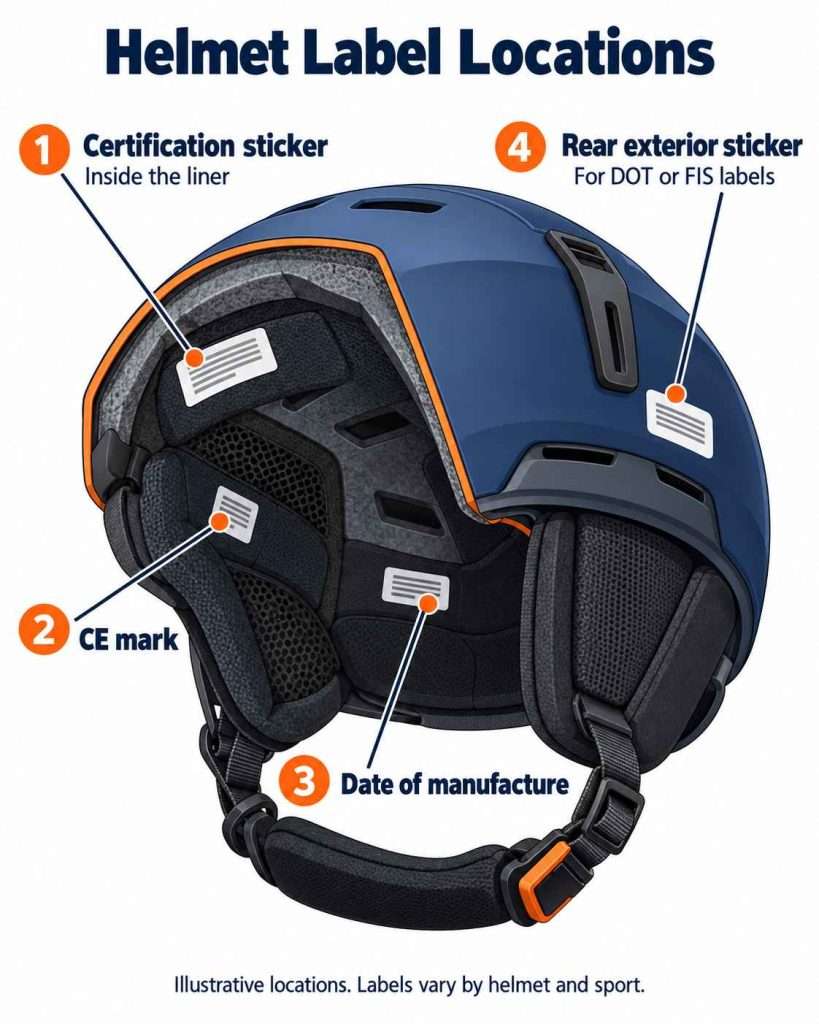
- Find the label. It’s usually inside the shell or under the liner (on one of mine I had to pull half the liner out to find it), although a DOT label must sit on the outside, at the back.
- Look for a standard number, not a slogan. “ASTM F2040” or “EN 1077” means something; “meets safety standards” means nothing.
- Check the EN 1077 class. A or B tells you how much coverage you’re getting.
- Look for the CE mark if the helmet was made for the European market.
- Racing? Look for the FIS RH 2013 label on the back.
- Snowmobiling? Make sure it says DOT, FMVSS No. 218, and CERTIFIED, not just a ski standard.
- Check the date of manufacture. Snell recommends replacing a ski helmet after five years.
If there’s no standard number anywhere on the helmet, walk away. That’s not a bargain, it’s a costume.
So, Which Ski Helmet Safety Standards Should You Look For?
For skiing and snowboarding in the U.S., look for ASTM F2040, and EN 1077 alongside it is a bonus. In Canada, any of CSA Z263.1, ASTM F2040, EN 1077, or Snell RS-98 will do the job.
Racers need FIS RH 2013, ski tourers should look for EN 18100, and snowmobilers need a DOT FMVSS 218 helmet, full stop.
None of it replaces common sense, a helmet that actually fits properly, and skiing within your ability. The sticker gets you in the door. The rest is up to you.
Frequently Asked Questions
Are kids’ ski helmets tested to different safety standards than adult ski helmets?
Where kids’ helmets really differ is fit. Common sense says buy the size that fits their head now, not one they’ll grow into (a helmet that wobbles around like a mixing bowl isn’t protecting anybody).
How can you tell if a ski helmet certification label is counterfeit or fake?
The most reliable check is the oldest one: buy from an authorized dealer, and if a premium brand is selling for a third of its usual price, it isn’t a bargain. When in doubt, email the manufacturer with the model and production date and ask them to confirm it.
Are cheap ski helmets sold on Amazon, Temu, or AliExpress actually certified to ASTM F2040 or EN 1077?
So treat the listing as advertising, not proof. Check the label inside when it arrives, and stick to known brands sold by the brand itself or an authorized retailer (saving $40 on the thing protecting your brain is a strange place to economize).
Does Virginia Tech rate ski and snowboard helmets the way it rates bicycle and football helmets?
The take-away is that certification tells you a helmet passed, while the star rating tells you how well it did. If two helmets fit you equally well, the one with more stars is the sensible pick.
Is there a test standard for rotational impact protection in ski helmets?
For now, rotational protection comes from systems like MIPS (Multi-directional Impact Protection System), which you’ll spot as the thin, often yellow liner that lets your head slide a little inside the shell. Independent testers like Virginia Tech and Sweden’s Folksam use angled impacts, so their results are the place to look if rotational protection matters to you.
Does attaching a GoPro mount to a ski helmet affect its safety?
The simple fix is to keep it low-profile. Use a strap or chin mount, or a helmet that comes with a mount designed by the manufacturer, and never drill into the shell (a hole in your helmet is about the worst DIY upgrade you can make).
Are visor ski helmets certified to the same standards as helmets worn with separate goggles?
The visor is the part that gets tested separately. It’s eye protection, so it falls under goggle standards such as ISO 18527-1 (the International Organization for Standardization ski goggle standard) or the older EN 174. Check the spec sheet lists both a helmet standard and an eye protection standard, because a good shell with an uncertified visor is only half the job done.
RELATED READS